


Prevalence and transmission of hepatitis E virus in domestic swine populations in different European countries
- PMID: 22534364
- PMCID: PMC3479409
- DOI: 10.1186/1756-0500-5-190
Prevalence and transmission of hepatitis E virus in domestic swine populations in different European countries
Abstract
Background: Hepatitis E virus (HEV) genotype 3 and 4 can cause liver disease in human and has its main reservoir in pigs. HEV investigations in pigs worldwide have been performed but there is still a lack of information on the infection dynamics in pig populations.
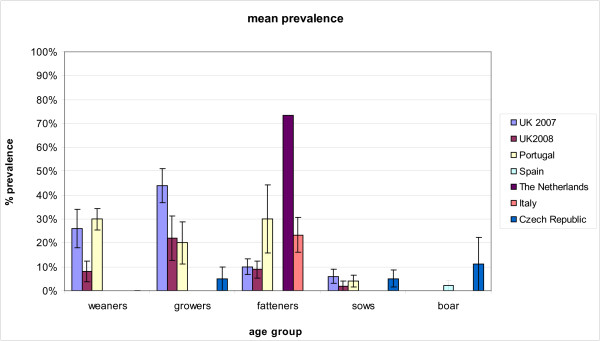
Findings: The HEV transmission dynamics in commercial pig farms in six different European countries was studied. The data collected show prevalence in weaners ranging from 8% to 30%. The average HEV prevalence in growers was between 20% and 44%. The fatteners prevalence ranged between 8% and 73%. Sows prevalence was similar in all countries. Boar faeces were tested for HEV only in Spain and Czech Republic, and the prevalence was 4.3% and 3.5% respectively. The collected data sets were analyzed using a recently developed model to estimate the transmission dynamics of HEV in the different countries confirming that HEV is endemic in pig farms.
Conclusions: This study has been performed using similar detection methods (real time RT-PCR) for all samples and the same model (SIR model) to analyse the data. Furthermore, it describes HEV prevalence and within-herd transmission dynamics in European Countries (EU): Czech Republic, Italy, Portugal, Spain, The Netherlands and United Kingdom, confirming that HEV is circulating in pig farms from weaners to fatteners and that the reproductive number mathematical defined as R0 is in the same range for all countries studied.
Figures
References
-
- Wei H, Zhang JQ, Lu HQ, Meng JH, Lu XX, Xie W. Construction and screening of hepatitis E virus-specific phage antibody combinatorial library. Xi Bao Yu Fen Zi Mian Yi Xue Za Zhi. 2003;19(5):473–475, 485. - PubMed
Publication types
MeSH terms
Substances
LinkOut - more resources
Full Text Sources
