. 2012 Oct 7;9(75):2708-17.
doi: 10.1098/rsif.2012.0138. Epub 2012 Apr 25.

Suitability of European climate for the Asian tiger mosquito Aedes albopictus: recent trends and future scenarios

Affiliations

Suitability of European climate for the Asian tiger mosquito Aedes albopictus: recent trends and future scenarios

Cyril Caminade et al. J R Soc Interface. .

Abstract

The Asian tiger mosquito (Aedes albopictus) is an invasive species that has the potential to transmit infectious diseases such as dengue and chikungunya fever. Using high-resolution observations and regional climate model scenarios for the future, we investigated the suitability of Europe for A. albopictus using both recent climate and future climate conditions. The results show that southern France, northern Italy, the northern coast of Spain, the eastern coast of the Adriatic Sea and western Turkey were climatically suitable areas for the establishment of the mosquito during the 1960-1980s. Over the last two decades, climate conditions have become more suitable for the mosquito over central northwestern Europe (Benelux, western Germany) and the Balkans, while they have become less suitable over southern Spain. Similar trends are likely in the future, with an increased risk simulated over northern Europe and slightly decreased risk over southern Europe. These distribution shifts are related to wetter and warmer conditions favouring the overwintering of A. albopictus in the north, and drier and warmer summers that might limit its southward expansion.


Figures
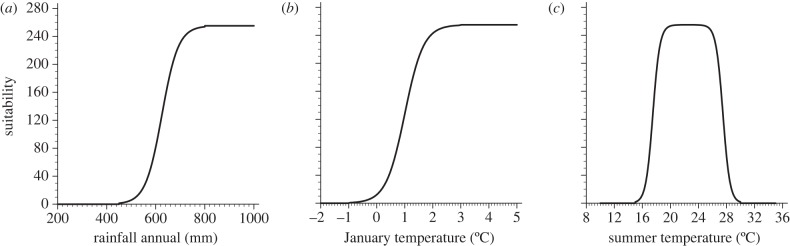
Figure 1.
Figure 1.
Sigmoidal functions that are employed to relate A. albopictus suitability (ranging from 0 to 255) to climate predictor variables such as (a) annual precipitation, (b) January temperature and (c) summer temperature. This is carried out for model 2. For annual precipitation, suitability is dropped to zero when rainfall is lower than 450 mm, and maximum (255) when precipitation is higher than 800 mm; for January temperature, the suitability is zero when temperatures are lower than −1°C, and maximum when temperatures are higher than 3°C; for summer temperature, the suitability is zero when temperatures are lower than 15°C and higher than 30°C, and maximum between 20°C and 25°C.
Figure 2.
Figure 2.
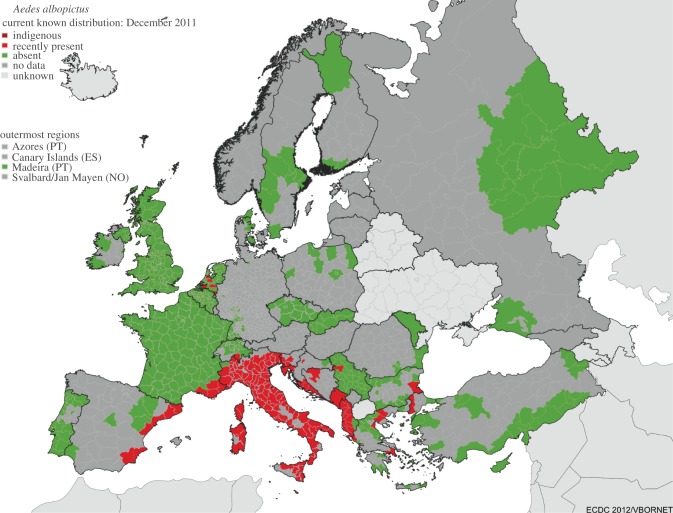
Known distribution of A. albopictus based on field observations from the ECDC/VBORNET project (December 2011). Dark red denotes established: the species is observed in at least one municipality of the shown administrative unit for at least 5 years counting back from the ‘distribution status date’. Red, recently present: the species was observed at least in one municipality during the last 5 years. Green, absent: surveys and studies on mosquitoes were conducted during the last 5 years and no specimens were reported. Medium grey, no data: no data over the last 5 years are available to local experts. Light grey, unknown: no information is available on the existence of studies on mosquito fauna over the last 5 years.
Figure 3.
Figure 3.
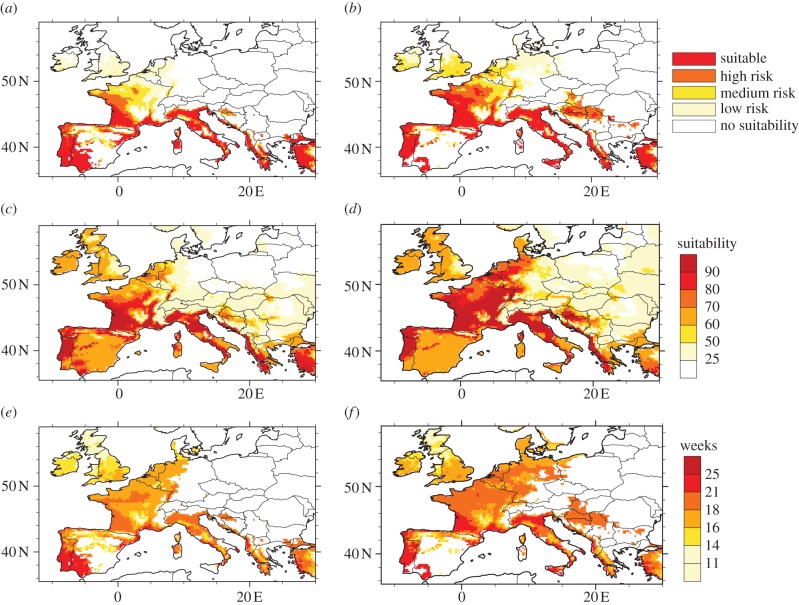
Observed climate suitability of A. albopictus based on different models (rows) and for two different time periods (columns). (a,b) The climate suitability is calculated based on model 1 for (a) 1960–1989 and (b) 1990–2009. (c,d) The climate suitability is based on model 2. This is carried out for (c) 1960–1989 and (d) 1990–2009. (e,f) Weeks of adult mosquito activity for (e) 1960–1989 and (f) 1990–2009 based on model 3. See §2 for further details.
Figure 4.
Figure 4.
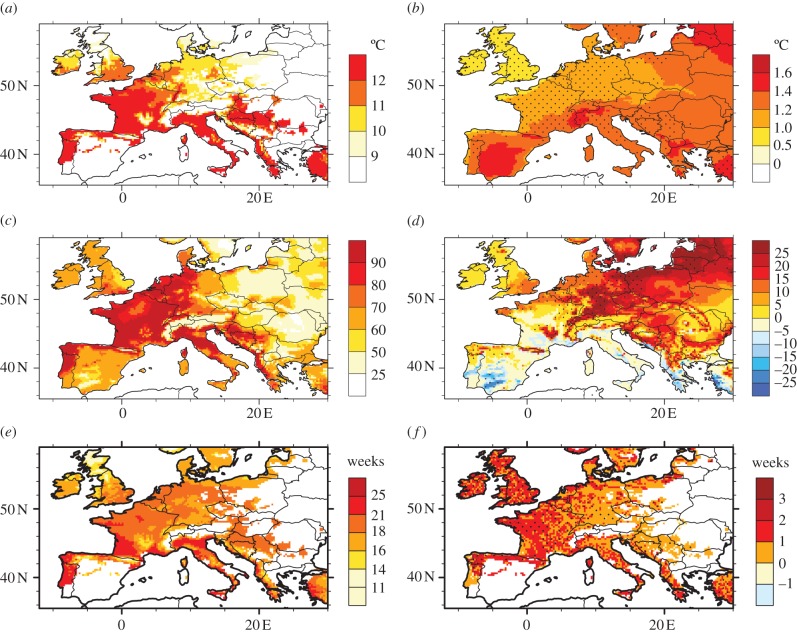
Future climate suitability of A. albopictus based on different models (rows). The left column depicts the mean suitability based on the ensemble mean of all RCM-driven projections for 2030–2050. The right column shows the future changes (2030–2050) with respect to the 1990–2009 climatology. The black dots depict the areas where the simulated mean changes are greater than two times the regional climate model ensemble standard deviation. (a) Mean future climate suitability based on model 1. (b) Annual temperature future change based on model 1. (c) Mean future climate suitability based on model 2. (d) Future suitability changes based on model 2. (e) Weeks of adult mosquito activity for 2030–2050 based on model 3. (f) Changes in adult mosquito activity for 2030–2050 based on model 3.
Figure 5.
Figure 5.
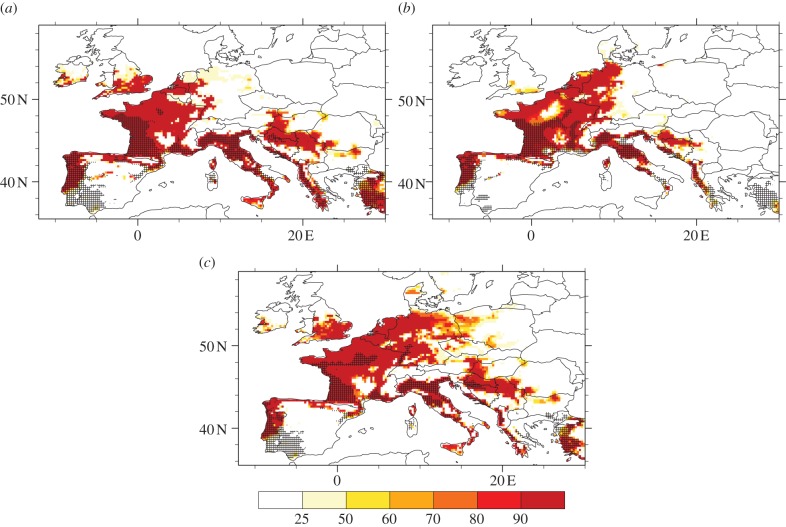
Regions of possible suitability for the A. albopictus mosquito according to different time periods and climatic thresholds. The horizontal and vertical striped pattern depicts climatic suitability for the 1960–1989 period based on the EOBS climate observations. The coloured pattern depicts the percentage of RCMs agreeing on the mosquito suitability/presence for the 2030–2050 period. (a) Suitability areas are defined for annual rainfall above 500 mm, annual temperatures above 11°C and January temperatures above 0°C (model 1). (b) Suitability is defined for model 2 output values above 80%. (c) The suitability is defined for adult mosquito activity above 18 weeks (model 3).

References

    1. Hawley W. A. 1988. Biology of Aedes albopictus. J. Am. Mosq. Contr. Assoc. Suppl. 1, 2–39 - PubMed
    1. Reiter P., Sprenger D. 1987. The used tire trade: a mechanism for the worldwide dispersal of container breeding mosquitoes. J. Am. Mosq. Contr. Assoc. 3, 494–501 - PubMed
    1. Mitchell C. 1995. Geographic spread of Aedes albopictus and potential for involvement in arbovirus cycles in the Mediterranean Basin. J. Vector Ecol. 20, 44–58
    1. Shroyer D. 1986. Aedes albopictus and arboviruses: a concise review of the literature. J. Am. Mosq. Contr. Assoc. 2, 424–428 - PubMed
    1. Estrada-Franco J., Craig G. B. 1995. Biology, disease relationship, and control of Aedes albopictus. Panamerican Health Organization, Technical Paper, 42. Washington, DC: PAHO.

Publication types