


Inclusion criteria provide heterogeneity in baseline profiles of patients with mild cognitive impairment: comparison of two prospective cohort studies
- PMID: 22535791
- PMCID: PMC3341597
- DOI: 10.1136/bmjopen-2011-000773
Inclusion criteria provide heterogeneity in baseline profiles of patients with mild cognitive impairment: comparison of two prospective cohort studies
Abstract
Background: Mild cognitive impairment (MCI) is considered to represent a transitional stage between ageing and Alzheimer's disease (AD). To aim at identifying neuroimaging measures associated with cognitive changes in healthy elderly and MCI patients, longitudinal multicentre studies are ongoing in several countries. The patient profiles of each study are based on unique inclusion criteria.
Objectives: The purpose of the study is to clarify differences in baseline profiles of MCI patients between Studies on Diagnosis of Early Alzheimer's Disease-Japan (SEAD-J) and Alzheimer's Disease Neuroimaging Initiative (ADNI) and to examine the association between baseline profiles and risk of early conversion to AD.
Design: Prospective cohort study.
Setting and participants: SEAD-J recruited 114 patients from nine facilities in Japan. A total of 200 patients in ADNI with fluorodeoxyglucose-positron emission tomography (FDG-PET) were enrolled from the USA.
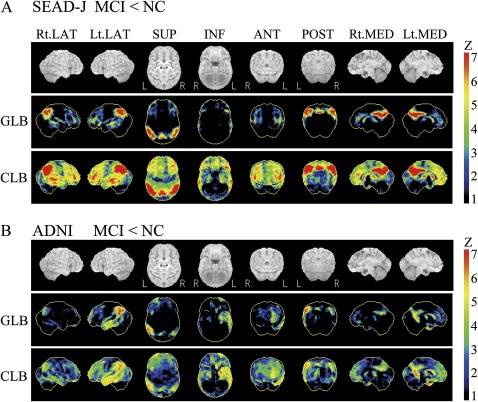
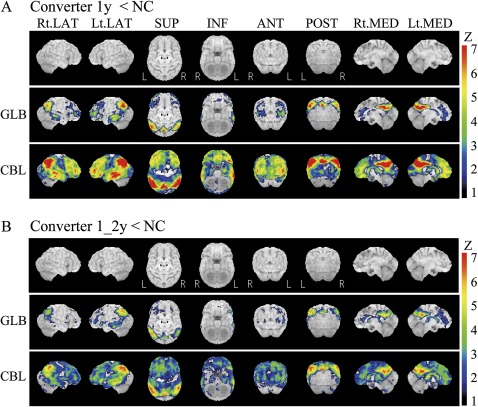
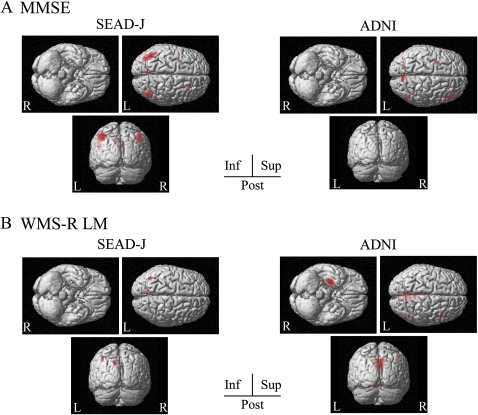
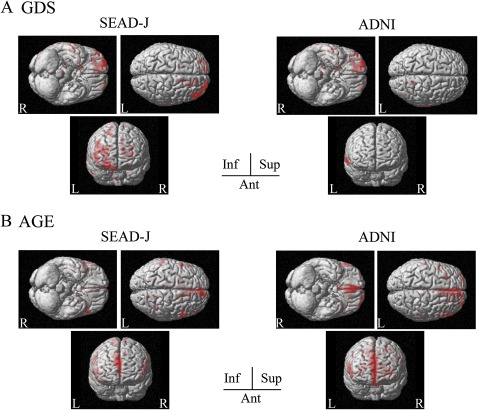
Methods: Baseline profiles were statistically analysed. For FDG-PET at a time of inclusion, associations between each profile and cerebral metabolic rate for glucose (CMRgl) were examined using SPM5 software. In each study, the ratio of conversion to AD within the 1-year and 2-year period after inclusion was investigated and differences in baseline profiles between AD converters and non-converters were analysed.
Results: SEAD-J included MCI patients with more severe verbal memory deficits and extracted patients with higher depressive tendencies. These differences were likely to be associated with criteria. SEAD-J exhibited a higher rate of conversion within 1 year compared with ADNI (24.5% vs 13.5%). In FDG-PET analyses of SEAD-J, AD converters within 1 year showed more severe decrease of FDG uptake in bilateral inferior parietal regions compared with non-converters.
Conclusions: Different inclusion criteria provided differences in baseline profiles. The severity of memory deficit might cause increase of the AD conversion within 1 year. Clinical outcomes of multicentre studies for early diagnosis of AD should be interpreted carefully considering profiles of patients.
Conflict of interest statement
Figures
References
-
- Petersen RC, Smith GE, Waring SC, et al. Mild cognitive impairment: clinical characterization and outcome. Arch Neurol 1999;56:303–8 - PubMed
-
- Bowen J, Teri L, Kukull W, et al. Progression to dementia in patients with isolated memory loss. Lancet 1997;349:763–5 - PubMed
-
- Petersen RC, Stevens JC, Ganguli M, et al. Practice parameter: early detection of dementia: mild cognitive impairment (an evidence-based review). Report of the Quality Standards Subcommittee of the American Academy of Neurology. Neurology 2001;56:1133–42 - PubMed
-
- Hoffman JM, Welsh-Bohmer KA, Hanson M, et al. FDG PET imaging in patients with pathologically verified dementia. J Nucl Med 2000;41:1920–8 - PubMed
-
- Silverman DH, Small GW, Chang CY, et al. Positron emission tomography in evaluation of dementia: regional brain metabolism and long-term outcome. JAMA 2001;286:2120–7 - PubMed
LinkOut - more resources
Full Text Sources
