. 2012 Jul;50(7):2194-202.
doi: 10.1128/JCM.00143-12. Epub 2012 Apr 25.

Rapid, high-throughput detection of rifampin resistance and heteroresistance in Mycobacterium tuberculosis by use of sloppy molecular beacon melting temperature coding

Affiliations

Rapid, high-throughput detection of rifampin resistance and heteroresistance in Mycobacterium tuberculosis by use of sloppy molecular beacon melting temperature coding

Soumitesh Chakravorty et al. J Clin Microbiol. 2012 Jul.

Abstract

Rifampin resistance in Mycobacterium tuberculosis is largely determined by mutations in an 80-bp rifampin resistance determining region (RRDR) of the rpoB gene. We developed a rapid single-well PCR assay to identify RRDR mutations. The assay uses sloppy molecular beacons to probe an asymmetric PCR of the M. tuberculosis RRDR by melting temperature (T(m)) analysis. A three-point T(m) code is generated which distinguishes wild-type from mutant RRDR DNA sequences in approximately 2 h. The assay was validated on synthetic oligonucleotide targets containing the 44 most common RRDR mutations. It was then tested on a panel of DNA extracted from 589 geographically diverse clinical M. tuberculosis cultures, including isolates with wild-type RRDR sequences and 25 different RRDR mutations. The assay detected 236/236 RRDR mutant sequences as mutant (sensitivity, 100%; 95% confidence interval [CI], 98 to 100%) and 353/353 RRDR wild-type sequences as wild type (specificity, 100%; 95% CI, 98.7 to 100%). The assay identified 222/225 rifampin-resistant isolates as rifampin resistant (sensitivity, 98.7%; 95% CI, 95.8 to 99.6%) and 335/336 rifampin-susceptible isolates as rifampin susceptible (specificity, 99.7%; 95% CI, 95.8 to 99.6%). All mutations were either individually identified or clustered into small mutation groups using the triple T(m) code. The assay accurately identified mixed (heteroresistant) samples and was shown analytically to detect RRDR mutations when present in at least 40% of the total M. tuberculosis DNA. This was at least as accurate as Sanger DNA sequencing. The assay was easy to use and well suited for high-throughput applications. This new sloppy molecular beacon assay should greatly simplify rifampin resistance testing in clinical laboratories.


Figures
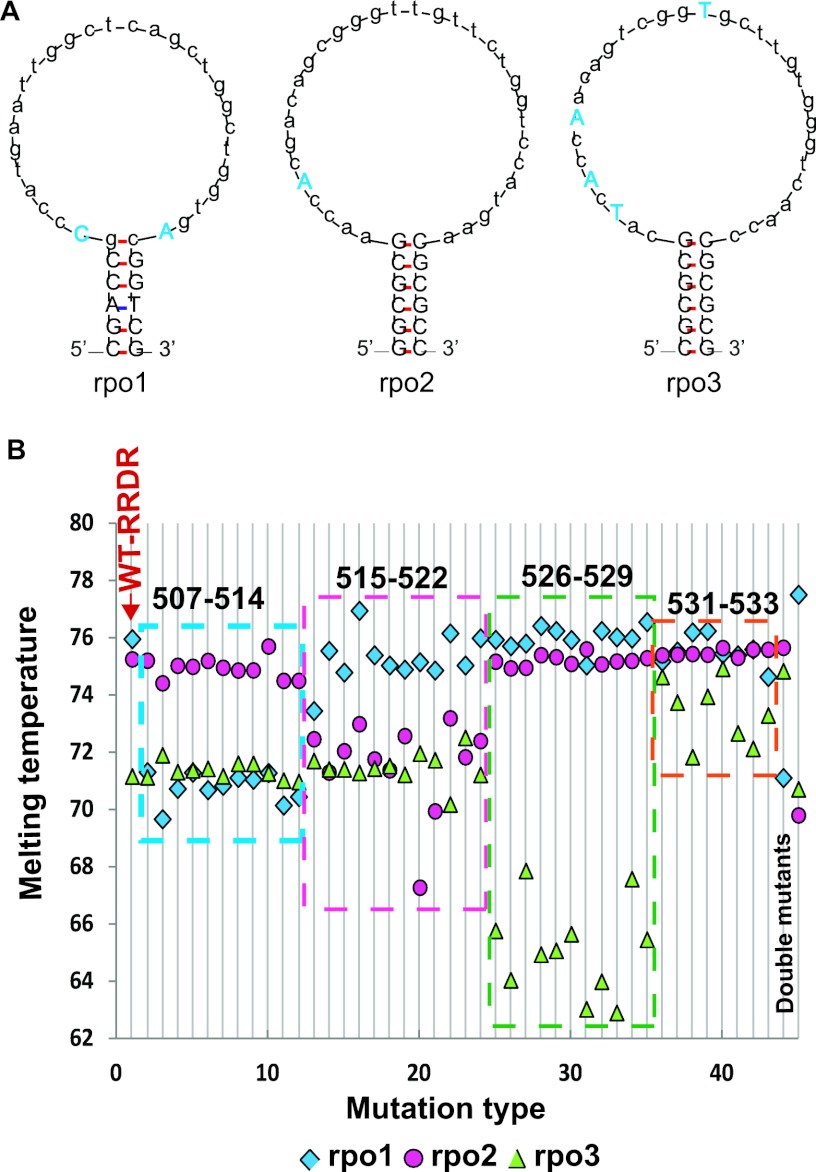
Fig. 1.
Fig. 1.
Probe structures and Tm profiles against artificial targets. (A) The stable stem-loop structures of the three SMB probes used in the assay are shown. Related and unrelated mutations in the loop region introduced to obtain a stable stem-loop structure are shown in blue uppercase letters. Uppercase letters in black show the stem regions. (B) Three-probe Tm code of the assay tested against artificial targets with the wild-type RRDR or known RRDR mutations. Each horizontal line containing a square, circle, and triangle represents a unique 3-point Tm code corresponding to a single RRDR sequence. Line 1 shows results for a wild-type RRDR target, and lines 2 to 45 show results for mutant RRDR targets. The sequences of the mutations tested correspond to those shown in rows 1 to 45 of Table 1. Mutants are detectible by the presence of a substantial shift in the Tm value of either one or more of the three Tm points. Lines 2 to 12 show RRDR sequences harboring mutations in codons 507 to 514. Lines 13 to 24, RRDR sequences harboring mutations in codons 515 to 522; lines 25 to 35, RRDR sequences harboring mutations in codons 526 to 529; lines 36 to 43, RRDR sequences harboring mutations in codons 531 to 533; lines 44 and 45 show two RRDR double mutants.
Fig. 2.
Fig. 2.
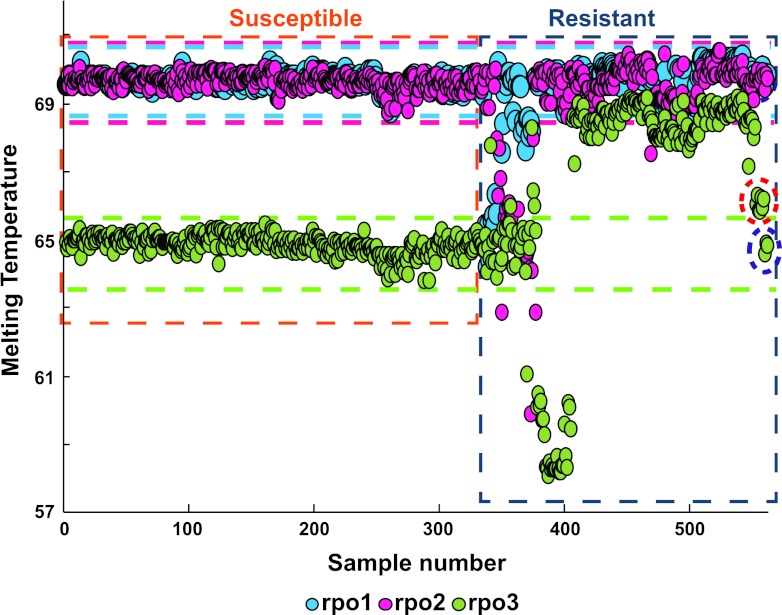
Three-point Tm profile of 589 clinical DNA study samples. The results of the assay tested against the clinical M. tuberculosis study isolates are shown. The horizontal green, pink, and light-blue lines represent the Tm zones corresponding to the wild-type RRDR sequence for each of the three individual probes. Samples with one or more of the three Tm values that fall outside these Tm zones are easily identified as rifampin resistant. Rifampin-susceptible and rifampin-resistant isolates can be distinctly clustered based on their individual Tm profiles, as shown enclosed within the orange and blue rectangles. The red circle indicates the samples with the 533CCG mutation, which was distinctly and independently clustered from the wild-type samples in spite of having a relatively low dTm value. The purple circle indicates the three rifampin-resistant samples with mutations in the rpoB gene outside the RRDR.
Fig. 3.
Fig. 3.
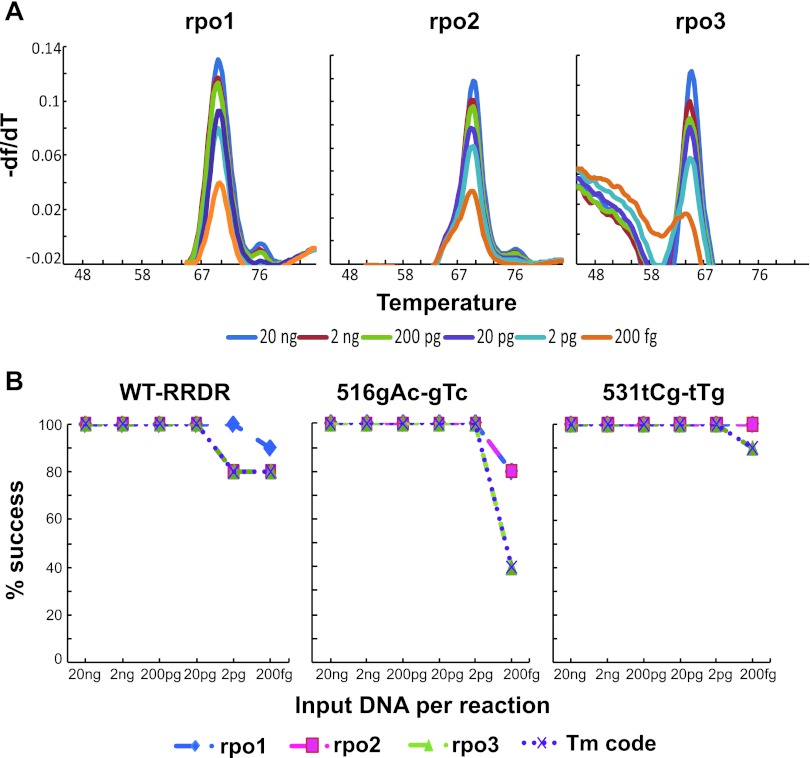
Analytical sensitivity of the assay. (A) Assay curves with limiting amounts of wild-type DNA target. Melting temperature profiles of the three SMB probes on serial dilutions of M. tuberculosis H37Rv genomic DNA with wild-type rpoB RRDR. (B) Limit of detection (LOD) of the assay against wild-type and RRDR mutant DNA. Tm values for each probe are shown for assays performed against the wild-type RRDR and two different RRDR mutant DNA samples. Assays were tested with a range of DNA concentrations as indicated. The LOD of the assay for each RRDR sequence type is defined by the LOD of the probe with the lowest analytical sensitivity. As shown, the LOD for wild-type RRDR was 20 pg, and the LOD for the 516GTC and 531TTG mutant RRDR samples was 2 pg.
Fig. 4.
Fig. 4.
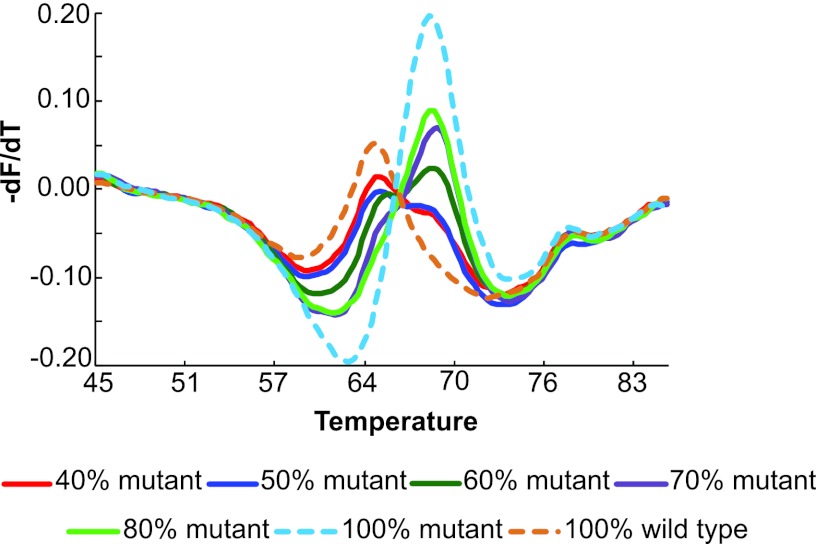
Detection of mixed-sequence heteroresistance. The assay was performed with various mixtures of wild-type and mutant DNA, as indicated. Double Tm peaks, indicating mixtures of wild-type and mutant target, were seen when as little as 40% mutant sequence was present.

References

    1. Ahmad S, Al-Mutairi NM, Mokaddas E. 2009. Comparison of performance of two DNA line probe assays for rapid detection of multidrug-resistant isolates of Mycobacterium tuberculosis. Indian J. Exp. Biol. 47:454–462 - PubMed
    1. Albert H, et al. 2010. Rapid screening of MDR-TB using molecular Line Probe Assay is feasible in Uganda. BMC Infect. Dis. 10:41. - PMC - PubMed
    1. Aldous WK, Pounder JI, Cloud JL, Woods GL. 2005. Comparison of six methods of extracting Mycobacterium tuberculosis DNA from processed sputum for testing by quantitative real-time PCR. J. Clin. Microbiol. 43:2471–2473 - PMC - PubMed
    1. Boehme CC, et al. 2011. Feasibility, diagnostic accuracy, and effectiveness of decentralised use of the Xpert MTB/RIF test for diagnosis of tuberculosis and multidrug resistance: a multicentre implementation study. Lancet 377:1495–1505 - PMC - PubMed
    1. Brossier F, Veziris N, Truffot-Pernot C, Jarlier V, Sougakoff W. 2006. Performance of the genotype MTBDR line probe assay for detection of resistance to rifampin and isoniazid in strains of Mycobacterium tuberculosis with low- and high-level resistance. J. Clin. Microbiol. 44:3659–3664 - PMC - PubMed

Publication types

MeSH terms