


Capturing single cell genomes of active polysaccharide degraders: an unexpected contribution of Verrucomicrobia
- PMID: 22536372
- PMCID: PMC3335022
- DOI: 10.1371/journal.pone.0035314
Capturing single cell genomes of active polysaccharide degraders: an unexpected contribution of Verrucomicrobia
Abstract
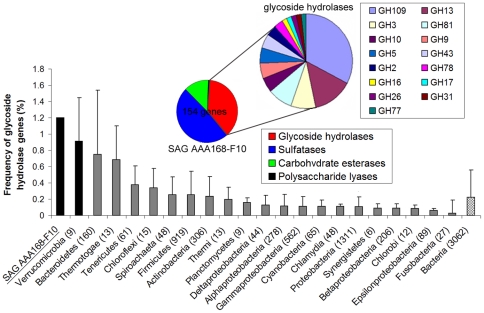
Microbial hydrolysis of polysaccharides is critical to ecosystem functioning and is of great interest in diverse biotechnological applications, such as biofuel production and bioremediation. Here we demonstrate the use of a new, efficient approach to recover genomes of active polysaccharide degraders from natural, complex microbial assemblages, using a combination of fluorescently labeled substrates, fluorescence-activated cell sorting, and single cell genomics. We employed this approach to analyze freshwater and coastal bacterioplankton for degraders of laminarin and xylan, two of the most abundant storage and structural polysaccharides in nature. Our results suggest that a few phylotypes of Verrucomicrobia make a considerable contribution to polysaccharide degradation, although they constituted only a minor fraction of the total microbial community. Genomic sequencing of five cells, representing the most predominant, polysaccharide-active Verrucomicrobia phylotype, revealed significant enrichment in genes encoding a wide spectrum of glycoside hydrolases, sulfatases, peptidases, carbohydrate lyases and esterases, confirming that these organisms were well equipped for the hydrolysis of diverse polysaccharides. Remarkably, this enrichment was on average higher than in the sequenced representatives of Bacteroidetes, which are frequently regarded as highly efficient biopolymer degraders. These findings shed light on the ecological roles of uncultured Verrucomicrobia and suggest specific taxa as promising bioprospecting targets. The employed method offers a powerful tool to rapidly identify and recover discrete genomes of active players in polysaccharide degradation, without the need for cultivation.
Conflict of interest statement
Figures



References
-
- Biddanda B, Benner R. Carbon, nitrogen, and carbohydrate fluxes during the production of particulate and dissolved organic matter by phytoplankton. Limnol Oceanogr. 1997;42:506–518.
-
- Arnosti C. Microbial extracellular enzymes and the marine carbon cycle. Ann Rev Mar Sci. 2011;3:401–425. - PubMed
-
- Rubin EM. Genomics of cellulosic biofuels. Nature. 2008;454:841–845. - PubMed
-
- Zeng X, Danquah MK, Chen XD, Lu Y. Microalgae bioengineering: From CO2 fixation to biofuel production. Renew Sust Energ. Rev. 2011;15:3252–3260.
-
- Blanch HW, Adams PD, Andrews-Cramer KM, Frommer WB, Simmons BA, et al. Addressing the need for alternative transportation fuels: The Joint BioEnergy Institute. ACS Chemical Biology. 2008;3:17–20. - PubMed
Publication types
MeSH terms
Substances
LinkOut - more resources
Full Text Sources
Molecular Biology Databases
