


Modulation of spinal GABAergic analgesia by inhibition of chloride extrusion capacity in mice
- PMID: 22537560
- PMCID: PMC3367103
- DOI: 10.1016/j.jpain.2012.03.002
Modulation of spinal GABAergic analgesia by inhibition of chloride extrusion capacity in mice
Abstract
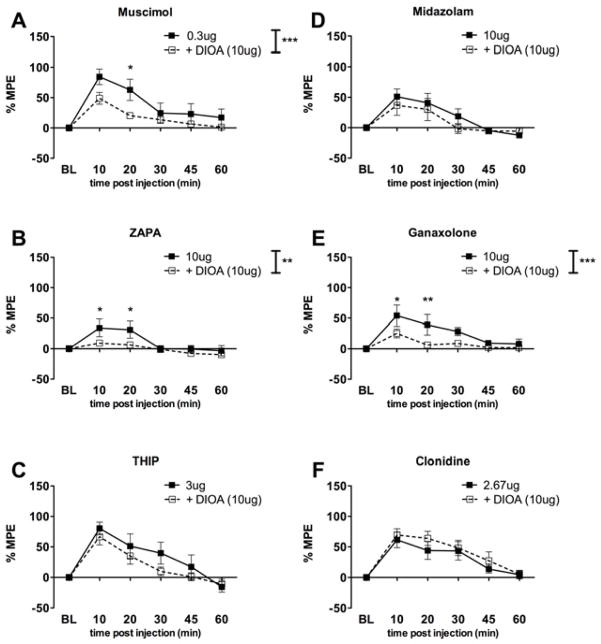
Spinal gamma-aminobutyric acid receptor type A (GABA(A)) receptor modulation with agonists and allosteric modulators evokes analgesia and antinociception. Changes in K(+)-Cl(-) cotransporter isoform 2 (KCC2) expression or function that occur after peripheral nerve injury can result in an impairment in the Cl(-) extrusion capacity of spinal dorsal horn neurons. This, in turn, alters Cl(-)-mediated hyperpolarization via GABA(A) receptor activation, contributing to allodynia or hypersensitivity associated with nerve injury or inflammation. A gap in knowledge exists concerning how this loss of spinal KCC2 activity differentially impacts the analgesic efficacy or potency of GABA(A) agonists and allosteric modulators. We utilized intrathecal drug administration in the tail flick assay to measure the analgesic effects of general GABA(A) agonists muscimol and Z-3-[(aminoiminomethyl)thio]prop-2-enoic acid (ZAPA), the ∂-subunit-preferring agonist 4,5,6,7-tetrahydroisoxazolo(5,4-c)pyridin-3-ol (THIP), and allosteric modulators of the benzodiazepine (midazolam) and neurosteroid (ganaxolone) class, alone or in the presence of K(+)-Cl(-) cotransporter isoform (KCC) blockade. Intrathecal muscimol, ZAPA, THIP midazolam, and ganaxolone all evoked significant analgesia in the tail flick test. Coadministration of either agonists or allosteric modulators with [(dihydroindenyl)oxy] alkanoic acid (DIOA) (a drug that blocks KCC2) had no effect on agonist or allosteric modulator potency. On the other hand, the analgesic efficacy of muscimol and ZAPA and the allosteric modulator ganaxolone were markedly reduced whereas THIP and midazolam were unaffected. Finally, in the spared nerve injury model, midazolam significantly reversed tactile hypersensitivity while ganaxolone had no effect. These results indicate that the KCC2-dependent Cl(-) extrusion capacity differentially regulates the analgesic efficacy of agonists and allosteric modulators at the GABA(A) receptor complex.
Perspective: Our work suggests that drug discovery efforts for the treatment of chronic pain disorders should target benzodiazepine or ∂-subunit-containing sites at the GABA(A) complex.
Copyright © 2012 American Pain Society. Published by Elsevier Inc. All rights reserved.
Conflict of interest statement
The authors have no conflicts of interest to declare.
Figures



References
-
- Aanonsen LM, Wilcox GL. Muscimol, gamma-aminobutyric acidA receptors and excitatory amino acids in the mouse spinal cord. J Pharmacol Exp Ther. 1989;248:1034–8. - PubMed
-
- Adkins CE, Pillai GV, Kerby J, Bonnert TP, Haldon C, McKernan RM, Gonzalez JE, Oades K, Whiting PJ, Simpson PB. alpha4beta3delta GABA(A) receptors characterized by fluorescence resonance energy transfer-derived measurements of membrane potential. J Biol Chem. 2001;276:38934–9. - PubMed
Publication types
MeSH terms
Substances
Grants and funding
LinkOut - more resources
Full Text Sources
Miscellaneous
