. 2012 Apr 26;4(1):15.
doi: 10.1186/1758-5996-4-15.

The skin function: a factor of anti-metabolic syndrome

Affiliations

The skin function: a factor of anti-metabolic syndrome

Shi-Sheng Zhou et al. Diabetol Metab Syndr. .

Abstract

The body's total antioxidant capacity represents a sum of the antioxidant capacity of various tissues/organs. A decrease in the body's antioxidant capacity may induce oxidative stress and subsequent metabolic syndrome, a clustering of risk factors for type 2 diabetes and cardiovascular disease. The skin, the largest organ of the body, is one of the major components of the body's total antioxidant defense system, primarily through its xenobiotic/drug biotransformation system, reactive oxygen species-scavenging system, and sweat glands- and sebaceous glands-mediated excretion system. Notably, unlike other contributors, the skin contribution is variable, depending on lifestyles and ambient temperature or seasonal variations. Emerging evidence suggests that decreased skin's antioxidant and excretory functions (e.g., due to sedentary lifestyles and low ambient temperature) may increase the risk for metabolic syndrome. This review focuses on the relationship between the variability of skin-mediated detoxification and elimination of exogenous and endogenous toxic substances and the development of metabolic syndrome. The potential role of sebum secretion in lipid and cholesterol homeostasis and its impact on metabolic syndrome, and the association between skin disorders (acanthosis nigricans, acne, and burn) and metabolic syndrome are also discussed.


Figures
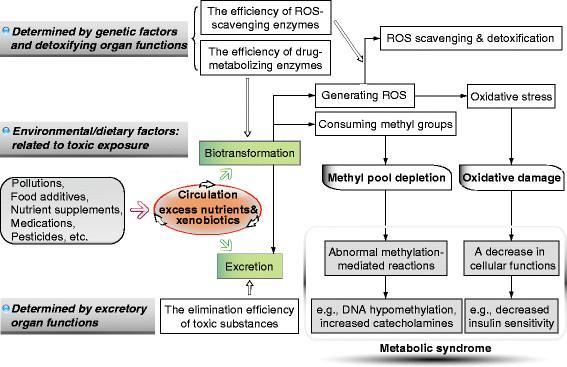
Figure 1
Figure 1
Possible link among environmental/dietary factors, genetic factors, oxidative stress, and aberrant methylation profile in MetS. Increased xenobiotic and synthetic-nutrient exposure may be the primary cause of MetS (See text and Ref. [2] for further details). ROS, reactive oxygen species.
Figure 2
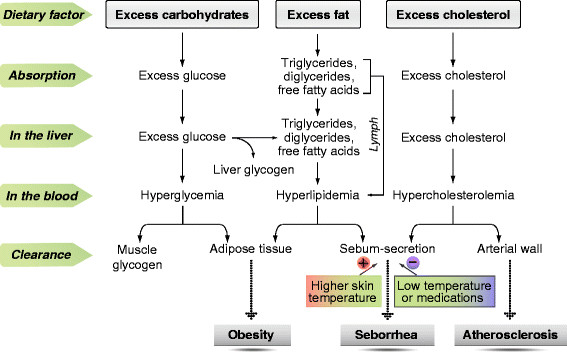
Figure 2
Relationships among excess energy intake, skin function and health outcomes. +, stimulation; –, inhibition.
Figure 3
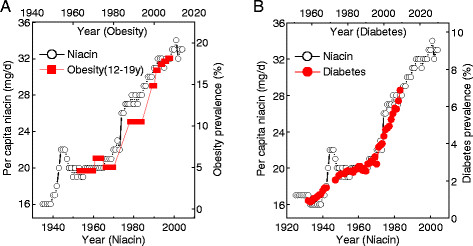
Figure 3
Trends in U.S. per capita niacin consumption and the prevalence of obesity and diabetes. The prevalence of obesity (A) and diabetes (B) increased in parallel with the increase in U.S. per capita niacin consumption with a lag of 10 years and 26 years, respectively (see Ref. [9,35] for detail). The sharp increase in niacin consumption in 1940s and 1974 is due to the implementation of mandatory grain fortification and the update of fortification standards, respectively. The data on the prevalence of obesity and diabetes are from the U.S. Centers for Disease Control and Prevention (http://www.cdc.gov/nchs/data/hestat/obesity_child_07_08/obesity_child_07_08.htm; and http://www.cdc.gov/diabetes/statistics/slides/long_term_trends.pdf. Accessed March 24, 2012). The data on U.S. per capita consumption of niacin is from Economic Research Service: Nutrient Availability Spreadsheets, (http://www.ers.usda.gov/data/foodconsumption/NutrientAvailIndex.htm. Accessed March 24, 2012).
Figure 4
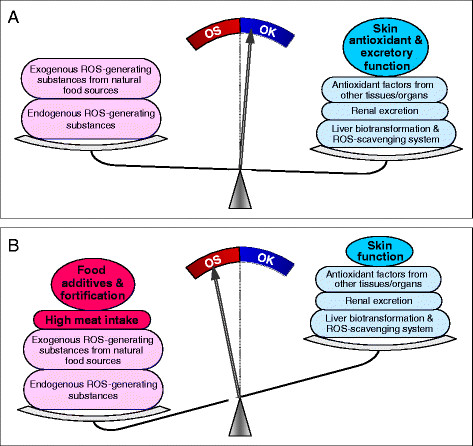
Figure 4
Factors affecting the balance between ROS production and scavenging. A, In traditional lifestyles, ROS are derived from the metabolism of endogenous and exogenous (i.e., natural dietary) substances. The skin, especially its sweat glands, may play an important antioxidant role. B, In modern lifestyles, dietary xenobiotics have significantly increased, while the skin functions, especially sweat-mediated excretion, is decreased due to sedentary lifestyles. As a result, an imbalance between ROS production and the body’s antioxidant defense system takes place. OK, antioxidant defense capacity > ROS production; OS, oxidative stress.

References

    1. Roberts CK, Sindhu KK. Oxidative stress and metabolic syndrome. Life Sci. 2009;84:705–712. doi: 10.1016/j.lfs.2009.02.026. - DOI - PubMed
    1. Zhou SS, Zhou YM, Li D, Lun YZ. Dietary methyl-consuming compounds and metabolic syndrome. Hypertens Res. 2011;34:1239–1245. doi: 10.1038/hr.2011.133. - DOI - PubMed
    1. Wong ND. Metabolic syndrome: cardiovascular risk assessment and management. Am J Cardiovasc Drugs. 2007;7:259–272. doi: 10.2165/00129784-200707040-00004. - DOI - PubMed
    1. Swinburn BA, Sacks G, Hall KD, McPherson K, Finegood DT, Moodie ML, Gortmaker SL. The global obesity pandemic: shaped by global drivers and local environments. Lancet. 2011;378:804–814. doi: 10.1016/S0140-6736(11)60813-1. - DOI - PubMed
    1. Grattagliano I, Palmieri VO, Portincasa P, Moschetta A, Palasciano G. Oxidative stress-induced risk factors associated with the metabolic syndrome: a unifying hypothesis. J Nutr Biochem. 2008;19:491–504. doi: 10.1016/j.jnutbio.2007.06.011. - DOI - PubMed

LinkOut - more resources