Effectiveness of a diabetes education and self management programme (DESMOND) for people with newly diagnosed type 2 diabetes mellitus: three year follow-up of a cluster randomised controlled trial in primary care
- PMID: 22539172
- PMCID: PMC3339877
- DOI: 10.1136/bmj.e2333
Effectiveness of a diabetes education and self management programme (DESMOND) for people with newly diagnosed type 2 diabetes mellitus: three year follow-up of a cluster randomised controlled trial in primary care
Abstract
Objective: To measure whether the benefits of a single education and self management structured programme for people with newly diagnosed type 2 diabetes mellitus are sustained at three years.
Design: Three year follow-up of a multicentre cluster randomised controlled trial in primary care, with randomisation at practice level.
Setting: 207 general practices in 13 primary care sites in the United Kingdom.
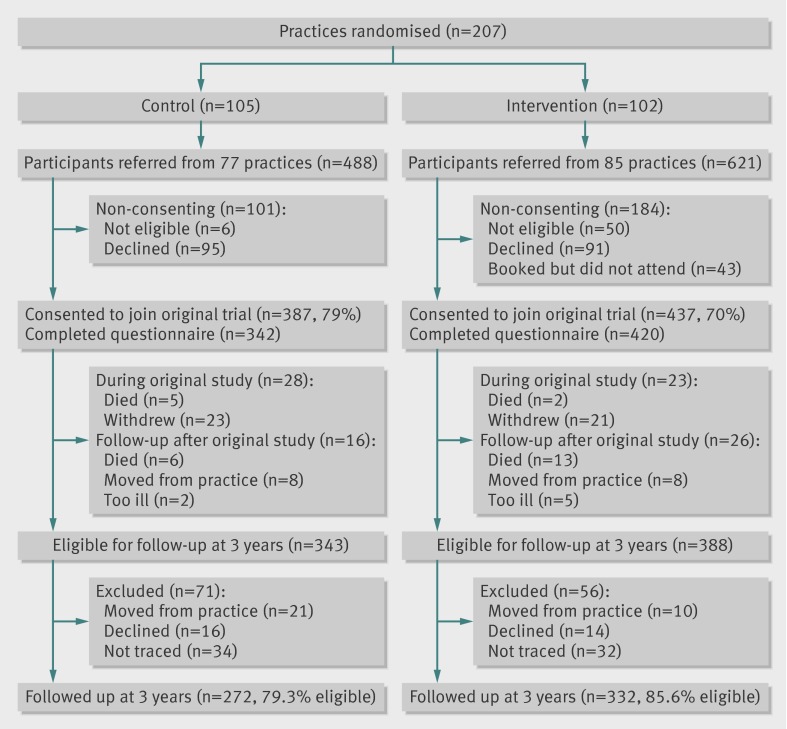
Participants: 731 of the 824 participants included in the original trial were eligible for follow-up. Biomedical data were collected on 604 (82.6%) and questionnaire data on 513 (70.1%) participants.
Intervention: A structured group education programme for six hours delivered in the community by two trained healthcare professional educators compared with usual care.
Main outcome measures: The primary outcome was glycated haemoglobin (HbA(1c)) levels. The secondary outcomes were blood pressure, weight, blood lipid levels, smoking status, physical activity, quality of life, beliefs about illness, depression, emotional impact of diabetes, and drug use at three years.
Results: HbA(1c) levels at three years had decreased in both groups. After adjusting for baseline and cluster the difference was not significant (difference -0.02, 95% confidence interval -0.22 to 0.17). The groups did not differ for the other biomedical and lifestyle outcomes and drug use. The significant benefits in the intervention group across four out of five health beliefs seen at 12 months were sustained at three years (P<0.01). Depression scores and quality of life did not differ at three years.
Conclusion: A single programme for people with newly diagnosed type 2 diabetes mellitus showed no difference in biomedical or lifestyle outcomes at three years although there were sustained improvements in some illness beliefs.
Trial registration: Current Controlled Trials ISRCTN17844016.
Conflict of interest statement
Competing interests: All authors have completed the ICMJE uniform disclosure form at
Comment in
-
Self management education and good professional consultation skills for patients with diabetes.BMJ. 2012 Apr 26;344:e2673. doi: 10.1136/bmj.e2673. BMJ. 2012. PMID: 22539175 No abstract available.
References
-
- Massi-Benedetti M. The cost of diabetes type ii in Europe: the CODE-2 study. Diabetologia 2002;45:S1-4. - PubMed
-
- Tapp R, Shaw J, Zimmet P, eds. Complications of diabetes. In: International diabetes federation, ed. Diabetes atlas. 2nd ed.International Diabetes Federation, 2003.
-
- Norris S, Nichols P, Caspersen C, Glasgow R, Engelgau M, Jack L. Increasing diabetes self management education in community settings. A systematic review. Am J Prev Med 2002;22:39-66. - PubMed
-
- UK Prospective Diabetes Study Group. Intensive blood-glucose control with sulphonylureas or insulin compared with conventional treatment and risk of complications in patients with type 2 diabetes (UKPDS 33). Lancet 1998;352:837-53. - PubMed
-
- Jarvis J, Skinner T, Carey M, Davies M. How can structured self-management patient education improve outcomes in people with type 2 diabetes? Diabet Obes Metab 2010;12:12-9. - PubMed
Publication types
MeSH terms
Substances
Associated data
Grants and funding
LinkOut - more resources
Full Text Sources
Medical
Miscellaneous