. 2012 Apr 25;32(17):5728-36.
doi: 10.1523/JNEUROSCI.2900-11.2012.

Imaging microglial/macrophage activation in spinal cords of experimental autoimmune encephalomyelitis rats by positron emission tomography using the mitochondrial 18 kDa translocator protein radioligand [¹⁸F]DPA-714

Affiliations

Imaging microglial/macrophage activation in spinal cords of experimental autoimmune encephalomyelitis rats by positron emission tomography using the mitochondrial 18 kDa translocator protein radioligand [¹⁸F]DPA-714

Galith Abourbeh et al. J Neurosci. .

Abstract

Multiple sclerosis (MS) is an inflammatory demyelinating disease of the CNS. Activated microglia/macrophages play a key role in the immunopathogenesis of MS and its corresponding animal models, experimental autoimmune encephalomyelitis (EAE). Microglia activation begins at early stages of the disease and is associated with elevated expression of the 18 kDa mitochondrial translocator protein (TSPO). Thus, positron emission tomography (PET) imaging of microglial activation using TSPO-specific radioligands could be valuable for monitoring disease-associated neuroinflammatory processes. EAE was induced in rats using a fragment of myelin basic protein, yielding acute clinical disease that reflects extensive spinal cord inflammation. Enhanced TSPO expression in spinal cords of EAE rats versus those of controls was confirmed by Western blot and immunohistochemistry. Biodistribution studies in control and EAE rats were performed using the TSPO radioligand [¹⁸F]DPA-714 [N,N-diethyl-2-(2-(4-(2-fluoroethoxy)phenyl)-5,7-dimethylpyrazolo[1,5-a]pyrimidin-3-yl)acetamide]. At 1 h after injection, almost fivefold higher levels of [¹⁸F]DPA-714 were measured in spinal cords of EAE rats versus controls. The specific binding of [¹⁸F]DPA-714 to TSPO in spinal cords was confirmed in competition studies, using unlabeled (R,S)-PK11195 [(R,S)-N-methyl-N-(1-methylpropyl)-1-(2-chlorophenyl)isoquinoline-3-carboxamide)] or DPA-714 in excess. MicroPET studies affirm that this differential radioactivity uptake in spinal cords of EAE versus control rats could be detected and quantified. Using [¹⁸F]DPA-714, neuroinflammation in spinal cords of EAE-induced rats could be visualized by PET, offering a sensitive technique for monitoring neuroinflammatory lesions in the CNS and particularly in the spinal cord. In addition to current MRI protocols, this approach could provide molecular images of neuroinflammation for detection, monitoring, and research in MS.


Figures

Figure 1.
Figure 1.
A representative EAE course in female Lewis rats after immunization with gpMBP68–86 fragment. Injection of gpMBP68–86 emulsion (25 μg/rat, n = 13) induces weight loss (A), succeeded by a monophasic acute illness (B) that peaks on 11–12 dpi, and regresses completely on ∼15 dpi. No clinical symptoms or weight loss are observed in control, CFA-injected rats (n = 7). Neurological scoring: 0, no symptoms; 1, flaccid tail; 2, hindlimb weakness; 3, paraparesis; 3.5, unilateral hindlimb paralysis; 4, bilateral hindlimb paralysis; and 5, bilateral hindlimb paralysis and incontinence. Results are expressed as mean + SEM.
Figure 2.
Figure 2.
Increased TSPO expression in spinal cords of EAE-induced rats compared with those of controls. Spinal cord homogenates were prepared from EAE rats (n = 7) at maximum deficit (neurologic scores of 4–5) and controls (n = 6) and analyzed for their TSPO content by Western blot. Higher levels of TSPO are present in spinal cords of EAE-induced rats versus those of controls (A). First lane on the left, an adrenal gland extract, used as positive control for TSPO expression. TSPO levels (normalized to those of α-tubulin) are approximately fivefold higher in spinal cords of EAE rats (B). ***p = 0.0001.
Figure 3.
Figure 3.
TSPO expression in spinal cords of EAE-induced rats is associated with activated microglia/macrophages. Paraffin-embedded spinal cord tissue sections (5 μm) were stained, as described in Materials and Methods, for nucleus (blue DAPI), for activated microglia/macrophages [red CD68 (A–D, F) or Iba-1 (E)], reactive astrocytes [white GFAP (B, D)], and TSPO expression [green NP155 (A–D, G)]. Representative immunohistochemical staining of spinal cord tissues from EAE (A, B, E–G) and control (C, D) rats identify activated microglia/macrophages, rather than reactive astrocytes, as the cellular source of TSPO expression.
Figure 4.
Figure 4.
Enhanced specific uptake of [18F]DPA-714 in spinal cords of EAE-induced rats versus those of controls in biodistribution studies. Distribution of radioactivity was measured at 1 h after intravenous injection of [18F]DPA-714 into control (n = 16) or EAE-induced (n = 15) rats, revealing fourfold to fivefold higher radioactivity uptake values in spinal cords of EAE rats. In competition studies, an excess of unlabeled (R,S)-PK11195 (n = 8) or DPA-714 (n = 7) was injected into EAE rats 30 min after injection of [18F]DPA-714. Radioactivity uptake in spinal cords of EAE rats was reduced by ∼50% after injection of either TSPO ligand, signifying specific binding of the tracer. ***p < 0.001; #p < 0.001, highly statistically significant difference with respect to the remaining three groups.
Figure 5.
Figure 5.
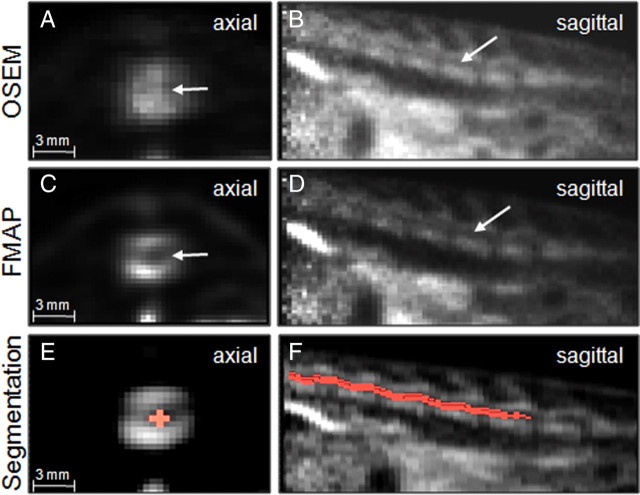
PET image reconstruction and segmentation of the spinal cord region after injection of [18F]DPA-714. Radioactivity concentrations in the spinal cords were measured using 30-min (summed-frame) images that correspond to the last 30 min of each dynamic acquisition. A representative PET image of an EAE-induced rat is demonstrated, reconstructed using both 2D-OSEM (A, B) and 3D-OSEM-MAP (FMAP) (C, D) reconstruction algorithms. Spinal cord regions (indicated by arrows) were segmented by drawing a 3 × 3-voxel cross per plane (centered on the cord), along the axial axis (E), yielding an approximated 3D representation of the spinal cord (F).
Figure 6.
Figure 6.
Enhanced uptake of [18F]DPA-714 in spinal cords of EAE-induced rats versus controls using microPET. Representative images of increased uptake of [18F]DPA-714 in spinal cords of EAE-induced rats (A, B) compared with CFA-injected controls (C, D) (spinal cords are indicated by arrowheads). Using FMAP image reconstruction algorithm, radioactivity concentration in spinal cords of EAE-induced rats (n = 8) was 2.6-fold higher than that of controls (n = 8) (E). Displacement of [18F]DPA-714 binding in spinal cord after administration of either unlabeled (R,S)-PK11195 (n = 8) or DPA-714 (n = 7) (1 mg/kg) could be demonstrated and quantified by PET. ***p < 0.001, compared with the other three groups.

References

    1. Agosta F, Absinta M, Sormani MP, Ghezzi A, Bertolotto A, Montanari E, Comi G, Filippi M. In vivo assessment of cervical cord damage in MS patients: a longitudinal diffusion tensor MRI study. Brain. 2007;130:2211–2219. - PubMed
    1. Anholt RR, De Souza EB, Oster-Granite ML, Snyder SH. Peripheral-type benzodiazepine receptors: autoradiographic localization in whole-body sections of neonatal rats. J Pharmacol Exp Ther. 1985;233:517–526. - PubMed
    1. Banati RB. Visualising microglial activation in vivo. Glia. 2002;40:206–217. - PubMed
    1. Banati RB. Neuropathological imaging: in vivo detection of glial activation as a measure of disease and adaptive change in the brain. Br Med Bull. 2003;65:121–131. - PubMed
    1. Banati RB, Newcombe J, Gunn RN, Cagnin A, Turkheimer F, Heppner F, Price G, Wegner F, Giovannoni G, Miller DH, Perkin GD, Smith T, Hewson AK, Bydder G, Kreutzberg GW, Jones T, Cuzner ML, Myers R. The peripheral benzodiazepine binding site in the brain in multiple sclerosis: quantitative in vivo imaging of microglia as a measure of disease activity. Brain. 2000;123:2321–2337. - PubMed

Publication types

MeSH terms

LinkOut - more resources