. 2012 Jul;191(3):791-803.
doi: 10.1534/genetics.112.140301. Epub 2012 Apr 27.

Chromatin modulation at the FLO11 promoter of Saccharomyces cerevisiae by HDAC and Swi/Snf complexes

Affiliations

Chromatin modulation at the FLO11 promoter of Saccharomyces cerevisiae by HDAC and Swi/Snf complexes

Ramón R Barrales et al. Genetics. 2012 Jul.

Abstract

Cell adhesion and biofilm formation are critical processes in the pathogenicity of fungi and are mediated through a family of adhesin proteins conserved throughout yeasts and fungi. In Saccharomyces cerevisiae, Flo11 is the main adhesin involved in cell adhesion and biofilm formation, making the study of its function and regulation in this nonpathogenic budding yeast highly relevant. The S. cerevisiae FLO11 gene is driven by a TATA-box-containing promoter that is regulated through one of the longest regulatory upstream regions (3 kb) in yeast. We reported recently that two chromatin cofactor complexes, the Rpd3L deacetylase and the Swi/Snf chromatin-remodeling complexes, contribute significantly to the regulation of FLO11. Here, we analyze directly how these complexes impact on FLO11 promoter chromatin structure and dissect further the interplay between histone deacetylases, chromatin remodeling, and the transcriptional repressor Sfl1. We show that the regulation of chromatin structure represents an important layer of control in the highly complex regulation of the FLO11 promoter.


Figures
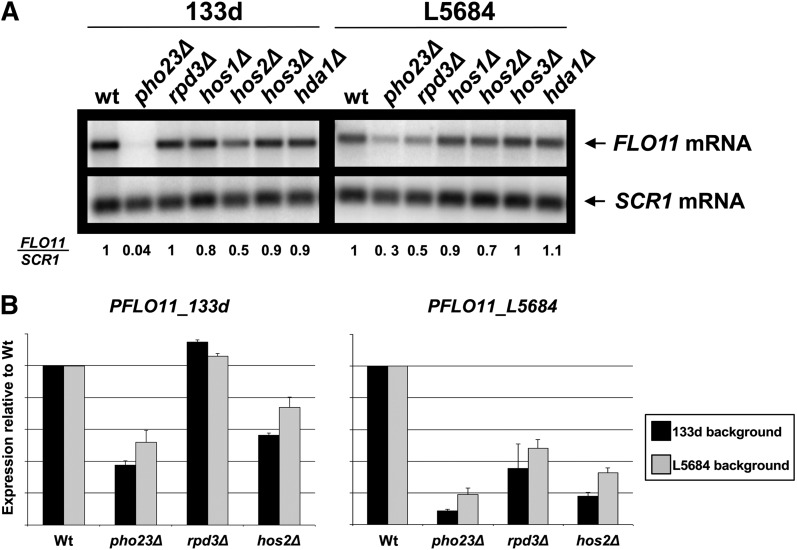
Figure 1
Figure 1
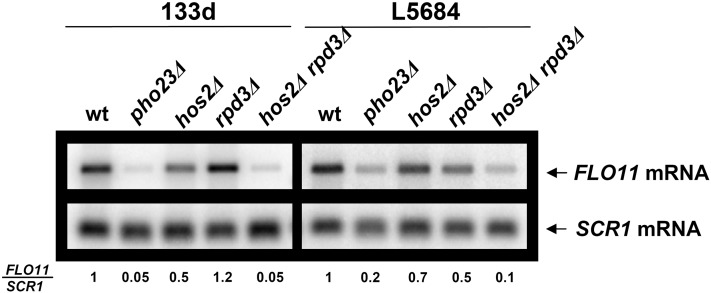
Strain-dependent activation of FLO11 transcription by the Hos2 or Rpd3 deacetylases. (A) Northern blot analysis of FLO11 mRNA levels in the indicated mutants of 133d (flor) or the L5684 (laboratory) yeast strains. SCR1 mRNA was probed as loading control. Numbers below the blot indicate FLO11 expression levels normalized to SCR1 and the respective quotient of the wild type. (B) The differential roles of deacetylases are specific to the promoter alleles. Expression levels were measured by flow cytometry or β-galactosidase assays for strains transformed with a plasmid containing the GFP ORF under the control of the 133d FLO11 promoter (PFLO11_133d) or the lacZ ORF under the control of the laboratory one (PFLO11_L5684), respectively, and normalized to wild type. Error bars represent the standard deviation of three biologically independent measurements.
Figure 2
Figure 2
Hos2 and Rpd3 synergistically activate FLO11 expression. Northern blot analysis as in Figure 1A, but including the hos2Δ rpd3Δ double mutant in 133d and L5684 strains.
Figure 3
Figure 3
Mutant phenotypes of histone depletion and acetylation at the FLO11 promoter. The level of acetylated histone H4 (A–E) and total histone H3 (F–J) occupancy over the FLO11 promoter and coding region as well as over the INO1 promoter was monitored by ChIP assay in the indicated wild type and mutants for both the 133d and the L5684 strain. Acetylated histone H4 levels are shown relative to histone H3 levels, and histone H3 levels were normalized to an amplicon at the telomere. Error bars represent the standard deviation of three biologically independent measurements. Diagrams above the panels show amplicon positions. The gray box in the FLO11 promoter corresponds to the 111-bp region that is deleted in the flor promoter allele. As a positive control, we used an amplicon at the INO1 promoter to test H3 levels and observed a strong decrease in nucleosome occupancy in the rpd3Δ and hos2Δ rpd3Δ mutants (F, I, and J) in agreement with increased INO1 transcription in these mutants (Rundlett et al. 1998).
Figure 4
Figure 4
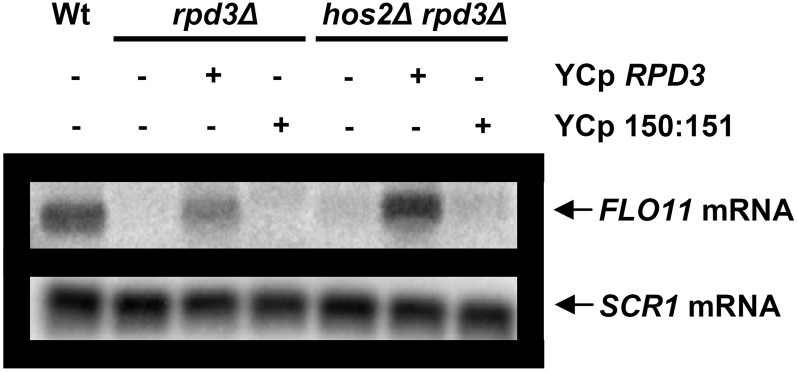
The enzymatic activity of Rpd3 is required for FLO11 activation in the laboratory strain. Northern blot analysis (as in Figure 1A) of FLO11 mRNA from wild type (L5684) and rpd3Δ or hos2Δ rpd3Δ mutant transformed (+) or not (−) with the plasmid containing either the RPD3 wild-type gene (YCp RPD3) or the RPD3 allele defective for deacetylase activity (YCp 150:151).
Figure 5
Figure 5
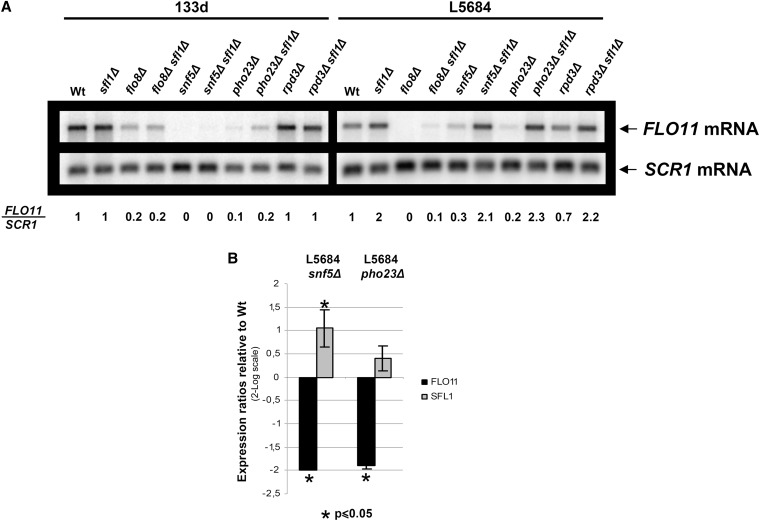
Sfl1-mediated repression is important for FLO11 regulation but is absent in the 133d strain. (A) Northern blot analysis of FLO11 mRNA, as described in Figure 1A, for the indicated wild-type and mutant strains. (B) qRT-PCR analysis of FLO11 and SFL1 expression in the laboratory strain. Expression was normalized to SCR1 expression and to wild type. Error bars represent the standard deviation of three biologically independent measurements.
Figure 6
Figure 6
Rpd3 counteracts the action of Sfl1 on the laboratory FLO11 allele by regulating ICR1 ncRNA. (A) Northern blot analysis of FLO11 mRNA, as described in Figure 1A, for the indicated wild-type and mutant strains. (B) qRT-PCR analysis of ICR1 ncRNA expression in both laboratory and 133d strains. Expression was normalized to SCR1 expression and to wild type. Error bars represent the standard deviation of three biologically independent measurements.
Figure 7
Figure 7
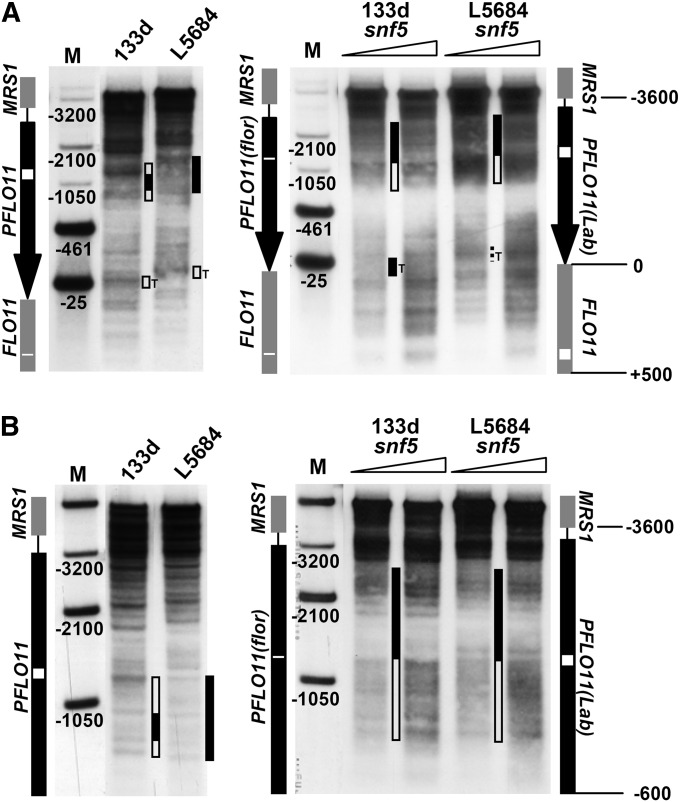
Chromatin structure at the FLO11 promoter is generally very similar between flor and laboratory alleles but is distinct in the vicinity of the 111-bp deletion. MNase indirect end-labeling analysis of chromatin structure at the FLO11 promoter in 133d and L5684 strains. Ramps above the lanes denote increasing MNase concentrations. MNase patterns of free DNA are shown for comparison. Secondary cleavage with XcmI is shown in A and with XbaI in B. The five marker bands of lanes M in A were generated by double digestion with XcmI and either StuI, XbaI, HpaI, XmnI, or AflI (from bottom to top, corresponding to positions −25, −461, −1050, −2100, and −3200 bp from FLO11 ATG). The three marker bands in lanes M of B were generated by double digestion with XbaI and HpaI, XmnI, or AflI (from bottom to top). Diagrams outlining the FLO11 promoter (black arrow in A and black line in B) and flanking ORFs (gray lines) are shown on either side of the blots. The regions where the flor allele has deletions in the promoter and ORF relative to the laboratory allele are marked by a white box for the laboratory and by a white line for the flor allele. Hypersensitive regions of interest are highlighted by open bars in between lanes, and more protected regions by solid bars. Note the protected region flanked by two bands next to the 111-bp deletion region (white box) in the L5684 allele in B. “T” denotes the TATA box region.
Figure 8
Figure 8
Pho23 is essential for the correct chromatin structure at the FLO11 promoter. MNase indirect end-labeling analysis of the FLO11 promoter, as in Figure 7 but including the pho23Δ mutants in the 133d and L5684 backgrounds. Secondary cleavage with XcmI is shown in A and with XbaI in B. Wild-type patterns taken from Figure 7 are shown on the left for comparison.
Figure 9
Figure 9
Snf5 is involved in nucleosome positioning at the FLO11 promoter. MNase indirect end-labeling analysis as in Figure 7, but including the snf5Δ mutants in flor and laboratory backgrounds. Secondary cleavage with XcmI is shown in A and with XbaI in B. Wild-type patterns taken from Figure 7 are shown on the left for comparison.

References

    1. Almer A., Rudolph H., Hinnen A., Horz W., 1986. Removal of positioned nucleosomes from the yeast PHO5 promoter upon PHO5 induction releases additional upstream activating DNA elements. EMBO J. 5: 2689–2696 - PMC - PubMed
    1. Barrales R. R., Jimenez J., Ibeas J. I., 2008. Identification of novel activation mechanisms for FLO11 regulation in Saccharomyces cerevisiae. Genetics 178: 145–156 - PMC - PubMed
    1. Braus G. H., Grundmann O., Bruckner S., Mosch H. U., 2003. Amino acid starvation and Gcn4p regulate adhesive growth and FLO11 gene expression in Saccharomyces cerevisiae. Mol. Biol. Cell 14: 4272–4284 - PMC - PubMed
    1. Bumgarner S. L., Dowell R. D., Grisafi P., Gifford D. K., Fink G. R., 2009. Toggle involving cis-interfering noncoding RNAs controls variegated gene expression in yeast. Proc. Natl. Acad. Sci. USA 106: 18321–18326 - PMC - PubMed
    1. Bumgarner S. L., Neuert G., Voight B. F., Symbor-Nagrabska A., Grisafi P., et al. , 2012. Single-cell analysis reveals that noncoding RNAs contribute to clonal heterogeneity by modulating transcription factor recruitment. Mol. Cell 45: 470–482 - PMC - PubMed

Publication types

MeSH terms

Substances