Comparative Study
. 2013 Feb;62(2):259-71.
doi: 10.1136/gutjnl-2011-301585. Epub 2012 Apr 28.

Metronomic oral topotecan prolongs survival and reduces liver metastasis in improved preclinical orthotopic and adjuvant therapy colon cancer models

Affiliations
Free PMC article
Comparative Study

Metronomic oral topotecan prolongs survival and reduces liver metastasis in improved preclinical orthotopic and adjuvant therapy colon cancer models

Christina Hackl et al. Gut. 2013 Feb.
Free PMC article

Abstract

Objective: Advanced and recurrent diseases are the major causes of death in colon cancer. No standard preclinical model addresses advanced disease and spontaneous metastasis after orthotopic tumour growth. In this study, the authors report the establishment of such standardised orthotopic mouse models of colon cancer and their use in evaluating metronomic topotecan alone or in combination with standard chemotherapy.

Design: Human colon cancer cell lines, transfected with human chorionic gonadotropin and luciferase, were injected orthotopically into the caecal wall of severe combined immunodeficient mice, intrasplenically or subcutaneously. For adjuvant therapy, caecal resections were performed 3-5 weeks after tumour cell injection. Chemotherapy drugs tested included uracil/tegafur, folinic acid, oxaliplatin, topotecan, pazopanib and various combinations.

Results: Subcutaneous tumours showed exaggerated sensitivity to treatment by delayed tumour growth (p=0.002) and increased survival (p=0.0064), but no metastatic spread. Intrasplenic cell injection resulted in rapid and extensive but artefactual metastasis without treatment effect. Intracaecal cell injection with tumour take rates of 87.5-100% showed spontaneous metastases at clinically relevant rates. Metronomic topotecan significantly polonged survival and reduced metastasis. In the adjuvant setting, metronomic maintenance therapy (after FOLFOX-like induction) prolonged survival compared with vehicle controls (p=0.0003), control followed by topotecan (p=0.0161) or FOLFOX-like therapy (p=0.0003).

Conclusion: The refined orthotopic implantation technique proved to be a clinically relevant model for metastasis and therapy studies. Furthermore, metronomic therapy with oral topotecan may be promising to consider for clinical trials of metastatic colon cancer and long-term adjuvant maintenance therapy of colon cancer.


Conflict of interest statement

Competing interests: RSK is a consultant to Taiho Pharmaceuticals, Japan, and GSK, USA. He receives funding from GSK to undertake studies using oral topotecan and pazopanib. CH, SM, GF, CM and PX have no competing interests.

Figures

Figure 1
Figure 1
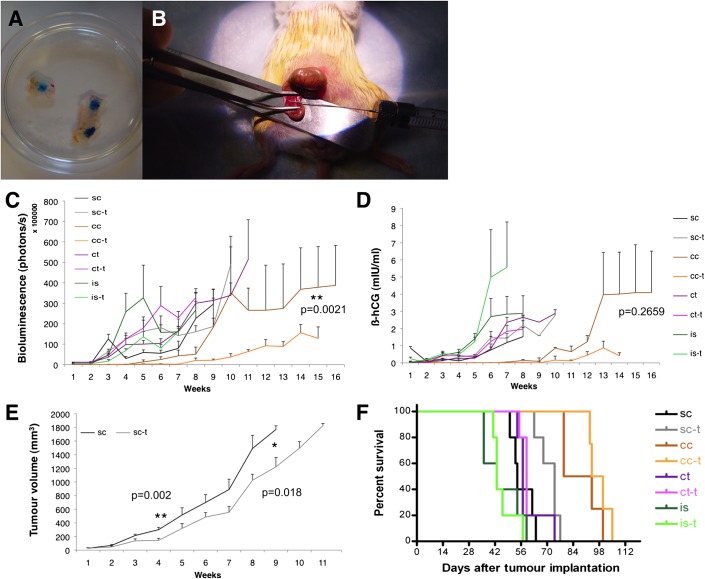
(A) An injection technique was established by injections of trypan blue into the caecal wall (excised pieces are shown on a petri dish). (B) Exposure of the caecum for orthotopic injections; for successful intra-caecal cell injection, the caecum was placed on a scalpel holder, flattened and stabilised with a forceps. (C) In vivo monitoring: quantification of bioluminescence, (D) ß-human chorionic gonadotropin (ß-hCG) secretion in the urine. (E) subcutaneous tumour sizes. (F) Survival curves. cc, caecal cell implantation; cc-t, caecal cell implantation plus treatment; ct, caecal tissue implantation; ct-t, caecal tissue implantation plus treatment; is, intrasplenic cell implantation; is-t, intrasplenic cell implantation plus treatment.
Figure 2
Figure 2
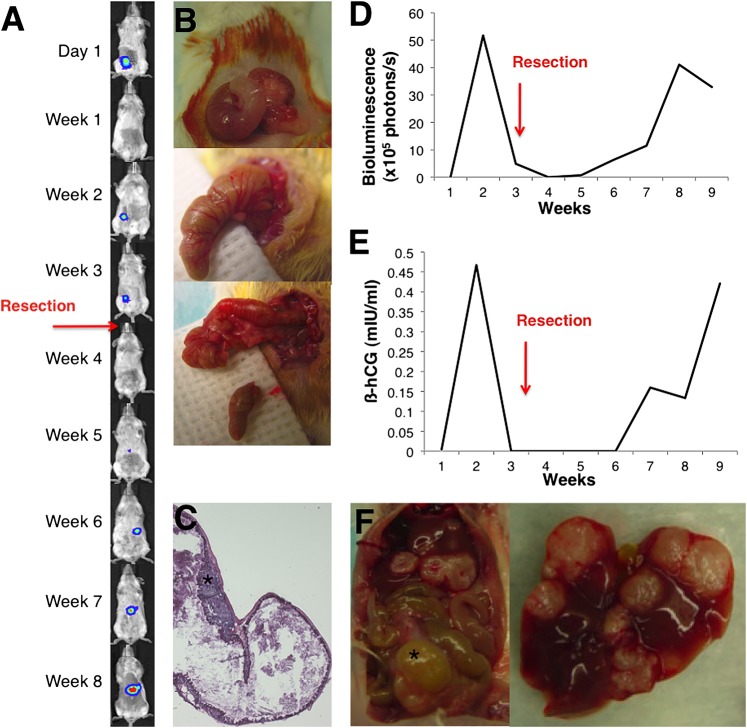
Adjuvant therapy model. (A) Bioluminescence monitoring served as non-invasive proof of successful complete tumour respectability. (B) Caecal resection: The caecum was ligated with 4/0 synthetic absorbable suture and excised. Complete tumour resection was shown by (C) H&E staining of the resected caecum including (*) tumour. (D) Quantification of bioluminescence. (E) ß-human chorionic gonadotropin levels. (F) Necropsy: nine weeks after tumour cell implantation, a local recurrence causing bowel obstruction (*) and multiple liver metastases were found.
Figure 3
Figure 3
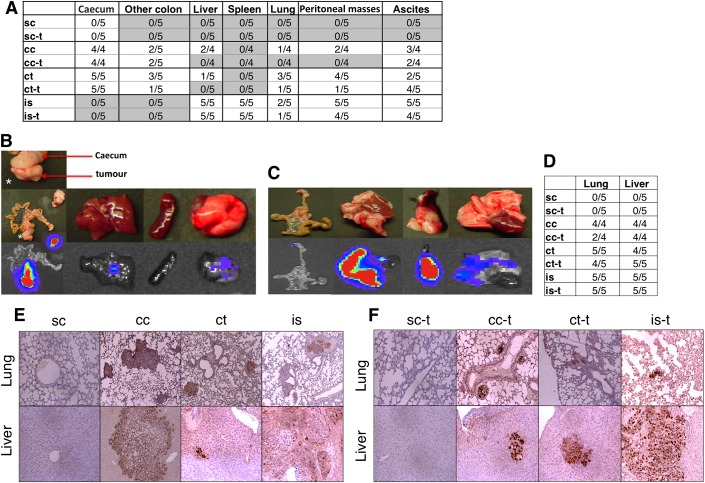
Postmortem evaluation. (A) Bioluminescence evaluation of metastasis. Treatment reduced metastatic spread after intracaecal tumour cell injection. (B) Representative photographs after caecal tumour fragment implantation and after (C) intrasplenic cell injection. (D) Microscopic quantification of metastasis after Ki67/haematoxylin staining, 100× magnification. Lungs and livers were screened for metastasis. No metastases were found in mice bearing subcutaneous tumours. After caecal cell implantation, 100% incidence of hepatic and pulmonary metastasis was found in vehicle-treated animals whereas only 50% of FOLFOX-like treated animals showed lung metastasis. After caecal tumour fragment implantation, hepatic and pulmonary metastasis was detected with no treatment effects. After intrasplenic injection, massive and treatment-resistant ‘metastasis’ was observed. Characteristic pictures are shown in (E) (untreated animals). (F) (treated animals). Refer to figure 1 and text for details of abbreviations.
Figure 4
Figure 4
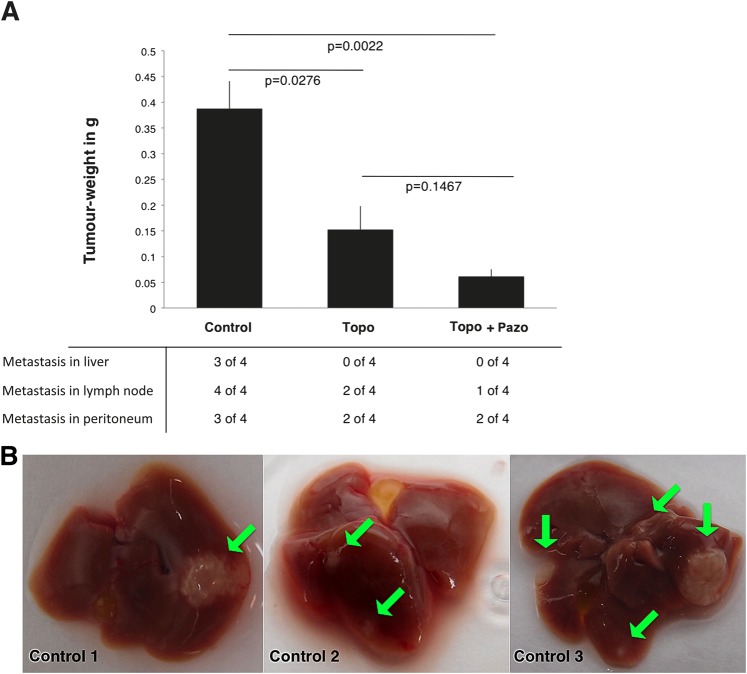
Evaluation of oral metronomic topotecan (topo). Twelve mice were orthotopically injected with HT29 human colon cancer cell and treated with control vehicle, topotecan or topotecan plus pazopanib (pazo) (n=4). Mice were sacrificed after 10 weeks. Primary tumour weights (A) and metastatic spread (B) were significantly reduced by topotecan mono- or combination therapy. Green arrows indicate hepatic metastases
Figure 5
Figure 5
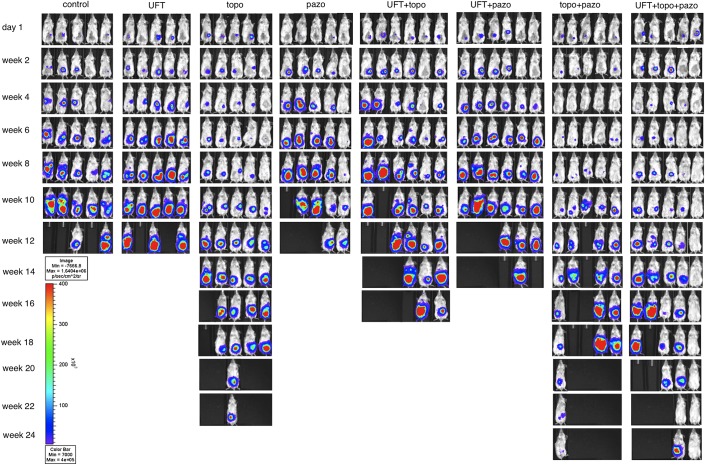
In vivo bioluminescence monitoring of orthotopic HT29.hCG.Luc tumours. All groups treated with topotecan mono- or combination therapy showed a slower increase in bioluminescence signal. pazo, pazopanib; topo, topotecan; UFT, uracil/tegafur.
Figure 6
Figure 6
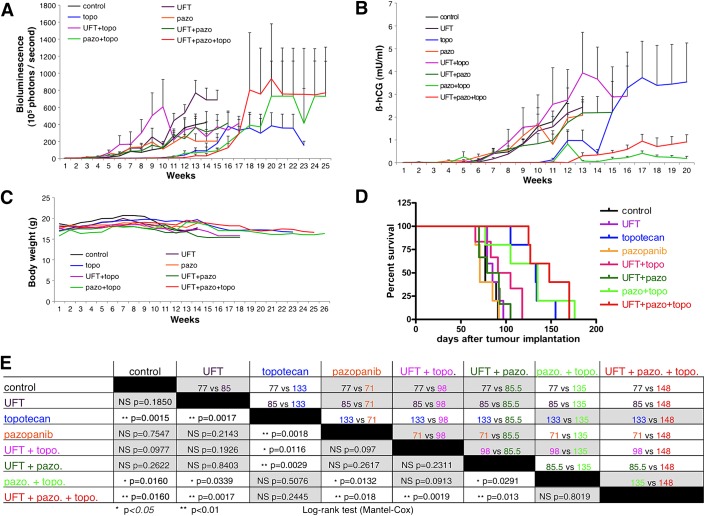
In vivo monitoring of orthotopic HT29.hCG.Luc tumours. Analysis of (A) bioluminescence, (B) ß-human chorionic gonadotropin (ß-hCG) secretion in the urine, (C) body weight. Survival curves and their statistical analyses are shown in panels D and E including p values (lower-left side) and median survival in days (upper-right side). Grey boxes contain results that are not considered significant. pazo, pazopanib; topo, topotecan; UFT, uracil/tegafur.
Figure 7
Figure 7
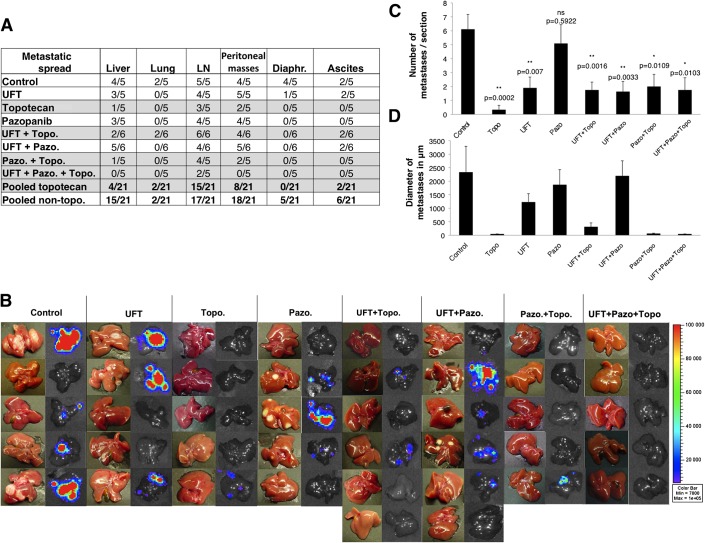
Postmortem necropsy and single-organ bioluminescence analysis of metastatic spread. Topotecan significantly reduced metastatic spread (A), most pronounced in the liver (B). Microscopic quantification of the number of hepatic metastases per section and the average diameter of metastases are shown in panels C and D. pazo, pazopanib; topo, topotecan; UFT, uracil/tegafur.

Comment in

References

    1. Parkin DM, Bray F, Ferlay J, et al. Global cancer statistics, 2002. CA Cancer J Clin 2005;55:74–108 - PubMed
    1. Donadon M, Ribero D, Morris-Stiff G, et al. New paradigm in the management of liver-only metastases from colorectal cancer. Gastrointest Cancer Res 2007;1:20–7 - PMC - PubMed
    1. Tomlinson JS, Jarnagin WR, DeMatteo RP, et al. Actual 10-year survival after resection of colorectal liver metastases defines cure. J Clin Oncol 2007;25:4575–80 - PubMed
    1. Abdalla EK, Adam R, Bilchik AJ, et al. Improving resectability of hepatic colorectal metastases: expert consensus statement. Ann Surg Oncol 2006;13:1271–80 - PubMed
    1. Pasquier E, Kavallaris M, Andre N. Metronomic chemotherapy: new rationale for new directions. Nat Rev Clin Oncol 2010;7:455–65 - PubMed

Publication types

MeSH terms

Supplementary concepts