. 2012 Sep;171(9):1339-48.
doi: 10.1007/s00431-012-1726-4. Epub 2012 Apr 29.

Hereditary angioedema (HAE) in children and adolescents--a consensus on therapeutic strategies

Affiliations

Hereditary angioedema (HAE) in children and adolescents--a consensus on therapeutic strategies

V Wahn et al. Eur J Pediatr. 2012 Sep.

Abstract

Hereditary angioedema due to C1 inhibitor (C1 esterase inhibitor) deficiency (types I and II HAE-C1-INH) is a rare disease that usually presents during childhood or adolescence with intermittent episodes of potentially life-threatening angioedema. Diagnosis as early as possible is important to avoid ineffective therapies and to properly treat swelling attacks. At a consensus meeting in June 2011, pediatricians and dermatologists from Germany, Austria, and Switzerland reviewed the currently available literature, including published international consensus recommendations for HAE therapy across all age groups. Published recommendations cannot be unconditionally adopted for pediatric patients in German-speaking countries given the current approval status of HAE drugs. This article provides an overview and discusses drugs available for HAE therapy, their approval status, and study results obtained in adult and pediatric patients. Recommendations for developing appropriate treatment strategies in the management of HAE in pediatric patients in German-speaking countries are provided.Conclusion Currently, plasma-derived C1 inhibitor concentrate is considered the best available option for the treatment of acute HAE-C1-INH attacks in pediatric patients in German-speaking countries, as well as for short-term and long-term prophylaxis.


Figures
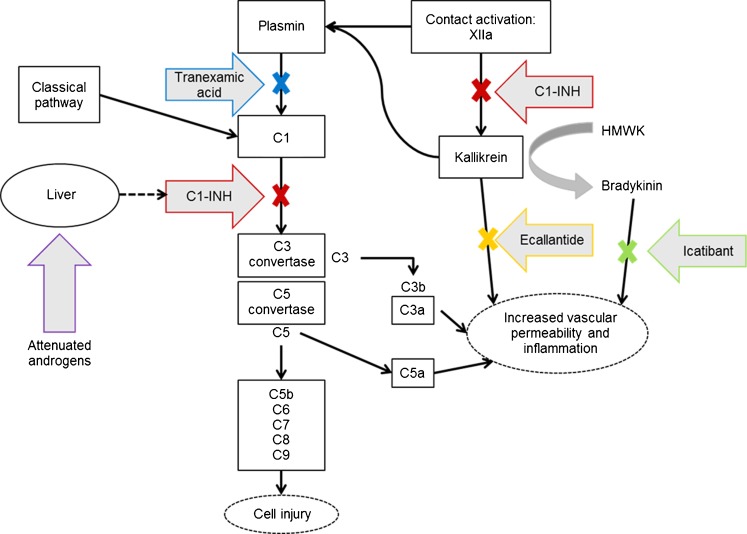
Fig. 1
Fig. 1
Mechanisms of action for therapeutic agents in treating or preventing HAE. Multiple pathways are capable of complement activation and generating inflammatory mediators including complement anaphylatoxins C3a and, more important, C5a. Activation of the final complement cascade produces a membrane attack complex that produces cellular injury. Angioedema occur after tissue injury from multiple causes. Tissue injury can activate contact activation (Hageman factor or factor XII) to generate kallikrein from prekallikrein, its precursor. Kallikrein in turn generates and activates plasmin from plasminogen, and plasmin can directly activate the C1 esterase complex to initiate complement activation. Under normal circumstances, C1-INH functions to inhibit both complement activation and, to a lesser extent, modulate contact activation. In HAE-C1-INH, because of quantitative or qualitative detective C1-INH, the pathway proceeds unchecked, generating mediators that increase capillary permeability to produce angioedema. Therapeutic approaches are directed at acutely restoring C1-INH levels, inhibiting kallikrein with ecallantide, inhibiting bradykinin with icatibant, and inhibiting plasmin with the lysine analogue tranexamic acid. Attenuated androgens have been used to increase liver synthesis of C1-INH. Figure and description have been adapted from [23]

References

    1. Bork K, Hardt J. Hereditary angioedema: increased number of attacks after frequent treatments with C1 inhibitor concentrate. Am J Med. 2009;122:780–783. doi: 10.1016/j.amjmed.2009.02.024. - DOI - PubMed
    1. Bork K, Hardt J, Schicketanz KH, Ressel N. Clinical studies of sudden upper airway obstruction in patients with hereditary angioedema due to C1 esterase inhibitor deficiency. Arch Intern Med. 2003;163:1229–1235. doi: 10.1001/archinte.163.10.1229. - DOI - PubMed
    1. Bork K, Hardt J, Staubach-Renz P, Witzke G. Risk of laryngeal edema and facial swellings after tooth extraction in patients with hereditary angioedema with and without prophylaxis with C1 inhibitor concentrate: a retrospective study. Oral Surg Oral Med Oral Pathol Oral Radiol Endod. 2011;112:58–64. doi: 10.1016/j.tripleo.2011.02.034. - DOI - PubMed
    1. Bork K, Siedlecki K, Bosch S, et al. Asphyxiation by laryngeal edema in patients with hereditary angioedema. Mayo Clin Proc. 2000;75:349–354. doi: 10.4065/75.4.349. - DOI - PubMed
    1. Bowen T. Hereditary angioedema: beyond international consensus—circa December 2010—the Canadian Society of Allergy and Clinical Immunology Dr. David McCourtie Lecture. Allergy asthma. Clin Immunol. 2011;7:1. - PMC - PubMed

Publication types

MeSH terms
