


Systematic review and mixed treatment comparison: dressings to heal diabetic foot ulcers
- PMID: 22544222
- PMCID: PMC3369130
- DOI: 10.1007/s00125-012-2558-5
Systematic review and mixed treatment comparison: dressings to heal diabetic foot ulcers
Abstract
Aims/hypothesis: Foot ulcers in people with diabetes are a common and serious global health issue. Dressings form a key part of ulcer treatment. Existing systematic reviews are limited by the lack of head-to-head comparisons of alternative dressings in a field where there are several different dressing options. We aimed to determine the relative effects of alternative wound dressings on the healing of diabetic foot ulcers.
Methods: This study was a systematic review involving Bayesian mixed treatment comparison. We included randomised controlled trials evaluating the effects on diabetic foot ulcer healing of one or more wound dressings. There were no restrictions based on language or publication status.
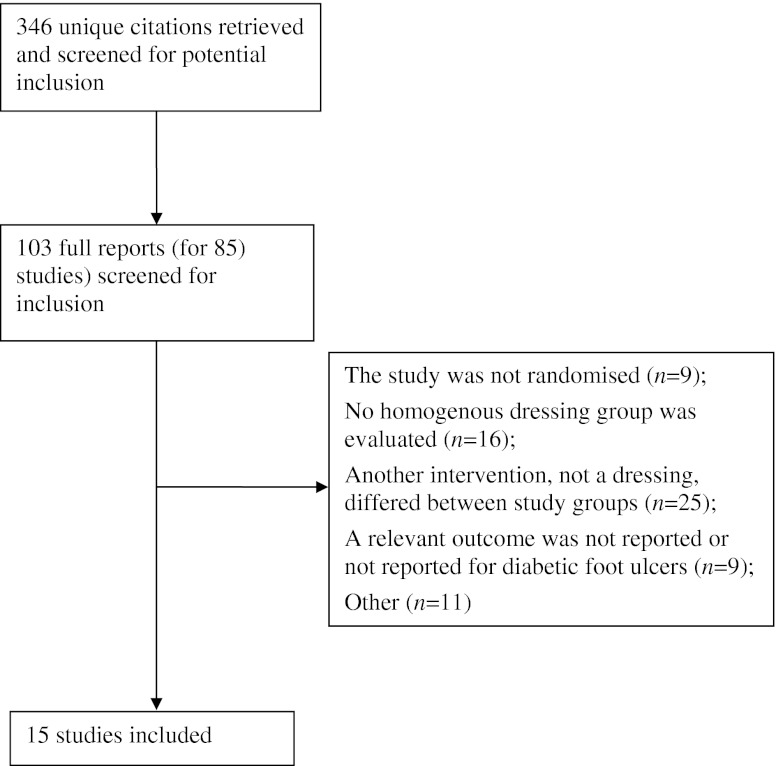
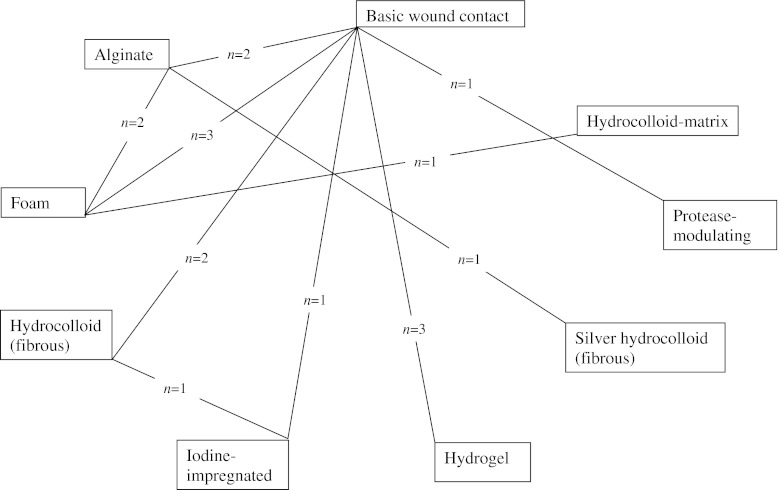
Results: Fifteen eligible studies, evaluating nine dressing types, were included. Ten direct treatment comparisons were made. Whilst there was increased healing associated with hydrogel and foam dressings compared with basic wound contact materials, these findings were based on data from small studies at unclear or high risk of bias. The mixed treatment comparison suggested that hydrocolloid-matrix dressings were associated with higher odds of ulcer healing than all other dressing types; there was a high degree of uncertainty around these estimates, which were deemed to be of very low quality.
Conclusions/interpretation: These findings summarise all available trial evidence regarding the use of dressings to heal diabetic foot ulcers. More expensive dressings may offer no advantages in terms of healing than cheaper basic dressings. In addition, evidence pointing to a difference in favour of 'advanced' dressing types over basic wound contact materials is of low or very low quality.
Figures
References
-
- Margolis D, Malay DS, Hoffstad OJ et al (2011) Prevalence of diabetes, diabetic foot ulcer, and lower extremity amputation among Medicare beneficiaries, 2006 to 2008. Diabetic Foot Ulcers. Data Points #1 (prepared by the University of Pennsylvania DEcIDE Center, under Contract No. HHSA29020050041I). AHRQ Publication No. 10(11)-EHC009-EF. Agency for Healthcare Research and Quality, Rockville, MD - PubMed
-
- Margolis D, Malay DS, Hoffstad OJ et al (2011) Economic burden of diabetic foot ulcers and amputations. Diabetic Foot Ulcers. Data Points #3 (prepared by the University of Pennsylvania DEcIDE Center, under Contract No. HHSA290200500411). AHRQ Publication No. 10(11)-EHC009-2-EF. Agency for Healthcare Research and Quality, Rockville, MD - PubMed
-
- British Medical Association and Royal Pharmaceutical Society of Great Britain (2010) British National Formulary, Sept 2010; 60, Appendix 8: Wound management Products and Elastic Hosiery. Available from bnf.org.uk/bnf/bnf/current/104946.htm, accessed 10 October 2010
-
- NHS Information Centre for Health and Social Care (2010) Prescription costs analysis England. Available from www.ic.nhs.uk/pubs/prescostanalysis2010, accessed 22 February 2011
Publication types
MeSH terms
Grants and funding
LinkOut - more resources
Full Text Sources
Medical
