


Galectins and their ligands: negative regulators of anti-tumor immunity
- PMID: 22544342
- PMCID: PMC3410977
- DOI: 10.1007/s10719-012-9379-0
Galectins and their ligands: negative regulators of anti-tumor immunity
Abstract
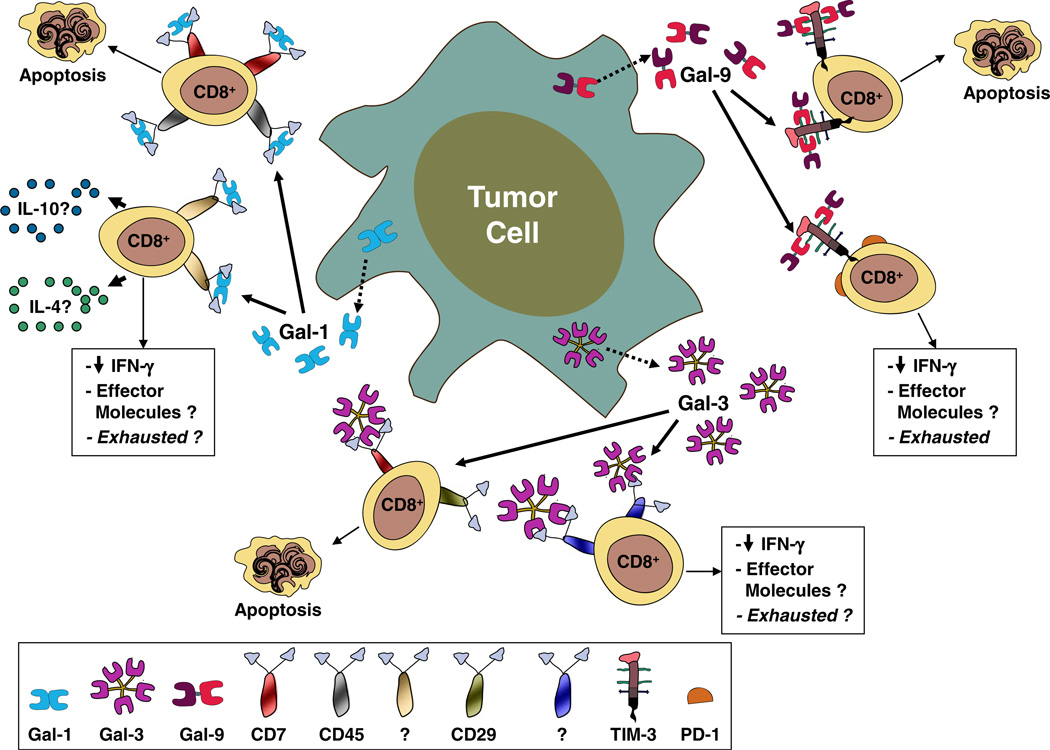
Cytotoxic CD8(+) T cells are major players of anti-tumor immune responses, as their functional activity can limit tumor growth and progression. Data show that cytotoxic T cells efficiently control the proliferation of tumor cells through major histocompatibility complex class I-mediated mechanisms; nevertheless, the presence of tumor-infiltrating CD8(+) T cells in lesional tissue does not always correlate with better prognosis and increased survival of cancer patients. Similarly, adoptive transfer of tumor-specific cytotoxic T cells has only shown marginal improvement in life spans of patients with metastatic disease. In this report, we discuss experimental evidence showing that expression of tumor-derived galectins, galectin (Gal)-1, Gal-3 and Gal-9, and concomitant presence of their ligands on the surface of anti-tumor immunocytes directly compromise anti-tumor CD8(+) T cell immune responses and, perhaps, undermine the promise of adoptive CD8(+) T cell immunotherapy. Furthermore, we describe novel strategies designed to counteract Gal-1-, Gal-3- and Gal-9-mediated effects and highlight their targeting potential for creating more effective anti-tumor immune responses. We believe that Gal and their ligands represent an efficacious targeted molecular paradigm that warrants clinical evaluation.
Figures
References
-
- Liu FT, Rabinovich GA. Galectins as modulators of tumour progression. Nat. Rev. 2005;1:29–41. - PubMed
-
- Camby I, Le Mercier M, Lefranc F, Kiss R. Galectin-1: a small protein with major functions. Glycobiology. 2006;11:137R–157R. - PubMed
-
- Zhu C, Anderson AC, Schubart A, Xiong H, Imitola J, Khoury SJ, Zheng XX, Strom TB, Kuchroo VK. The Tim-3 ligand galectin-9 negatively regulates T helper type 1 immunity. Nat. Immunol. 2005;12:1245–1252. - PubMed
-
- Dhirapong A, Lleo A, Leung P, Gershwin ME, Liu FT. The immunological potential of galectin-1 and -3. Autoimmun. Rev. 2009;5:360–363. - PubMed
-
- Saussez S, Glinoer D, Chantrain G, Pattou F, Carnaille B, Andre S, Gabius HJ, Laurent G. Serum galectin-1 and galectin-3 levels in benign and malignant nodular thyroid disease. Thyroid. 2008;7:705–712. - PubMed
Publication types
MeSH terms
Substances
Grants and funding
LinkOut - more resources
Full Text Sources
Other Literature Sources
Research Materials
