


Clinicopathologic features, patterns of recurrence, and survival among women with triple-negative breast cancer in the National Comprehensive Cancer Network
- PMID: 22544643
- PMCID: PMC3611659
- DOI: 10.1002/cncr.27581
Clinicopathologic features, patterns of recurrence, and survival among women with triple-negative breast cancer in the National Comprehensive Cancer Network
Abstract
Background: The objective of this study was to describe clinicopathologic features, patterns of recurrence, and survival according to breast cancer subtype with a focus on triple-negative tumors.
Methods: In total, 15,204 women were evaluated who presented to National Comprehensive Cancer Network centers with stage I through III breast cancer between January 2000 and December 2006. Tumors were classified as positive for estrogen receptor (ER) and/or progesterone receptor (PR) (hormone receptor [HR]-positive) and negative for human epidermal growth factor receptor 2 (HER2); positive for HER2 and any ER or PR status (HER2-positive); or negative for ER, PR, and HER2 (triple-negative).
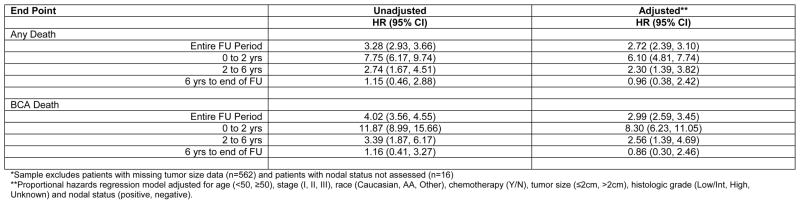
Results: Subtype distribution was triple-negative in 17% of women (n = 2569), HER2-positive in 17% of women (n = 2602), and HR-positive/HER2-negative in 66% of women (n = 10,033). The triple-negative subtype was more frequent in African Americans compared with Caucasians (adjusted odds ratio, 1.98; P < .0001). Premenopausal women, but not postmenopausal women, with high body mass index had an increased likelihood of having the triple-negative subtype (P = .02). Women with triple-negative cancers were less likely to present on the basis of an abnormal screening mammogram (29% vs 48%; P < .0001) and were more likely to present with higher tumor classification, but they were less likely to have lymph node involvement. Relative to HR-positive/HER2-negative tumors, triple-negative tumors were associated with a greater risk of brain or lung metastases; and women with triple-negative tumors had worse breast cancer-specific and overall survival, even after adjusting for age, disease stage, race, tumor grade, and receipt of adjuvant chemotherapy (overall survival: adjusted hazard ratio, 2.72; 95% confidence interval, 2.39-3.10; P < .0001). The difference in the risk of death by subtype was most dramatic within the first 2 years after diagnosis (overall survival for 0-2 years: OR, 6.10; 95% confidence interval, 4.81-7.74).
Conclusions: Triple-negative tumors were associated with unique risk factors and worse outcomes compared with HR-positive/HER2-negative tumors.
Copyright © 2012 American Cancer Society.
Figures

References
-
- Perou CM, Sorlie T, Eisen MB, van de Rijn M, Jeffrey SS, Rees CA, et al. Molecular portraits of human breast tumours. Nature. 2000;406(6797):747–52. Available from http://www.ncbi.nlm.nih.gov/entrez/query.fcgi?cmd=Retrieve&db=PubMed&dop.... - PubMed
-
- Kreike B, van Kouwenhove M, Horlings H, Weigelt B, Peterse H, Bartelink H, et al. Gene expression profiling and histopathological characterization of triple-negative/basal-like breast carcinomas. Breast Cancer Res. 2007;9(5):R65. Available from http://www.ncbi.nlm.nih.gov/entrez/query.fcgi?cmd=Retrieve&db=PubMed&dop.... - PMC - PubMed
-
- Schneider BP, Winer EP, Foulkes WD, Garber J, Perou CM, Richardson A, et al. Triple-negative breast cancer: risk factors to potential targets. Clin Cancer Res. 2008;14(24):8010–8. Available from http://www.ncbi.nlm.nih.gov/entrez/query.fcgi?cmd=Retrieve&db=PubMed&dop.... - PubMed
-
- Carey LA, Perou CM, Livasy CA, Dressler LG, Cowan D, Conway K, et al. Race, breast cancer subtypes, and survival in the Carolina Breast Cancer Study. Jama. 2006;295(21):2492–502. Available from http://www.ncbi.nlm.nih.gov/entrez/query.fcgi?cmd=Retrieve&db=PubMed&dop.... - PubMed
-
- Yang XR, Sherman ME, Rimm DL, Lissowska J, Brinton LA, Peplonska B, et al. Differences in risk factors for breast cancer molecular subtypes in a population-based study. Cancer Epidemiol Biomarkers Prev. 2007;16(3):439–43. Available from http://www.ncbi.nlm.nih.gov/entrez/query.fcgi?cmd=Retrieve&db=PubMed&dop.... - PubMed
Publication types
MeSH terms
Substances
Grants and funding
LinkOut - more resources
Full Text Sources
Other Literature Sources
Medical
Research Materials
Miscellaneous
