Review
. 2012 Jul 15;590(14):3219-30.
doi: 10.1113/jphysiol.2012.229864. Epub 2012 Apr 30.

'Autonomic conflict': a different way to die during cold water immersion?

Affiliations
Review

'Autonomic conflict': a different way to die during cold water immersion?

Michael J Shattock et al. J Physiol. .

Abstract

Cold water submersion can induce a high incidence of cardiac arrhythmias in healthy volunteers. Submersion and the release of breath holding can activate two powerful and antagonistic responses: the 'cold shock response' and the 'diving response'. The former involves the activation of a sympathetically driven tachycardia while the latter promotes a parasympathetically mediated bradycardia. We propose that the strong and simultaneous activation of the two limbs of the autonomic nervous system ('autonomic conflict') may account for these arrhythmias and may, in some vulnerable individuals, be responsible for deaths that have previously wrongly been ascribed to drowning or hypothermia. In this review, we consider the evidence supporting this claim and also hypothesise that other environmental triggers may induce autonomic conflict and this may be more widely responsible for sudden death in individuals with other predisposing conditions.


Figures
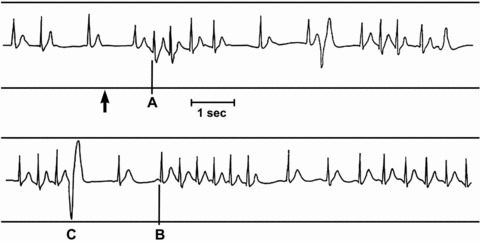
Figure 1
Figure 1. ECG trace during submersion
The end of breath hold is indicated by the arrow: supraventricular extrasystoles (A), run of supraventricular tachycardia (B) and premature ventricular complex (C) (reproduced with permission from the Undersea & Hyperbaric Medical Society, from Tipton et al. (1994)).
Figure 2
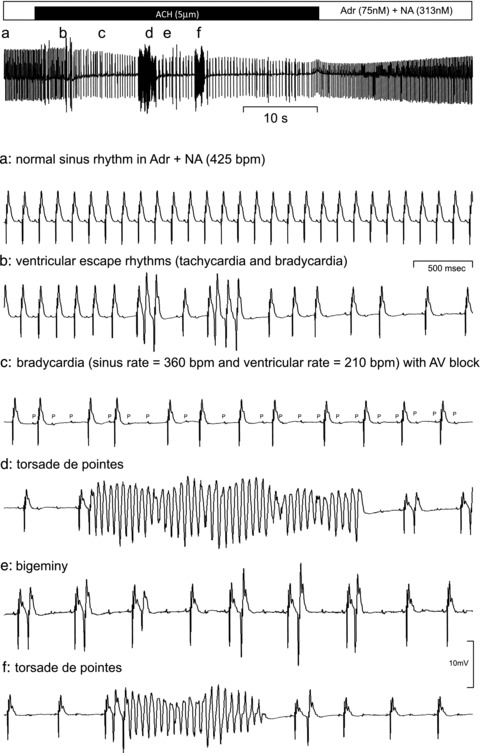
Figure 2. An example of an epicardial ECG recorded from an isolated rat heart during simulated autonomic conflict
The heart was perfused with a constant background concentration of adrenaline (75 nm) and noradrenaline (313 nm) and a 1 min period of acetylcholine (ACh: 5 μm) was superimposed as indicated. The top trace shows a slow time-base recording and the arrhythmias recorded at the points marked a–f on this trace are expanded below.
Figure 3
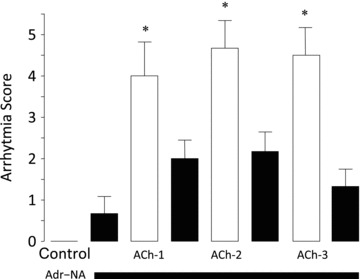
Figure 3. Total arrhythmia score for three successive periods of simulated autonomic conflict in isolated rat hearts
Hearts were perfused with a constant background concentration of adrenaline (75 nm) and noradrenaline (313 nm) and then three 1-min periods of acetylcholine (ACh) were superimposed separated by 3 min of ACh washout. Arrhythmia scoring: (1) AV block, (2) ventricular premature beats, (3) bigeminy, (4) salvo, (5) ventricular tachycardia, (6) ventricular fibrillation, (7) torsades de pointes. *P < 0.05 when compared with the immediately preceding adrenaline/noradrenaline perfusion period. Data are means ± SEM (n= 6).
Figure 4
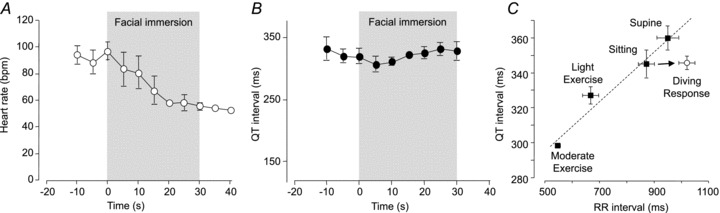
Figure 4. Heart rate changes (A) and QT interval (B) measured during the activation of the diving response elicited by a 30 s facial immersion in cold water (12°C) with breath-hold
Participants were young, healthy volunteers (n= 4). C, relationship between the QT interval of the ECG and prevailing hearts rate (RR interval) in healthy male participants during mild and moderate exercise, while sitting, supine or after 30 s of facial immersion with apnoea (diving response). The nomogram described by the filled symbols is fitted with a straight line: QT (ms) = (0.14 × RR) + 225. Data are expressed as means ± SEM (n= 10) and r2 for the regression line is 0.9592. C reproduced with permission from Wong et al. (2009).
Figure 5
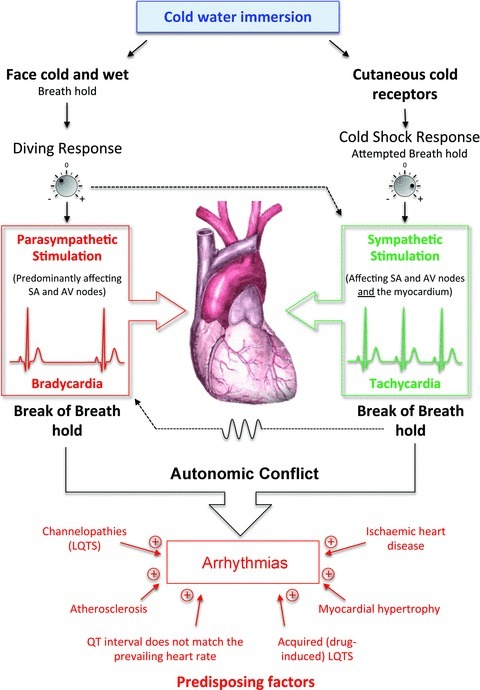
Figure 5. Autonomic conflict
Cold water immersion activates two powerful reflexes – the diving response (on facial immersion) and the cold shock response (on the activation of cutaneous cold receptors). The magnitudes of these responses can vary with a range of factors including water temperature, clothing and habituation. Individually, the diving response triggers a parasympathetically driven bradycardia while cold shock activates a sympathetically driven tachycardia. We hypothesise that together these conflicting inputs to the heart can lead to arrhythmias – particularly at the break of breath hold which increases parasymypathetic tone that varies with respiration. The substrate for arrhythmias is enhanced by various predisposing factors including the failure of the QT interval to match the rapid and transient changes in heart rate. In circumstances other than cold water immersion these may additionally include awakening, anger, stress, arousal etc.

References

    1. Ackerman MJ, Tester DJ, Porter CJ. Swimming, a gene-specific arrhythmogenic trigger for inherited long QT syndrome. Mayo Clin Proc. 1999;74:1088–1094. - PubMed
    1. Angell-James JE, de Burgh Daly M. Some aspects of upper respiratory tract reflexes. Acta Otolaryngol. 1975;79:242–252. - PubMed
    1. Arnold RW. Extremes in human breath hold, facial immersion bradycardia. Undersea Biomed Res. 1985;12:183–190. - PubMed
    1. Arnold L, Page J, Attwell D, Cannell M, Eisner DA. The dependence on heart rate of the human ventricular action potential duration. Cardiovasc Res. 1982;16:547–551. - PubMed
    1. Baharav A, Kotagal S, Gibbons V, Rubin BK, Pratt G, Karin J, Akselrod S. Fluctuations in autonomic nervous activity during sleep displayed by power spectrum analysis of heart rate variability. Neurology. 1995;45:1183–1187. - PubMed