


Outcomes of endodontic therapy in general practice: a study by the Practitioners Engaged in Applied Research and Learning Network
- PMID: 22547719
- PMCID: PMC4394182
- DOI: 10.14219/jada.archive.2012.0208
Outcomes of endodontic therapy in general practice: a study by the Practitioners Engaged in Applied Research and Learning Network
Abstract
Background: The authors undertook a study involving members of a dental practice-based research network to determine the outcome and factors associated with success and failure of endodontic therapy.
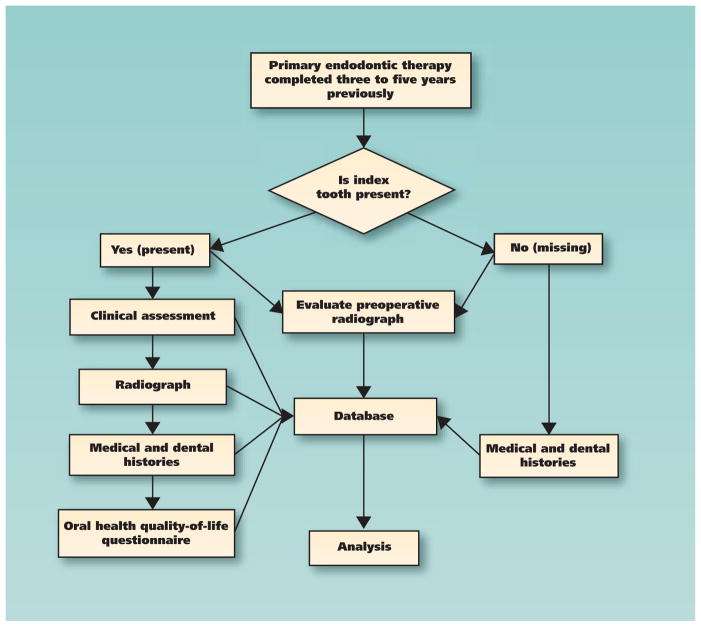
Methods: Members in participating practices (practitioner-investigators [P-Is]) invited the enrollment of all patients seeking treatment in the practice who had undergone primary endodontic therapy and restoration in a permanent tooth three to five years previously. If a patient had more than one tooth so treated, the P-I selected as the index tooth the tooth treated earliest during the three- to five-year period. The authors excluded from the study any teeth that served as abutments for removable partial dentures or overdentures, third molars and teeth undergoing active orthodontic endodontic therapy. The primary outcome was retention of the index tooth. Secondary outcomes, in addition to extraction, that defined failure included clinical or radiographic evidence (or both) of periapical pathosis, endodontic retreatment or pain on percussion.
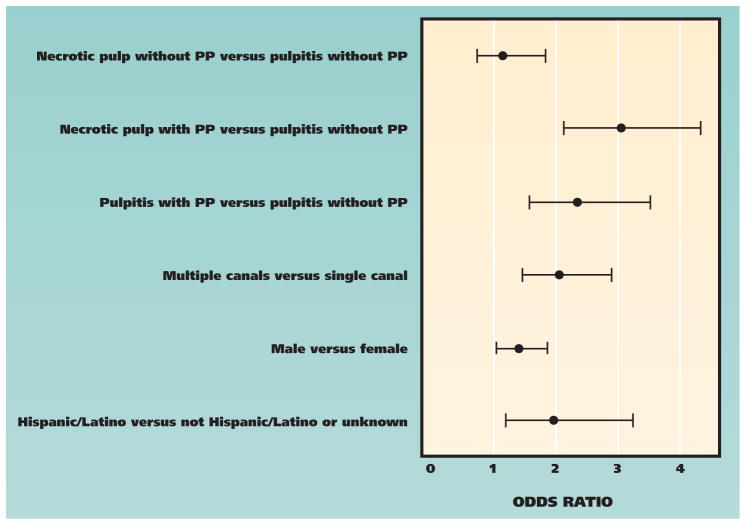
Results: P-Is in 64 network practices enrolled 1,312 patients with a mean (standard deviation) time to follow-up of 3.9 (0.6) years. During that period, 3.3 percent of the index teeth were extracted, 2.2 percent underwent retreatment, 3.6 percent had pain on percussion and 10.6 percent had periapical radiolucencies for a combined failure rate of 19.1 percent. The presence of preoperative periapical radiolucency with a diagnosis of either irreversible pulpitis or necrotic pulp was associated with failure after multivariate analysis, as were multiple canals, male sex and Hispanic/Latino ethnicity.
Conclusions: These results suggest that failure rates for endodontic therapy are higher than previously reported in general practices, according to results of studies based on dental insurance claims data.
Clinical implications: The results of this study can help guide the practitioner in deciding the most appropriate course of therapy for teeth with irreversible pulpitis, necrotic pulp or periapical periodontitis.
Figures
Comment in
-
Endodontic outcomes.J Am Dent Assoc. 2012 Sep;143(9):963-4; author reply 964-5. doi: 10.14219/jada.archive.2012.0310. J Am Dent Assoc. 2012. PMID: 22942138 No abstract available.
-
More about Outcomes.J Am Dent Assoc. 2012 Sep;143(9):965-6; author reply 966-7. doi: 10.14219/jada.archive.2012.0312. J Am Dent Assoc. 2012. PMID: 22942140 No abstract available.
-
Endodontics in general practice.J Am Dent Assoc. 2012 Oct;143(10):1071-2; author reply 1072. doi: 10.14219/jada.archive.2012.0027. J Am Dent Assoc. 2012. PMID: 23024301 No abstract available.
References
-
- Ng YL, Mann V, Rahbaran S, Lewsey J, Gulabivala K. Outcome of primary root canal therapy: systematic review of the literature, part 1: effects of study characteristics on probability of success (published online ahead of print Oct. 10, 2007) Int Endod J. 2007;40(12):921–939. doi: 10.1111/j.1365-2591.2007.01322.x. - DOI - PubMed
-
- Torabinejad M, Anderson P, Bader J, et al. Outcomes of root canal treatment and restoration, implant-supported single crowns, fixed partial dentures, and extraction without replacement: a systematic review. J Prosthet Dent. 2007;98(4):285–311. - PubMed
-
- Lazarski MP, Walker WA, 3rd, Flores CM, Schindler WG, Hargreaves KM. Epidemiological evaluation of the outcomes of nonsurgical root canal treatment in a large cohort of insured dental patients. J Endod. 2001;27(12):791–796. - PubMed
-
- Salehrabi R, Rotstein I. Endodontic treatment outcomes in a large patient population in the USA: an epidemiological study. J Endod. 2004;30(12):846–850. - PubMed
Publication types
MeSH terms
Grants and funding
LinkOut - more resources
Full Text Sources
Research Materials
Miscellaneous
