Comparative Study
. 2012 May 15;109(20):7729-34.
doi: 10.1073/pnas.1120251109. Epub 2012 Apr 30.

Mycobacterium tuberculosis Eis protein initiates suppression of host immune responses by acetylation of DUSP16/MKP-7

Affiliations
Comparative Study

Mycobacterium tuberculosis Eis protein initiates suppression of host immune responses by acetylation of DUSP16/MKP-7

Kyoung Hoon Kim et al. Proc Natl Acad Sci U S A. .

Abstract

The intracellular pathogen Mycobacterium tuberculosis (Mtb) causes tuberculosis. Enhanced intracellular survival (Eis) protein, secreted by Mtb, enhances survival of Mycobacterium smegmatis (Msm) in macrophages. Mtb Eis was shown to suppress host immune defenses by negatively modulating autophagy, inflammation, and cell death through JNK-dependent inhibition of reactive oxygen species (ROS) generation. Mtb Eis was recently demonstrated to contribute to drug resistance by acetylating multiple amines of aminoglycosides. However, the mechanism of enhanced intracellular survival by Mtb Eis remains unanswered. Therefore, we have characterized both Mtb and Msm Eis proteins biochemically and structurally. We have discovered that Mtb Eis is an efficient N(ε)-acetyltransferase, rapidly acetylating Lys55 of dual-specificity protein phosphatase 16 (DUSP16)/mitogen-activated protein kinase phosphatase-7 (MKP-7), a JNK-specific phosphatase. In contrast, Msm Eis is more efficient as an N(α)-acetyltransferase. We also show that Msm Eis acetylates aminoglycosides as readily as Mtb Eis. Furthermore, Mtb Eis, but not Msm Eis, inhibits LPS-induced JNK phosphorylation. This functional difference against DUSP16/MKP-7 can be understood by comparing the structures of two Eis proteins. The active site of Mtb Eis with a narrow channel seems more suitable for sequence-specific recognition of the protein substrate than the pocket-shaped active site of Msm Eis. We propose that Mtb Eis initiates the inhibition of JNK-dependent autophagy, phagosome maturation, and ROS generation by acetylating DUSP16/MKP-7. Our work thus provides insight into the mechanism of suppressing host immune responses and enhancing mycobacterial survival within macrophages by Mtb Eis.


Conflict of interest statement

The authors declare no conflict of interest.

Figures
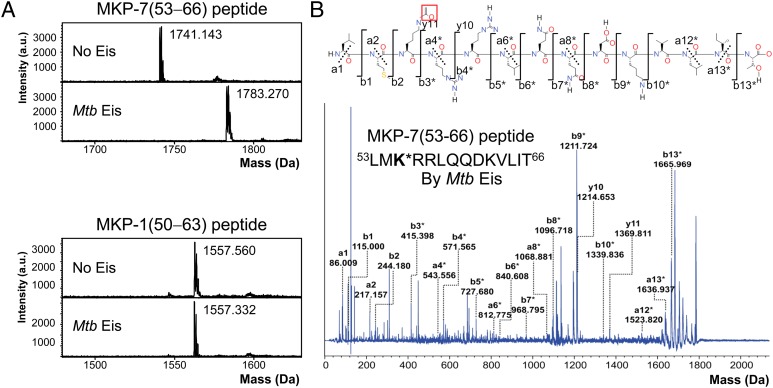
Fig. 1.
Fig. 1.
Acetyltransferase assay of Mtb Eis using MKP-7(53−66) and MKP-1(50−63) peptides by mass spectrometry. (A) Mass spectra of the MKP-7(53−66) peptide before and after acetylation reaction by Mtb Eis (Upper). The observed increase in the peptide mass by 42 Da indicates that the peptide is acetylated at a single site. Mass spectra of the MKP-1(50−63) peptide before and after acetylation reaction by Mtb Eis (Lower) indicate that this peptide is not acetylated by Mtb Eis. (B) MALDI MS/MS spectrum of the MKP-7(53−66) peptide acetylated by Mtb Eis. The fragments marked with an asterisk (*) are +42 Da-shifted ions, compared with the counterparts that would be generated from the unmodified peptide. The acetylated MKP-7(53−66) fragmentation notation using the scheme of Roepstorff and Fohlman (45) is given above the spectrum. The acetyl group of modified Lys55 is highlighted by enclosing in a red box.
Fig. 2.
Fig. 2.
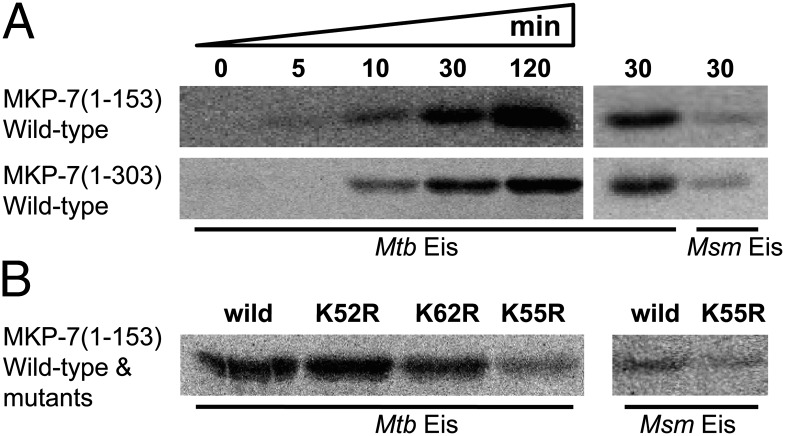
Acetyltransferase activity assay of Mtb Eis and Msm Eis using the recombinant human DUSP/MKP-7(1−153) and DUSP/MKP-7(1−303) proteins as potential substrates. (A) Time-course acetyltransferase activity assay of Mtb Eis and a comparison of Mtb Eis and Msm Eis activities. The wild-type DUSP16/MKP-7(1−153) and DUSP/MKP-7(1−303) were incubated with [14C]-labeled acetyl CoA and Eis for the indicated duration at 37 °C. The reaction products were separated by 15% (wt/vol) SDS/PAGE, and the acetylated protein bands were visualized using a Bioimage analyzer. (B) Acetyltransferase activity of Mtb Eis and Msm Eis toward the wild-type and mutants of DUSP16/MKP-7(1−153). All reactions were carried out at 37 °C for 30 min.
Fig. 3.
Fig. 3.
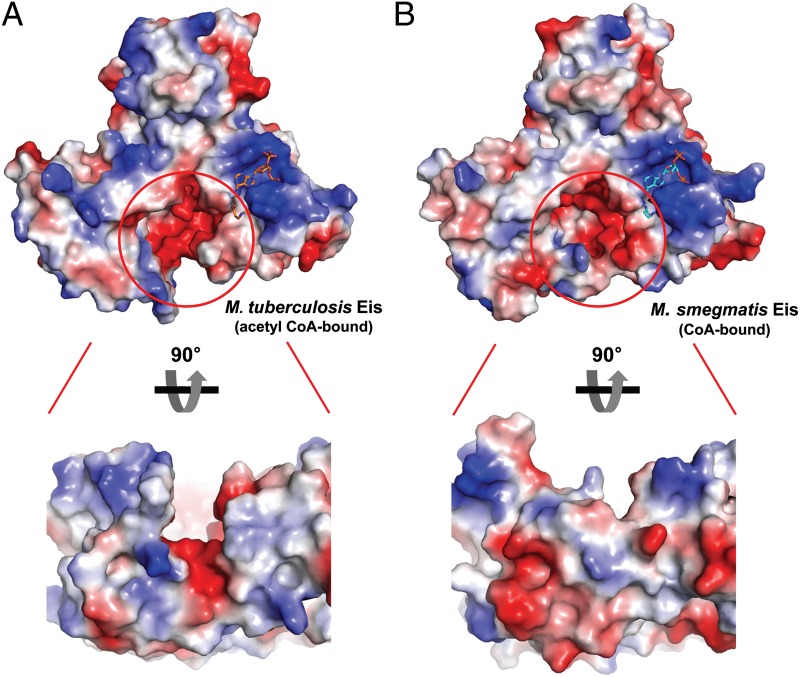
Comparison of Mtb and Msm Eis monomers. (A) Electrostatic potential at the surface of Mtb Eis monomer, with an enlarged view from an orthogonal angle. (B) Electrostatic potential at the surface of Msm Eis monomer, with an enlarged view from an orthogonal angle. Blue and red correspond to positive and negative potentials, respectively. Red circles indicate possible substrate binding sites of Mtb and Msm Eis.
Fig. 4.
Fig. 4.
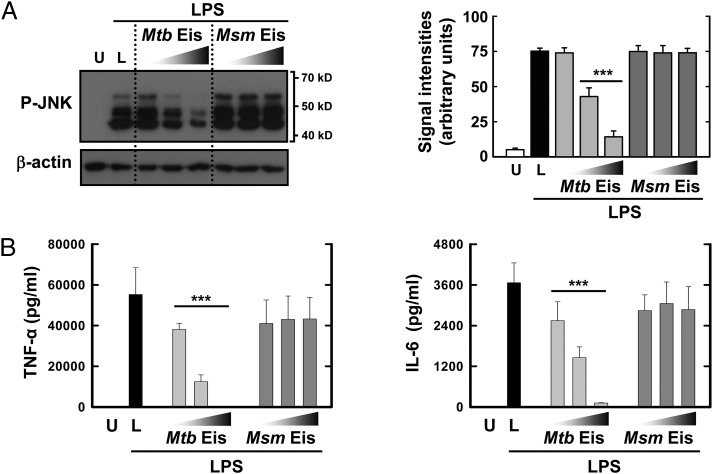
Effects of Mtb Eis on JNK activation and cytokine production in BMDM cells. (A) Mtb Eis, but not Msm Eis, suppresses JNK activation in BMDM cells upon LPS stimulation. Cells were treated with or without Mtb Eis (or Msm Eis) (5, 10, or 20 μg mL−1) for 1 h, followed by stimulation with LPS (100 ng mL−1) for 30 min. Cells were then harvested, lysed, and subjected to Western blot analysis using antibodies raised to phospho-JNK and β-actin. Data shown are representative of three independent experiments that all yielded similar results. Expression of phospho-JNK and β-actin in cytoplasmic extracts of BMDMs was quantified densitometrically (Right). Data represent the mean ± SD of three independent experiments. ***P < 0.001 vs. LPS-stimulated condition. U, LPS-untreated; L, LPS-treated condition without Mtb Eis or Msm Eis. (B) Mtb Eis, but not Msm Eis, suppresses proinflammatory cytokine production in BMDM cells upon LPS stimulation. Cells were treated with or without Mtb Eis (or Msm Eis) (5, 10, or 20 μg mL−1) for 1 h, followed by stimulation with LPS (100 ng mL−1) for 18 h. Supernatants were harvested, and the levels of TNF-α and IL-6 were measured by ELISA.

References

    1. Dye C, Williams BG. The population dynamics and control of tuberculosis. Science. 2010;328:856–861. - PubMed
    1. Chiang CY, Centis R, Migliori GB. Drug-resistant tuberculosis: Past, present, future. Respirology. 2010;15:413–432. - PubMed
    1. Dahl JL, Wei J, Moulder JW, Laal S, Friedman RL. Subcellular localization of the Iitracellular survival-enhancing Eis protein of Mycobacterium tuberculosis. Infect Immun. 2001;69:4295–4302. - PMC - PubMed
    1. Lin PL, Flynn JL. Understanding latent tuberculosis: A moving target. J Immunol. 2010;185:15–22. - PMC - PubMed
    1. Getahun H, Gunneberg C, Granich R, Nunn P. HIV infection-associated tuberculosis: The epidemiology and the response. Clin Infect Dis. 2010;50(Suppl 3):S201–S207. - PubMed

Publication types

MeSH terms

Substances