


The Rapid TEG α-Angle may be a sensitive predictor of transfusion in moderately injured blunt trauma patients
- PMID: 22547997
- PMCID: PMC3322428
- DOI: 10.1100/2012/821794
The Rapid TEG α-Angle may be a sensitive predictor of transfusion in moderately injured blunt trauma patients
Abstract
Background: To guide the administration of blood products, coagulation screening of trauma patients should be fast and accurate. The purpose of this study was to identify the correlation between CCT and TEG in trauma, to determine which CCT or TEG parameter is most sensitive in predicting transfusion in trauma, and to define TEG cut-off points for trauma care.
Methods: A six-month, prospective observational study of 76 adult patients with suspected multiple injuries was conducted at a Level 1 trauma centre of a university hospital. Physicians blinded to TEG results made the decision to transfuse based on clinical evaluation.
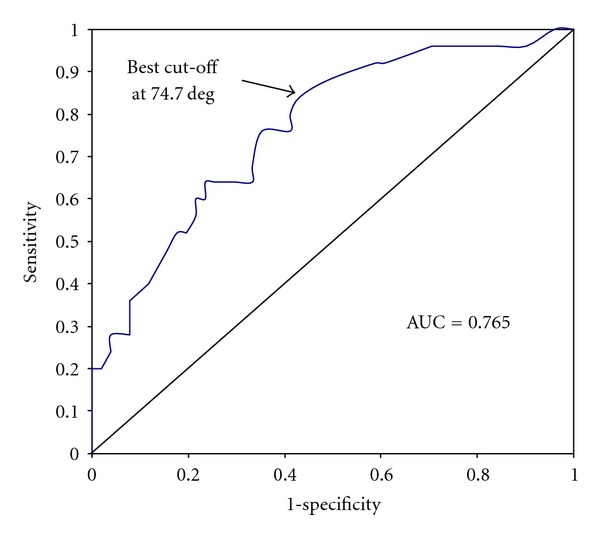
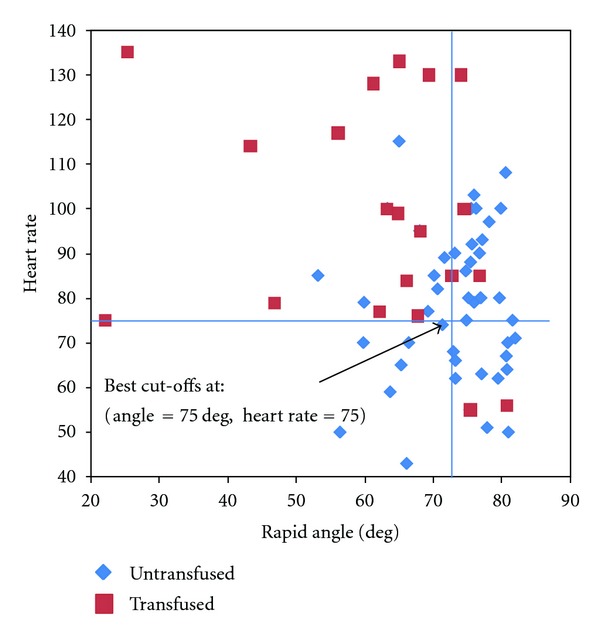
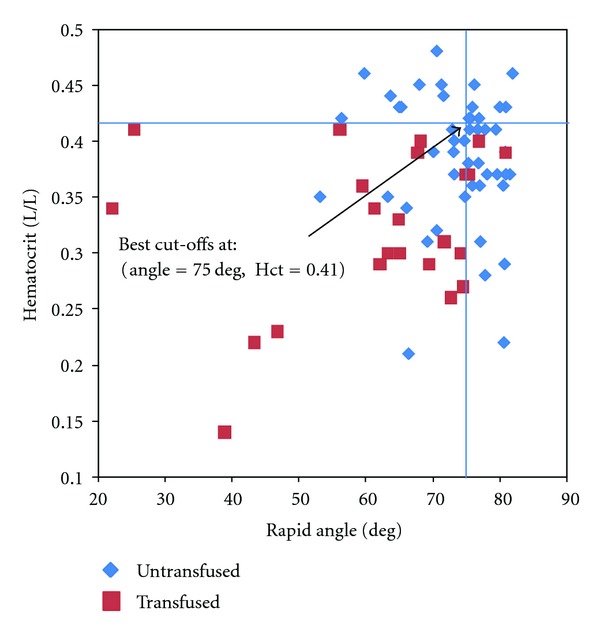
Results: The study results showed that conventional coagulation tests correlate moderately with Rapid TEG parameters (R: 0.44-0.61). Kaolin and Rapid TEG were more sensitive than CCTs, and the Rapid TEG α-Angle was identified as the single parameter with the greatest sensitivity (84%) and validity (77%) at a cut-off of 74.7 degrees. When the Rapid TEG α-Angle was combined with heart rate >75 bpm, or haematocrit < 41%, sensitivity (84%, 88%) and specificity (75%, 73%) were improved.
Conclusion: Cutoff points for transfusion can be determined with the Rapid TEG α-Angle and can provide better sensitivity than CCTs, but a larger study population is needed to reproduce this finding.
Figures
References
-
- Davenport R, Curry N, Manson J, et al. Hemostatic effects of fresh frozen plasma may be maximal at red cell ratios of 1:2. Journal of Trauma. 2011;70(1):90–96. - PubMed
-
- Mitra B, Cameron PA, Mori A, Fitzgerald M. Acute coagulopathy and early deaths post major trauma. Injury. In press. - PubMed
-
- Jeger V, Urwyler N, Zimmermann H, Exadaktylos AK. Trauma-induced coagulopathy in severely injured patients: knowledge lost in translation? Emergency Medicine Journal. 2010;27(7):551–552. - PubMed
Publication types
MeSH terms
LinkOut - more resources
Full Text Sources
Medical
