. 2012 May 1;4(5):41.
doi: 10.1186/gm340.

Gene regulatory network inference: evaluation and application to ovarian cancer allows the prioritization of drug targets

Affiliations

Gene regulatory network inference: evaluation and application to ovarian cancer allows the prioritization of drug targets

Piyush B Madhamshettiwar et al. Genome Med. .

Abstract

Background: Altered networks of gene regulation underlie many complex conditions, including cancer. Inferring gene regulatory networks from high-throughput microarray expression data is a fundamental but challenging task in computational systems biology and its translation to genomic medicine. Although diverse computational and statistical approaches have been brought to bear on the gene regulatory network inference problem, their relative strengths and disadvantages remain poorly understood, largely because comparative analyses usually consider only small subsets of methods, use only synthetic data, and/or fail to adopt a common measure of inference quality.

Methods: We report a comprehensive comparative evaluation of nine state-of-the art gene regulatory network inference methods encompassing the main algorithmic approaches (mutual information, correlation, partial correlation, random forests, support vector machines) using 38 simulated datasets and empirical serous papillary ovarian adenocarcinoma expression-microarray data. We then apply the best-performing method to infer normal and cancer networks. We assess the druggability of the proteins encoded by our predicted target genes using the CancerResource and PharmGKB webtools and databases.

Results: We observe large differences in the accuracy with which these methods predict the underlying gene regulatory network depending on features of the data, network size, topology, experiment type, and parameter settings. Applying the best-performing method (the supervised method SIRENE) to the serous papillary ovarian adenocarcinoma dataset, we infer and rank regulatory interactions, some previously reported and others novel. For selected novel interactions we propose testable mechanistic models linking gene regulation to cancer. Using network analysis and visualization, we uncover cross-regulation of angiogenesis-specific genes through three key transcription factors in normal and cancer conditions. Druggabilty analysis of proteins encoded by the 10 highest-confidence target genes, and by 15 genes with differential regulation in normal and cancer conditions, reveals 75% to be potential drug targets.

Conclusions: Our study represents a concrete application of gene regulatory network inference to ovarian cancer, demonstrating the complete cycle of computational systems biology research, from genome-scale data analysis via network inference, evaluation of methods, to the generation of novel testable hypotheses, their prioritization for experimental validation, and discovery of potential drug targets.


Figures
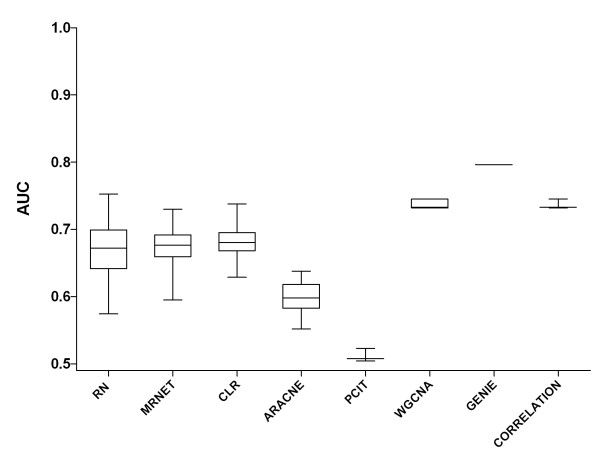
Figure 1
Figure 1
Parameter optimization of methods. Comparison of unsupervised GRNI (gene regulatory network inference) methods using the DREAM4 multifactorial dataset. Each boxplot represents variation in prediction accuracy over the different parameter values used for optimization. With GENIE (Gene Network Inference with Ensemble of Trees), no parameter was found useful for optimization, so it was used with default settings. For information on the complete parameter sweep see Figure S1 in Additional file 3.
Figure 2
Figure 2
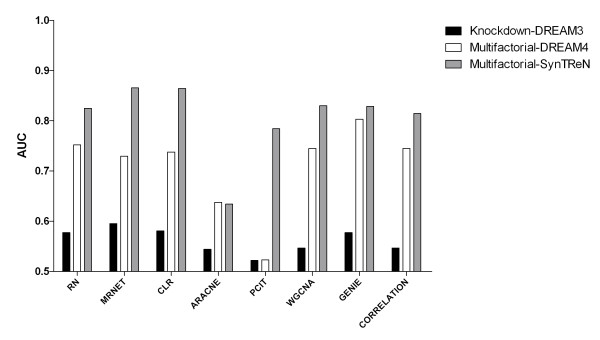
Accuracies of gene regulatory network inference methods on two different data types. Comparison of unsupervised GRNI methods on two different data types, knockdown, and multifactorial with 100 genes and 100 samples.
Figure 3
Figure 3
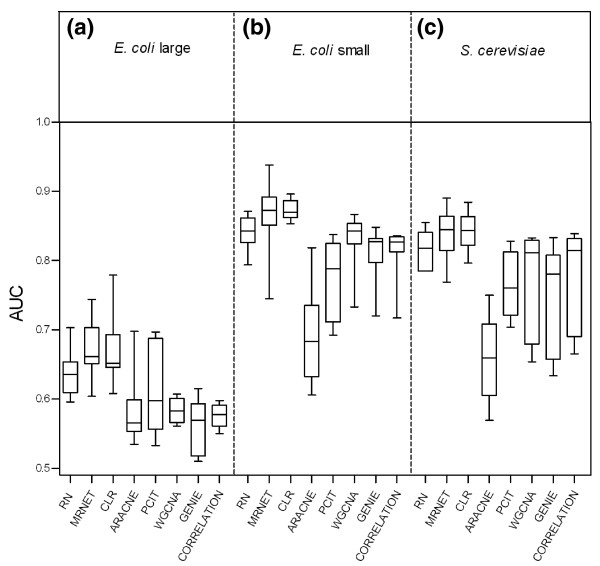
Accuracies of gene regulatory network inference methods on different networks. (a-c) Comparison of accuracies (AUCs) of unsupervised GRNI methods on the sub-networks extracted from three source networks: E. coli large (a), E. coli small (b), and S. cerevisiae (c). Each boxplot represents variation in the accuracy of that method obtained using optimal parameter settings for each of the 12 datasets generated by SynTReN. The highest accuracies were achieved on the small E. coli networks.
Figure 4
Figure 4
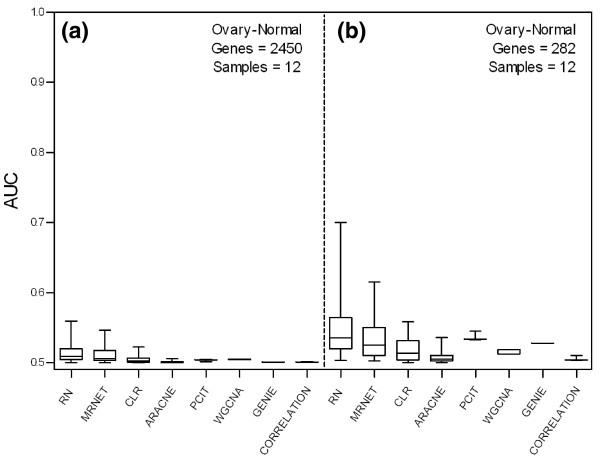
Accuracies of gene regulatory network inference methods on empirical data. Accuracies (AUCs) of unsupervised GRNI methods on normal ovarian microarray data. (a) Prediction accuracy of methods on normal ovarian data with 2,450 genes and 12 samples. (b) Prediction accuracy of methods on normal ovarian data with 282 differentially expressed genes and 12 samples.
Figure 5
Figure 5
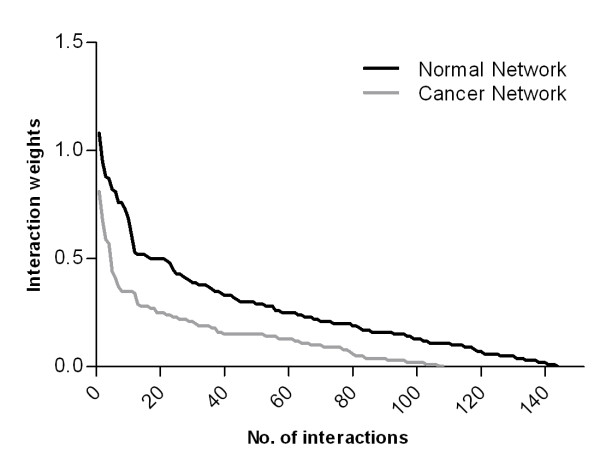
Structural variation between the normal and cancer networks. Comparison of interaction weights predicted by SIRENE for normal and cancer.
Figure 6
Figure 6
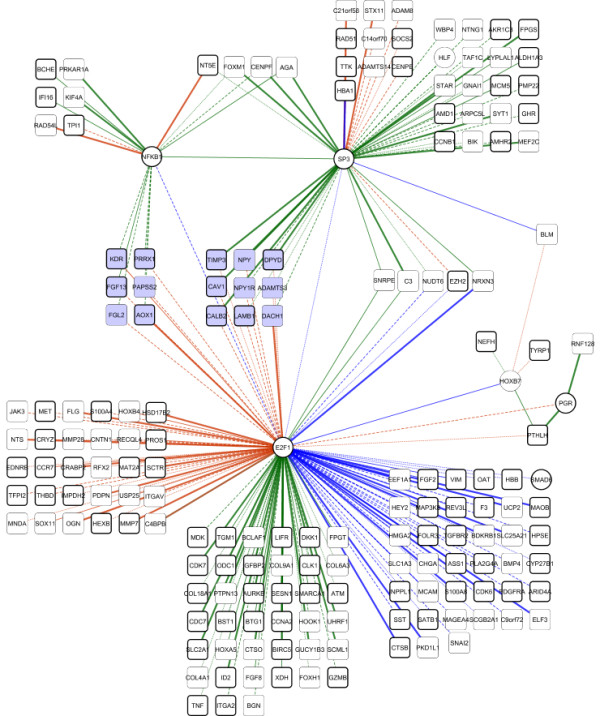
The ovarian gene regulatory network. The ovarian network inferred using SIRENE, showing target genes (rectangles) and transcription factors (circles). Two clusters of genes (shaded blue, in the centre of the figure) switch regulators between the two conditions, controlled by SP3 or NFκB1 in normal and by E2F1 in cancer. Bold nodes are known to have protein products that are targeted by anti-cancer drugs. Edge colors: green, normal; orange, cancer; blue, both. Edge line type: bold, literature and TFBS; solid, literature; dashed, TFBS; dotted, no evidence.

References

    1. Hanahan D, Weinberg RA. Hallmarks of cancer: the next generation. Cell. 2011;144:646–674. doi: 10.1016/j.cell.2011.02.013. - DOI - PubMed
    1. Gentles AJ, Gallahan D. Systems biology: confronting the complexity of cancer. Cancer Res. 2011;71:5961–5964. doi: 10.1158/0008-5472.CAN-11-1569. - DOI - PMC - PubMed
    1. Barabasi AL, Gulbahce N, Loscalzo J. Network medicine: a network-based approach to human disease. Nat Rev Genet. 2011;12:56–68. doi: 10.1038/nrg2918. - DOI - PMC - PubMed
    1. Xia Y, Yu H, Jansen R, Seringhaus M, Baxter S, Greenbaum D, Zhao H, Gerstein M. Analyzing cellular biochemistry in terms of molecular networks. Annu Rev Biochem. 2004;73:1051–1087. doi: 10.1146/annurev.biochem.73.011303.073950. - DOI - PubMed
    1. Karlebach G, Shamir R. Modelling and analysis of gene regulatory networks. Nat Rev Mol Cell Biol. 2008;9:770–780. doi: 10.1038/nrm2503. - DOI - PubMed

LinkOut - more resources