


Substituting homemade fruit juice for sugar-sweetened beverages is associated with lower odds of metabolic syndrome among Hispanic adults
- PMID: 22551801
- PMCID: PMC3349979
- DOI: 10.3945/jn.111.149344
Substituting homemade fruit juice for sugar-sweetened beverages is associated with lower odds of metabolic syndrome among Hispanic adults
Abstract
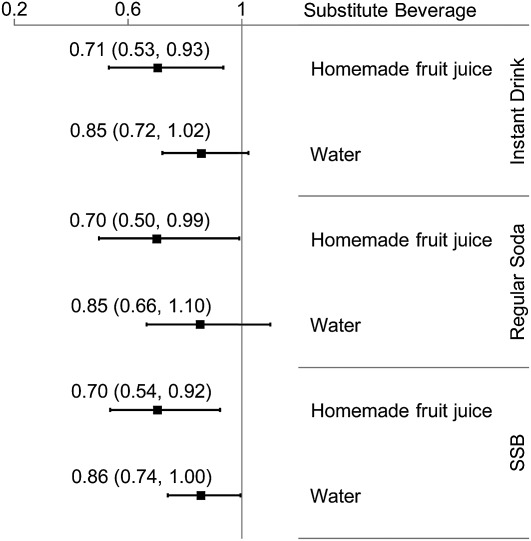
Consumption of sugar-sweetened beverages (SSB) has been associated with metabolic syndrome (MetS); however, studies conducted on Hispanic adults are scarce. To determine the association between beverages consumed by Hispanic adults and MetS and its components, data were analyzed in 1872 Costa Rican adults who served as controls of a population-based, case-control study of coronary heart disease. Multivariate-adjusted means were calculated for components of MetS by servings (never, ≤ 1/wk; 2-6/wk, ≥ 1/d) of 2 traditional fruit-based beverages ("fresco" and freshly-squeezed homemade fruit juice, separately) and 2 SSB (instant drinks and regular sodas, separately and combined). The prevalence ratio (PR) of MetS was calculated for each beverage and the OR was calculated by substituting one serving of homemade fruit juice or water for one of SSB. Significant positive trends were observed for increasing servings of instant drinks with plasma TG and waist circumference and for regular soda with waist circumference (all P-trend < 0.001). Increasing servings of homemade fruit juice were positively associated with HDL cholesterol (P-trend = 0.033). Consuming ≥1 serving/d of instant drinks was associated with a higher PR of MetS [1.42 (95% CI: 1.11, 1.83)] compared with no consumption. Substituting one serving of homemade fruit juice for instant drink was associated with 29% (95% CI: 7, 47%) lower odds of MetS and for regular soda with 30% (95% CI: 1, 50%) lower odds. Substituting water for combined SSB was marginally significant (OR = 0.86 (95% CI: 0.74, 1.00). In conclusion, reducing the consumption of SSB and substituting them with homemade fruit juices in moderation may be a culturally appropriate approach to lower MetS among Hispanic adults.
Conflict of interest statement
Author disclosures: J. Mattei, V. Malik, F. B. Hu, and H. Campos, no conflicts of interest.
Figures
References
-
- Lorenzo C, Williams K, Hunt KJ, Haffner SM. The National Cholesterol Education Program-Adult Treatment Panel III, International Diabetes Federation, and World Health Organization definitions of the metabolic syndrome as predictors of incident cardiovascular disease and diabetes. Diabetes Care. 2007;30:8–13 - PubMed
-
- Denova-Gutiérrez E, Talavera JO, Huitron-Bravo G, Mendez-Hernandez P, Salmeron J. Sweetened beverage consumption and increased risk of metabolic syndrome in Mexican adults. Public Health Nutr. 2010;13:835–42 - PubMed
Publication types
MeSH terms
Substances
Grants and funding
LinkOut - more resources
Full Text Sources
Medical
Research Materials
Miscellaneous
