Preservation of 5300 year old red blood cells in the Iceman
- PMID: 22552923
- PMCID: PMC3427508
- DOI: 10.1098/rsif.2012.0174
Preservation of 5300 year old red blood cells in the Iceman
Abstract
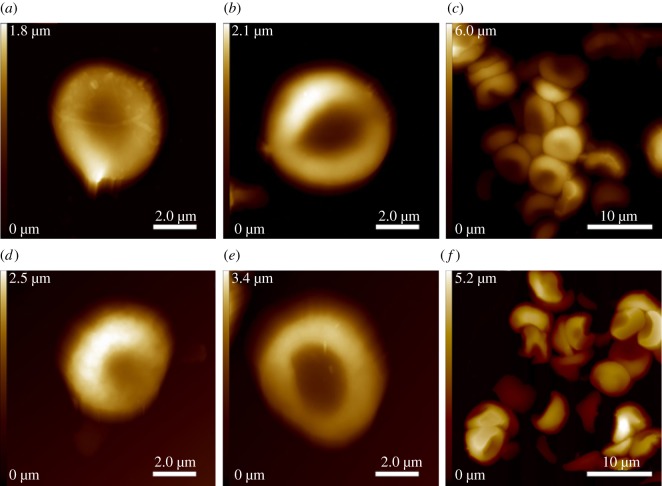
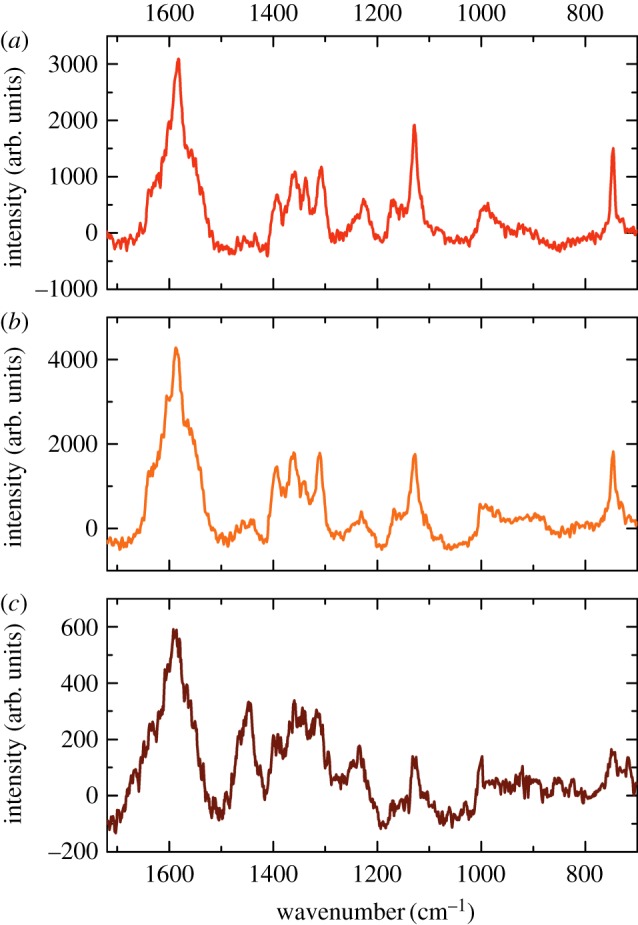
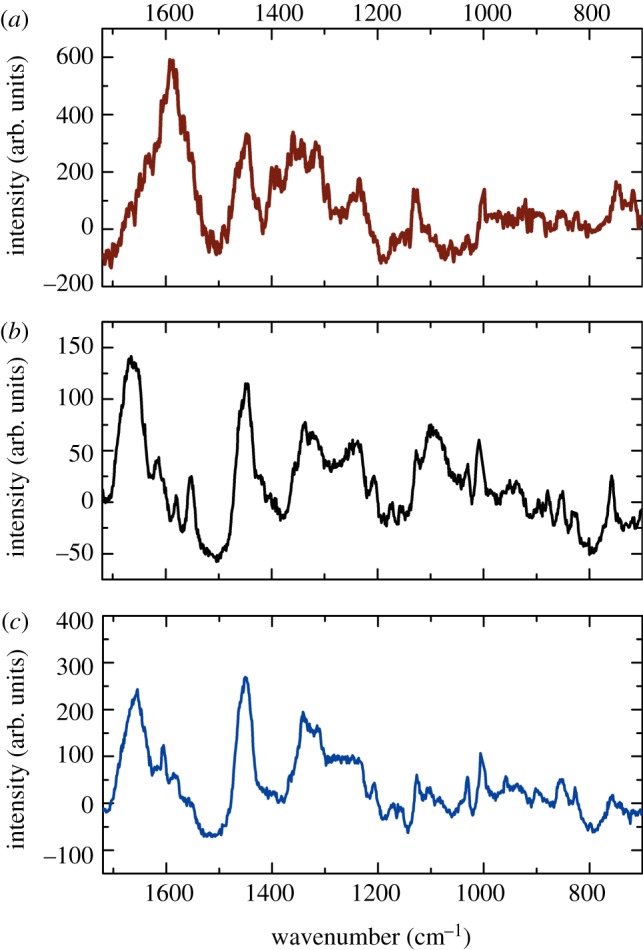
Changes in elasticity and structures of red blood cells (RBCs) are important indicators of disease, and this makes them interesting for medical studies. In forensics, blood analyses represent a crucial part of crime scene investigations. For these reasons, the recovery and analysis of blood cells from ancient tissues is of major interest. In this study, we show that RBCs were preserved in Iceman tissue samples for more than 5000 years. The morphological and molecular composition of the blood corpuscle is verified by atomic force microscope and Raman spectroscopy measurements. The cell size and shape approximated those of healthy, dried, recent RBCs. Raman spectra of the ancient corpuscle revealed bands that are characteristic of haemoglobin. Additional vibrational modes typical for other proteinaceous fragments, possibly fibrin, suggested the formation of a blood clot. The band intensities, however, were approximately an order of magnitude weaker than those of recent RBCs. This fact points to a decrease in the RBC-specific metalloprotein haemoglobin and, thus, to a degradation of the cells. Together, the results show the preservation of RBCs in the 5000 year old mummy tissue and give the first insights into their degradation.
Figures

Similar articles
-
Nanostructure and mechanics of mummified type I collagen from the 5300-year-old Tyrolean Iceman.Proc Biol Sci. 2010 Aug 7;277(1692):2301-9. doi: 10.1098/rspb.2010.0377. Epub 2010 Mar 31. Proc Biol Sci. 2010. PMID: 20356896 Free PMC article.
-
The 'Iceman': molecular structure of 5200-year-old skin characterised by Raman spectroscopy and electron microscopy.Biochim Biophys Acta. 1995 Jan 5;1246(1):98-105. doi: 10.1016/0167-4838(94)00189-n. Biochim Biophys Acta. 1995. PMID: 7811737
-
Insights into the morphological pattern of erythrocytes' aging: Coupling quantitative AFM data to microcalorimetry and Raman spectroscopy.J Mol Recognit. 2018 Nov;31(11):e2732. doi: 10.1002/jmr.2732. Epub 2018 Jun 6. J Mol Recognit. 2018. PMID: 29876977
-
Atomic force microscopy: From red blood cells to immunohaematology.Adv Colloid Interface Sci. 2017 Nov;249:149-162. doi: 10.1016/j.cis.2017.05.011. Epub 2017 May 11. Adv Colloid Interface Sci. 2017. PMID: 28515013 Review.
-
The Current Situation of the Tyrolean Iceman.Gerontology. 2019;65(6):699-706. doi: 10.1159/000501878. Epub 2019 Sep 10. Gerontology. 2019. PMID: 31505504 Review.
Cited by
-
The Iceman's Last Meal Consisted of Fat, Wild Meat, and Cereals.Curr Biol. 2018 Jul 23;28(14):2348-2355.e9. doi: 10.1016/j.cub.2018.05.067. Epub 2018 Jul 12. Curr Biol. 2018. PMID: 30017480 Free PMC article.
-
The masks of Lorenzo Tenchini: their anatomy and surgical/bioengineering clues.J Anat. 2019 Dec;235(6):1036-1044. doi: 10.1111/joa.13069. Epub 2019 Oct 21. J Anat. 2019. PMID: 31637719 Free PMC article. Review.
-
Paleoproteomic study of the Iceman's brain tissue.Cell Mol Life Sci. 2013 Oct;70(19):3709-22. doi: 10.1007/s00018-013-1360-y. Epub 2013 Jun 6. Cell Mol Life Sci. 2013. PMID: 23739949 Free PMC article.
References
-
- Hawass Z., et al. 2010. Ancestry and pathology in King Tutankhamun's family. JAMA 303, 638–64710.1001/jama.2010.121 (doi:10.1001/jama.2010.121) - DOI - DOI - PubMed
-
- Keller A., et al. 2012. New insights into the Tyrolean Iceman's origin and phenotype as inferred by whole-genome sequencing. Nat. Commun. 3, 698.10.1038/ncomms1701 (doi:10.1038/ncomms1701) - DOI - DOI - PubMed
-
- Lynnerup N. 2007. Mummies. Am. J. Phys. Anthropol. 134(Suppl. 45), 162–19010.1002/ajpa.20728 (doi:10.1002/ajpa.20728) - DOI - DOI - PubMed
-
- Nerlich A. G., Haas C. J., Zink A., Szeimies U., Hagedorn H. G. 1997. Molecular evidence for tuberculosis in an ancient Egyptian mummy. Lancet 350, 1404.10.1016/S0140-6736(05)65185-9 (doi:10.1016/S0140-6736(05)65185-9) - DOI - DOI - PubMed
-
- Zink A., Haas C. J., Reischl U., Szeimies U., Nerlich A. G. 2001. Molecular analysis of skeletal tuberculosis in an ancient Egyptian population. J. Med. Microbiol. 50, 355–366 - PubMed
Publication types
MeSH terms
Substances
LinkOut - more resources
Full Text Sources