


Self-reported comorbid pains in severe headaches or migraines in a US national sample
- PMID: 22553936
- PMCID: PMC3370154
- DOI: 10.1111/j.1526-4610.2012.02155.x
Self-reported comorbid pains in severe headaches or migraines in a US national sample
Abstract
Aims: To compare prevalence of self-reported comorbid temporomandibular joint muscle disorder-type, neck, back, and joint pains in people with severe headache or migraine; and analyze these self-reported pains in the 2000-2005 US National Health Interview Survey by gender and age for non-Hispanic whites, Hispanics, and non-Hispanic blacks (African Americans).
Methods: National Health Interview Survey data included information on gender, age, race, ethnicity, health status, and common pain types: severe headache or migraine, temporomandibular joint muscle disorder-type, neck, and low back in the last 3 months, as well as prior-month joint pains. Analyses included survey prevalence estimation and survey logistic regression to obtain odds ratios and 95% confidence intervals.
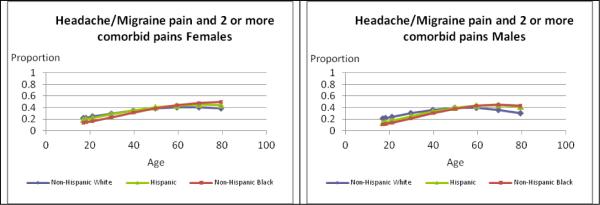
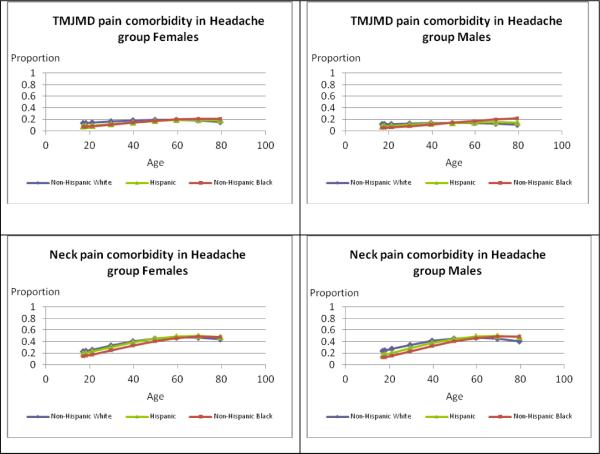
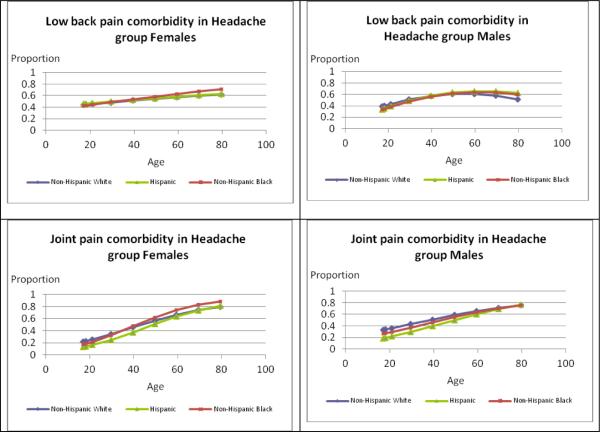
Results: The study included 189,967 adults: 48% males, 52% females; 73% white, 12% Hispanic, and 11% black. Of the entire sample, 29,712 (15%) reported severe headache or migraine, and 19,228 (64%) had severe headache or migraine with at least 1 comorbid pain. Two or more comorbid pains were reported in 10,200 (33%), with no gender difference, and with Hispanics (n = 1847 or 32%) and blacks (n = 1301 or 30%) less likely to report 2 or more comorbid pains than whites (n = 6747 or 34%) (odds ratio = 0.91, P = .032; OR = 0.82, P < .001, respectively). This group also reported significantly lower ratings of self-rated health (P < .001). Differences in type of comorbid pain by age patterns were found.
Conclusions: Severe headache or migraine is often associated with other common pains, seldom existing alone. Two or more comorbid pains are common, similarly affecting gender and racial/ethnic groups.
© 2012 American Headache Society.
Figures
References
-
- Robbins MS, Lipton RB. The epidemiology of primary headache disorders. Semin Neurol. 2010;30:107–119. - PubMed
-
- Scher AI, Bigal ME, Lipton RB. Comorbidity of migraine. Curr Opin Neurol. 2005;18:305–310. - PubMed
-
- Scher A, Stewart WF, Lipton RB. The comorbidity of headache with other pain syndromes. Headache. 2006;46:1416–1423. - PubMed
-
- De Tommaso M, Sandaro M, Serpino C, et al. Fibromyalgia comorbidity in primary headaches. Cephalalgia. 2009;29:453–464. - PubMed
-
- Crystal SC, Robbins MS. Epidemiology of tension-type headache. Curr Pain Headache Rep. 2010;14:449–454. - PubMed
Publication types
MeSH terms
Grants and funding
LinkOut - more resources
Full Text Sources
Medical
