. 2012 Jun;84(6):1150-64.
doi: 10.1111/j.1365-2958.2012.08083.x. Epub 2012 May 23.

The putative protein methyltransferase LAE1 controls cellulase gene expression in Trichoderma reesei

Affiliations
Free PMC article

The putative protein methyltransferase LAE1 controls cellulase gene expression in Trichoderma reesei

Bernhard Seiboth et al. Mol Microbiol. 2012 Jun.
Free PMC article

Abstract

Trichoderma reesei is an industrial producer of enzymes that degrade lignocellulosic polysaccharides to soluble monomers, which can be fermented to biofuels. Here we show that the expression of genes for lignocellulose degradation are controlled by the orthologous T. reesei protein methyltransferase LAE1. In a lae1 deletion mutant we observed a complete loss of expression of all seven cellulases, auxiliary factors for cellulose degradation, β-glucosidases and xylanases were no longer expressed. Conversely, enhanced expression of lae1 resulted in significantly increased cellulase gene transcription. Lae1-modulated cellulase gene expression was dependent on the function of the general cellulase regulator XYR1, but also xyr1 expression was LAE1-dependent. LAE1 was also essential for conidiation of T. reesei. Chromatin immunoprecipitation followed by high-throughput sequencing ('ChIP-seq') showed that lae1 expression was not obviously correlated with H3K4 di- or trimethylation (indicative of active transcription) or H3K9 trimethylation (typical for heterochromatin regions) in CAZyme coding regions, suggesting that LAE1 does not affect CAZyme gene expression by directly modulating H3K4 or H3K9 methylation. Our data demonstrate that the putative protein methyltransferase LAE1 is essential for cellulase gene expression in T. reesei through mechanisms that remain to be identified.


Figures

Figure 1
Figure 1
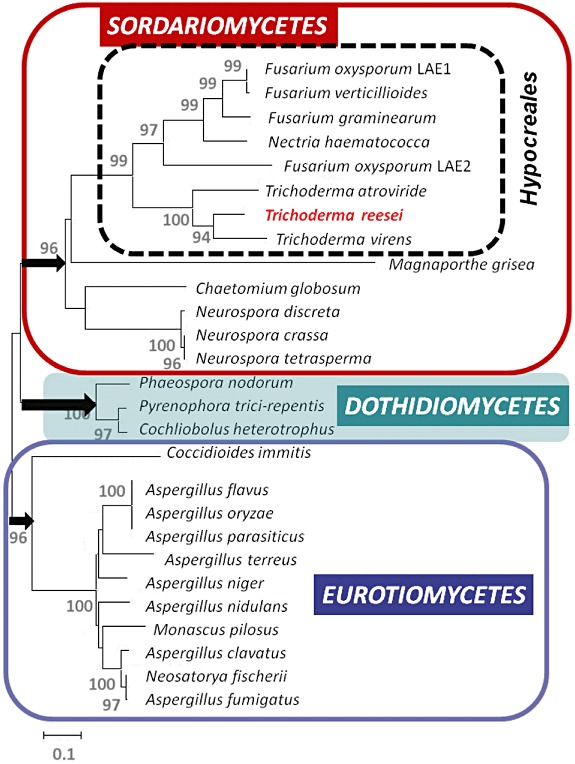
Phylogenetic analysis of LaeA/LAE1 proteins from Eurotiomycetes, Dothidiomycetes and Sordariomycetes. Accession numbers for protein sequences are listed in Table S3. The tree was constructed by Neighbor Joining in MEGA 5.0 (Tamura et al., 2011) with 500 bootstrap replicates (coefficients are indicated below the respective nodes). Gaps in the alignment were not considered.
Figure 2
Figure 2
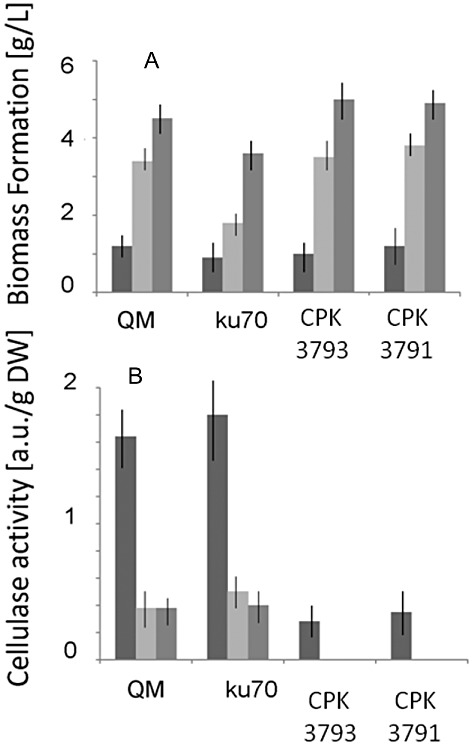
Effect of loss-of-function of lae1 on biomass formation and cellulase/hemicellulase enzyme formation by T. reesei. Growth (A) and cellulase formation (B) of T. reesei QM 9414, the transformation recipient ku70 and the corresponding Δlae1 strains CPK3793 and CPK3791 on 1% (w/v) lactose. Cellulase expression is given in arbitrary units and related to the respective biomass dry weight of the strain at the respective time point (given in A). The three bars represent (from left to right) values for 48, 72 and 96 h of cultivation. Experiments are means of three biological replicates, and the SD given by vertical bars.
Figure 3
Figure 3
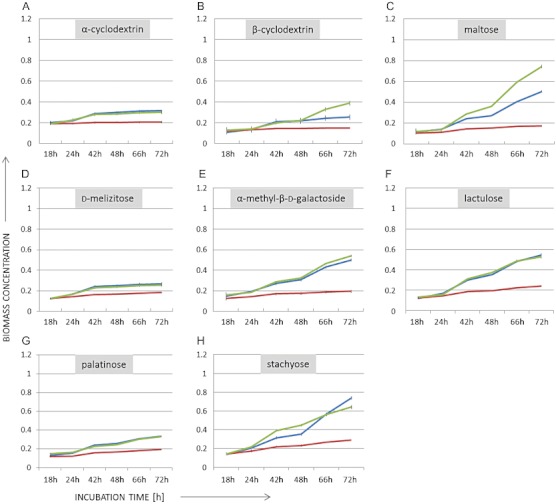
Growth of T. reesei QM 9414 (blue), the Δlae1 strain (CPK3793, red) and the strain expressing tef1:lae1 (CPK4086, green) on several oligosaccharides. Data were obtained from Phenotype microarrays as described (Druzhinina et al., 2006). Carbon sources used were: (A) α-cyclodextrin, (B) β-cyclodextrin, (C) maltose, (D) d-melizitose [α-d-glucopyranosyl-(1→3)-O-β-d-fructofuranosyl-(2→1)-α-d-glucopyranoside], (E) α-methyl-β-d-galactoside, (F) lactulose [4-O-β-d-galactopyranosyl-d-fructofuranose], (G) palatinose [6-O-α-d-Glucopyranosyl-d-fructose], (H) stachyose [β-d-Fructofuranosyl-O-α-d-galactopyranosyl-(1→6)-O-α-d-galactopyranosyl-(1→6)-α-d-glucopyranoside]. The vertical axis shows the OD750 that is equivalent to biomass formation (g l−1).
Figure 4
Figure 4
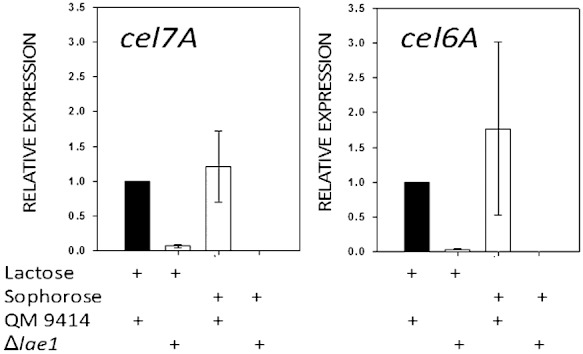
Expression of the two cellobiohydrolase-encoding genes cel7a and cel6a in T. reesei QM 9414 and the Δlae1 strain CPK3793 during growth on lactose or incubation with sophorose. Cellulase transcript levels in QM 9414 during growth on lactose are given with full bars and set to 1.0. The respective transcript levels in relation to QM 9414 are shown with open bars. Data are means of triplicate determinations from two biological replicates.
Figure 5
Figure 5
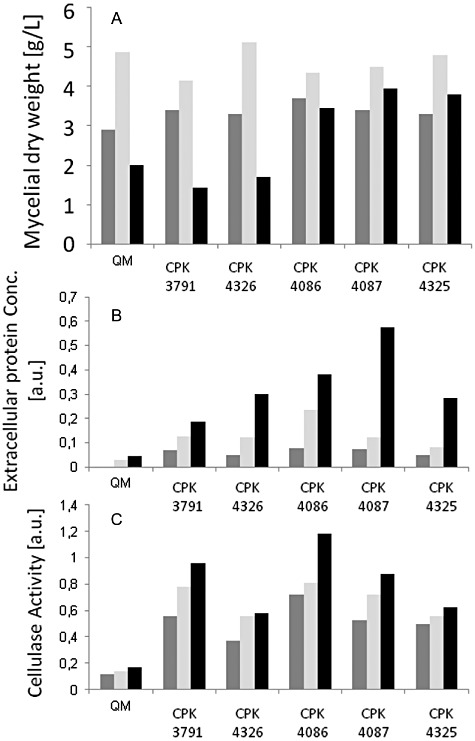
Biomass formation (A), cellulase production (B) and extracellular protein (C) during growth of T. reesei QM 9414 (QM) and several mutant strains bearing additional copies of the tef1:lae1 gene construct (CPK3791, CPK4326, CPK4086, CPK4087, CPK4325) on lactose. The three bars represent (from left to right) values for 48, 72 and 96 h of cultivation. Each bar is from a single experiment only but representative of at least four biological replica that were consistent with the claims.
Figure 6
Figure 6
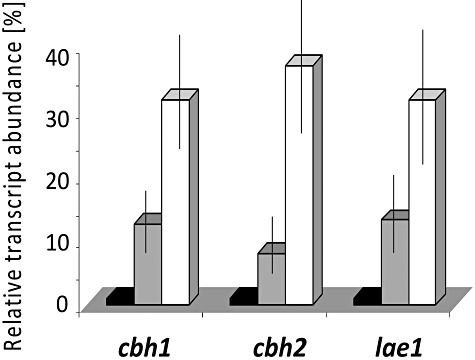
Relative abundance of transcripts for cel7a, cel6a and lae1 at 26 h of growth on lactose in two T. reesei tef1:lae1 mutant strains (CPK4086, grey bars; CPK3791, white bars) in relation to the QM 9414 recipient strain (black bars). Transcripts were normalized to the housekeeping gene tef1, and the respective ratio in QM 9414 set to 1. Other strains are given in percentage to that of the QM 9414. Copy numbers were determined as described in Experimental procedures: CPK4086 had two additional copies indicating a single ectopically integrated copy; CPK3791, however, had three additional copies, suggesting more than one ectopically integrated copy, but the exact number was not determined. Vertical bars indicate SD.
Figure 7
Figure 7
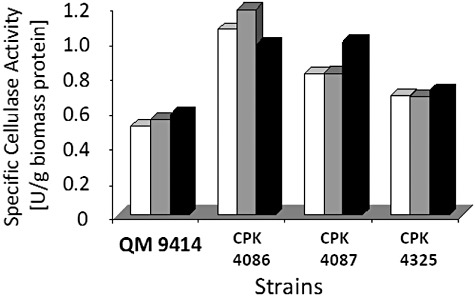
Cellulase activity during growth of selected T. reesei tef1:lae1 mutant strains on cellulose. Activities are given as arbitrary units and are related to 1 g of fungal biomass protein. Bars indicate measurements after 7, 9 and 11 days of incubation (from left to right). Data are means from four measurements and two independent biological replicates.
Figure 8
Figure 8
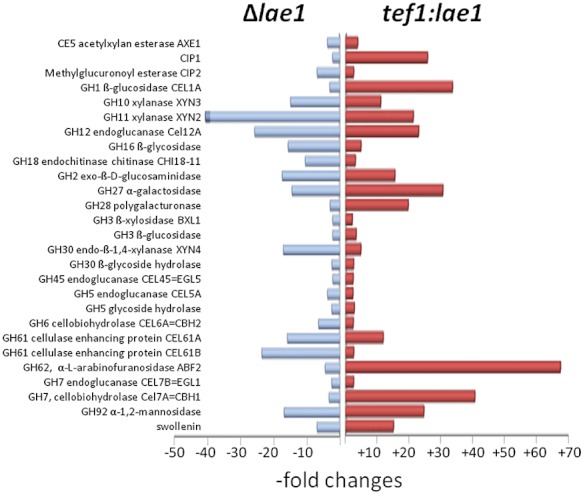
Relative changes in expression of CAZome genes in the Δlae1 (CPK3793) and the tef1:lae1 (CPK4086) strains, given as the fold changes of transcript hybridization in relation to the parent strain. Only values with P < 0.05 are shown.
Figure 9
Figure 9
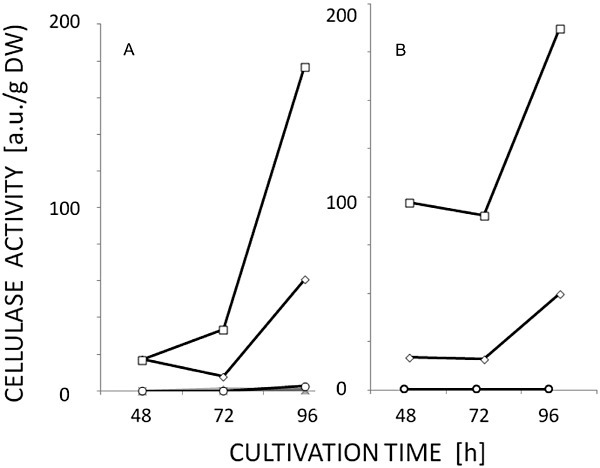
Cellulase formation in delta-lae1 (CPK3793) and delta-xyr1 strains of T. reesei is unaffected by the constitutive overexpression of xyr1 or lae1. A. Overexpression of xyr1 in a delta-lae1 background: three different transformants yielded identical results and thus shown only for one of them (circles). The wild-type QM 9414, and QM 9414 containing a single pki1:xyr1 copy are given as comparison (diamonds and squares respectively). B. Overexpression of lae1 in a delta-xyr1 background: three different transformants yielded again identical results and thus shown only for one of them (circles). The wild-type QM 9414, and strain CPK4086 overexpressing tef1:lae1 are given as comparison (diamonds and squares respectively). Data from a single experiment only are shown, but are consistent with the results from at least two separate biological replicas.
Figure 10
Figure 10
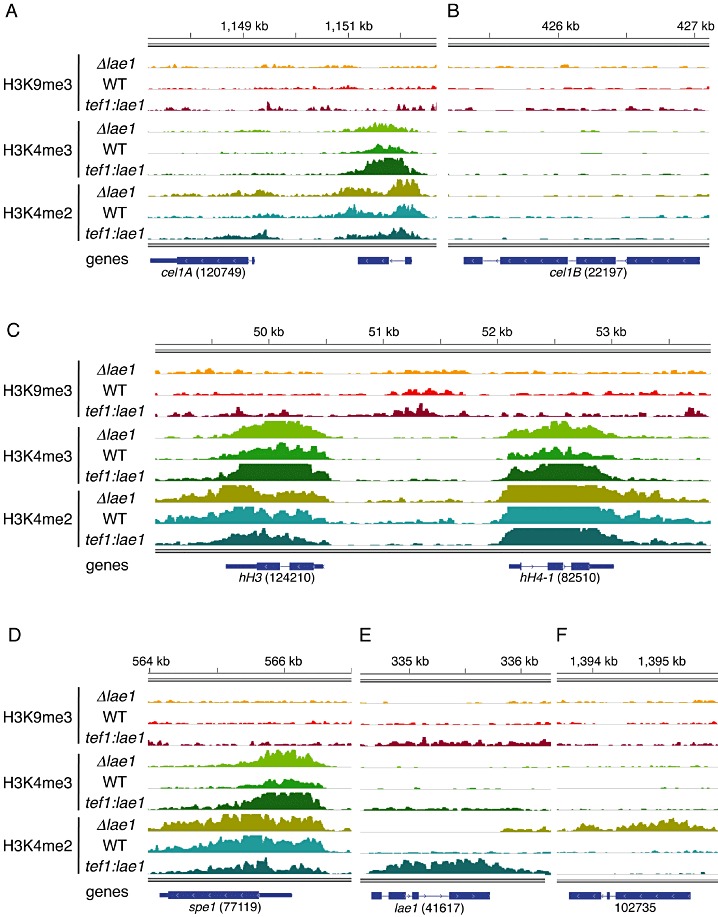
Selected results of ChIP-seq with antibodies against H3K9me3, H3K4me3 and H3K4me2 in Δlae1 (CPK3793), wild type (QM 9414) and the LAE1-overexpressing tef1:lae1 strain CPK4086. Genes of interest are shown below regions of enrichment (y-axis scale, 0–30 for all tracks, all data were normalized for relative abundance). A. H3K4me3 is mildly enriched in the 5′ region of cel1a but not nearly as strongly as in the neighbouring gene, which is not affected by changes in LAE1 expression. B. The most common pattern of CAZyme gene histone modifications tested here was no significant enrichment under any condition, represented here by cel1b. C. In contrast, highly expressed genes, like hH3 and hH4-1 show both H3K4me2 and -me3 but no H3K9me3 enrichment in a lae-1-independent manner. D. The same is true for a typical metabolic gene, spe1, the gene for ornithine decarboxylase. E. The lae1 gene serves as control, as no signal is detected in Δlae1, but H3K4me2 is enriched in the tef1:lae1 strain. F. A predicted gene encoding a protein with a carbohydrate-binding motif (protein ID 102735) shows enrichment of H3K4me2 only in the Δlae1 strain.
Figure 11
Figure 11
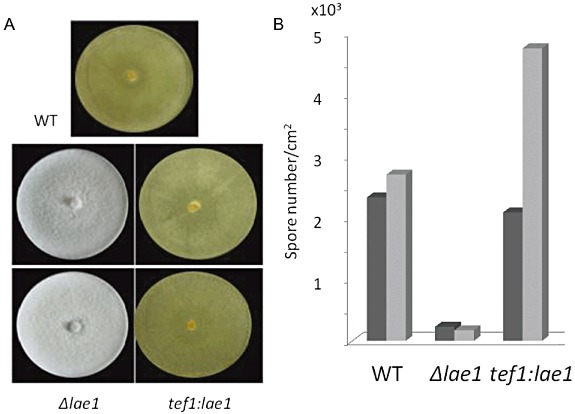
LAE1 affects sporulation in T. reesei. (A) Phenotype of T. reesei QM 9414 (WT), Δlae1 (CPK3793 on top, and CPK4086 below) and lae1OE strains (CPK4086) on top, CPK3791 below); (B) effect of light on sporulation in T. reesei WT, Δlae1 (CPK3793) and lae1OE (CPK4086) strains. Only one strain is shown, but consistent data have been obtained with at least two more strains of both lae1 genotypes.

References

    1. Akel E, Metz B, Seiboth B, Kubicek CP. Molecular regulation of arabinan and l-arabinose metabolism in Hypocrea jecorinaTrichoderma reesei. Eukaryot Cell. 2009;8:1837–1844. - PMC - PubMed
    1. Bayram O, Braus GH. Coordination of secondary metabolism and development in fungi: the velvet family of regulatory proteins. FEMS Microbiol Rev. 2012;36:1–24. - PubMed
    1. Bayram O, Krappmann S, Ni M, Bok JW, Helmstaedt K, Valerius O, et al. VelB/VeA/LaeA complex coordinates light signal with fungal development and secondary metabolism. Science. 2008;320:1504–1506. - PubMed
    1. Benjamini Y, Hochberg Y. Controlling the false discovery rate: a practical and powerful approach to multiple testing. J R Stat Soc Ser B. 1995;57:289–300.
    1. Bok JW, Keller NP. LaeA, a regulator of secondary metabolism in Aspergillus spp. Eukaryot Cell. 2004;3:527–535. - PMC - PubMed

Publication types

MeSH terms

Associated data