


The influence of language deprivation in early childhood on L2 processing: An ERP comparison of deaf native signers and deaf signers with a delayed language acquisition
- PMID: 22554360
- PMCID: PMC3404011
- DOI: 10.1186/1471-2202-13-44
The influence of language deprivation in early childhood on L2 processing: An ERP comparison of deaf native signers and deaf signers with a delayed language acquisition
Abstract
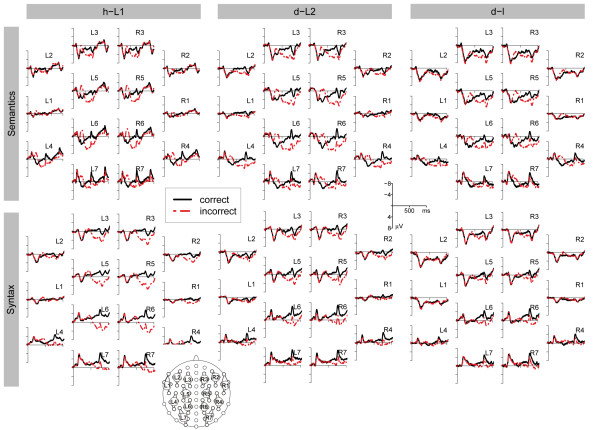
Background: To examine which language function depends on early experience, the present study compared deaf native signers, deaf non-native signers and hearing German native speakers while processing German sentences. The participants watched simple written sentences while event-related potentials (ERPs) were recorded. At the end of each sentence they were asked to judge whether the sentence was correct or not. Two types of violations were introduced in the middle of the sentence: a semantically implausible noun or a violation of subject-verb number agreement.
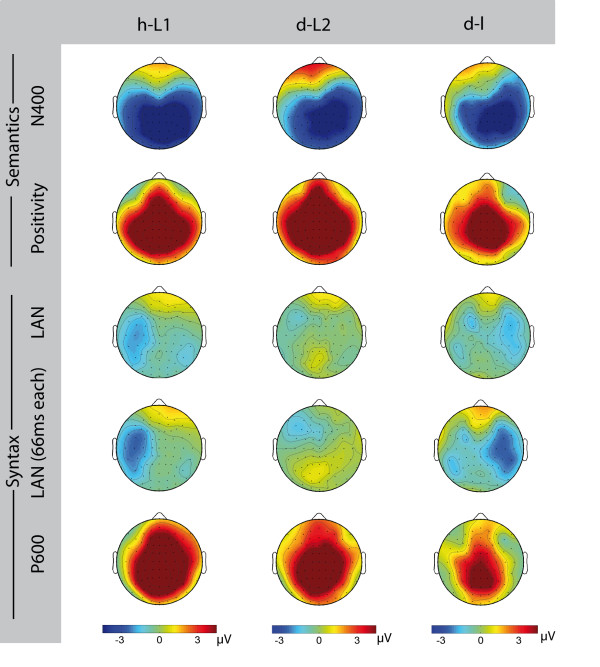
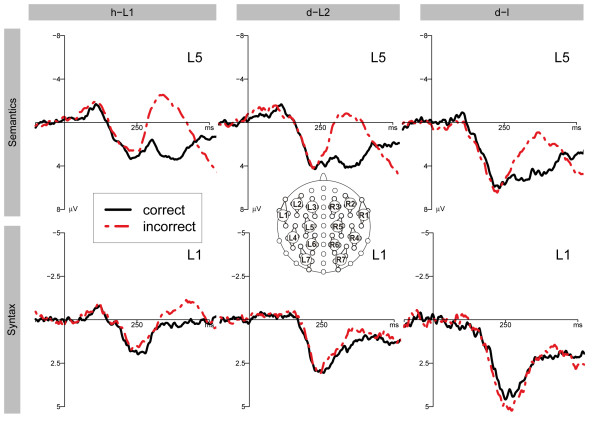
Results: The results showed a similar ERP pattern after semantic violations (an N400 followed by a positivity) in all three groups. After syntactic violations, native German speakers and native signers of German sign language (DGS) with German as second language (L2) showed a left anterior negativity (LAN) followed by a P600, whereas no LAN but a negativity over the right hemisphere instead was found in deaf participants with a delayed onset of first language (L1) acquisition. The P600 of this group had a smaller amplitude and a different scalp distribution as compared to German native speakers.
Conclusions: The results of the present study suggest that language deprivation in early childhood alters the cerebral organization of syntactic language processing mechanisms for L2. Semantic language processing instead was unaffected.
Figures
References
-
- Poppendieker R. Freies Schreiben und Gebärden. Voraussetzungen und Bedingungen des Erwerbs von Schreibkompetenz durch gehörlose Kinder, Signum; 1992.
-
- Fischer R. Looking back. Signum, A reader on the history of deaf communities and their sign languages. Hamburg; 1993.
-
- Morford JP, Hänel-Faulhaber B. Homesigners as Late Learners: Connecting the Dots from Delayed Acquisition in Childhood to Sign Language Processing in Adulthood. Lang Linguistics Compass. 2011;5:525–537. doi: 10.1111/j.1749-818X.2011.00296.x. - DOI
-
- Goldin-Meadow S, Mayberry RI. How do profoundly deaf children learn to read? Learn Disabil Res Pract. 2001;16:222–229. doi: 10.1111/0938-8982.00022. - DOI
-
- Newport EL, Maier RP. In: In The Cross-Linguistic Study of Language Acquisition. Slobin D, editor. Erlbaum, Hillsdale, NJ; 1985. The Acquisition of American Sign Language; pp. 881–938.
Publication types
MeSH terms
LinkOut - more resources
Full Text Sources
Medical
