


Age-related changes in CD8 T cell homeostasis and immunity to infection
- PMID: 22554418
- PMCID: PMC3480557
- DOI: 10.1016/j.smim.2012.04.009
Age-related changes in CD8 T cell homeostasis and immunity to infection
Abstract
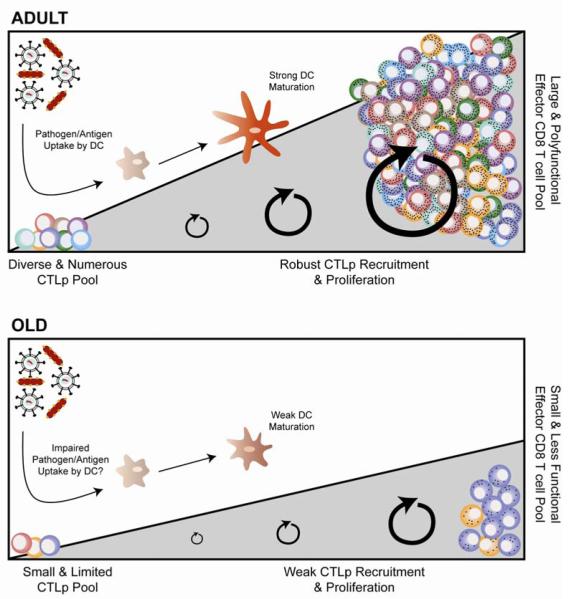
Studies of CD8 T cell responses to vaccination or infection with various pathogens in both animal models and human subjects have revealed a markedly consistent array of age-related defects. In general, recent work shows that aged CD8 T cell responses are decreased in magnitude, and show poor differentiation into effector cells, with a reduced arsenal of effector functions. Here we review potential mechanisms underlying these defects. We specifically address phenotypic and numeric changes to the naïve CD8 T cell precursor pool, the impact of persistent viral infection(s) and inflammation, and contributions of the aging environment in which these cells are activated.
Copyright © 2012 Elsevier Ltd. All rights reserved.
Figures
References
-
- WHO Ageing and Life-Course [Internet] http://www.who.int/ageing/en/
-
- Older Americans 2010: Key Indicators of Well-Being [Internet] http://www.agingstats.gov/agingstatsdotnet/main_site/default.aspx.
-
- Gorina Y, Kelly T, Lubitz J, Hines Z. Trends in influenza and pneumonia among older persons in the United States. Aging Trends. 2008;8:1–11. - PubMed
-
- Goodwin K, Viboud C, Simonsen L. Antibody response to influenza vaccination in the elderly: a quantitative review. Vaccine. 2006;24:1159–1169. - PubMed
-
- Deng Y, Jing Y, Campbell AE, Gravenstein S. Age-related impaired type 1 T cell responses to influenza: reduced activation ex vivo, decreased expansion in CTL culture in vitro, and blunted response to influenza vaccination in vivo in the elderly. J Immunol. 2004;172:3437–3446. - PubMed
Publication types
MeSH terms
Grants and funding
LinkOut - more resources
Full Text Sources
Other Literature Sources
Medical
Research Materials
