. 2012 Aug 16:217:56-66.
doi: 10.1016/j.neuroscience.2012.04.054. Epub 2012 Apr 30.

The C-terminus of neuronal Kv2.1 channels is required for channel localization and targeting but not for NMDA-receptor-mediated regulation of channel function

Affiliations

The C-terminus of neuronal Kv2.1 channels is required for channel localization and targeting but not for NMDA-receptor-mediated regulation of channel function

S B Baver et al. Neuroscience. .

Abstract

The delayed rectifier voltage-gated potassium channel Kv2.1 underlies a majority of the somatic K(+) current in neurons and is particularly important for regulating intrinsic neuronal excitability. Various stimuli alter Kv2.1 channel gating as well as localization of the channel to cell-surface cluster domains. It has been postulated that specific domains within the C-terminus of Kv2.1 are critical for channel gating and sub-cellular localization; however, the distinct regions that govern these processes remain elusive. Here we show that the soluble C-terminal fragment of the closely related channel Kv2.2 displaces Kv2.1 from clusters in both rat hippocampal neurons and HEK293 cells, however neither steady-state activity nor N-methyl-d-aspartate (NMDA)-dependent modulation is altered in spite of this non-clustered localization. Further, we demonstrate that the C-terminus of Kv2.1 is not necessary for steady-state gating, sensitivity to intracellular phosphatase or NMDA-dependent modulation, though this region is required for localization of Kv2.1 to clusters. Thus, the molecular determinants of Kv2.1 localization and modulation are distinct regions of the channel that function independently.


Figures

Figure 1
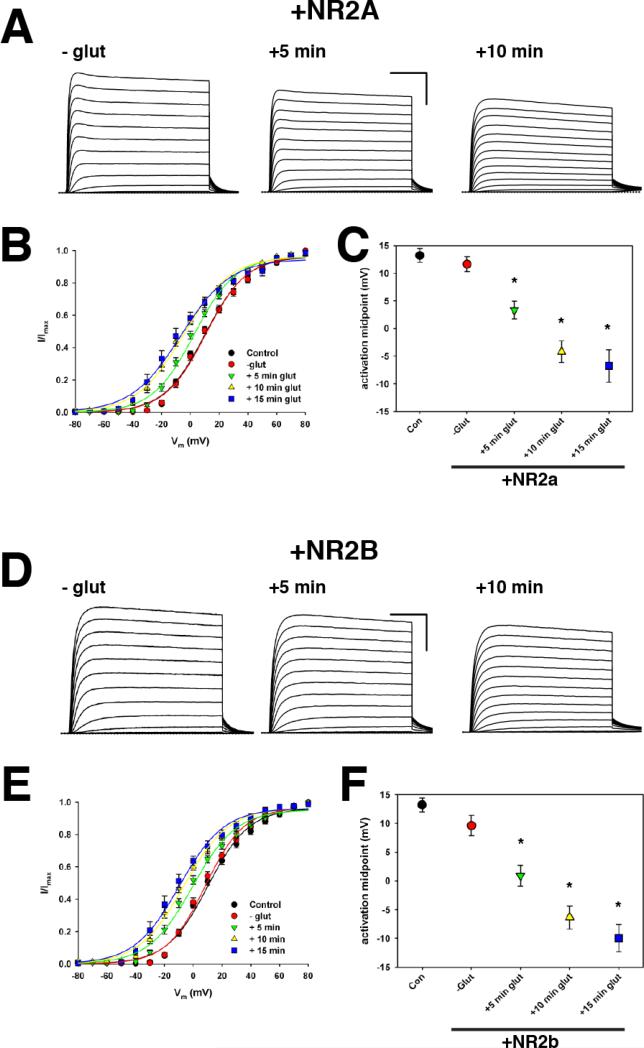
Figure 1. Modulation of Kv2.1 by NMDAR does not depend on the identity of the NR2 subunit
A. Representative whole-cell currents from an HEK293 cell expressing GFP-Kv2.1 plus NR2a-containing NMDAR either before (-glut) or at the indicated time after the addition of 10 μM glutamate to the extracellular solution. Scale bars: 50 ms, 1 nA. B. Average normalized tail current-voltage (I-V) relationship for the timepoints described in A. C. Average V1/2 for all timepoints following glutamate addition. *, p < 0.001. D. Representative whole-cell recordings from HEK293 cell expressing GFP-Kv2.1 plus NR2b-containing NMDAR. Conditions are the same as in A. E. Average normalized tail I-V relationships for all timepoints. F. Average V1/2 for all timepoints after glutamate addition, *, p < 0.001.
Figure 2
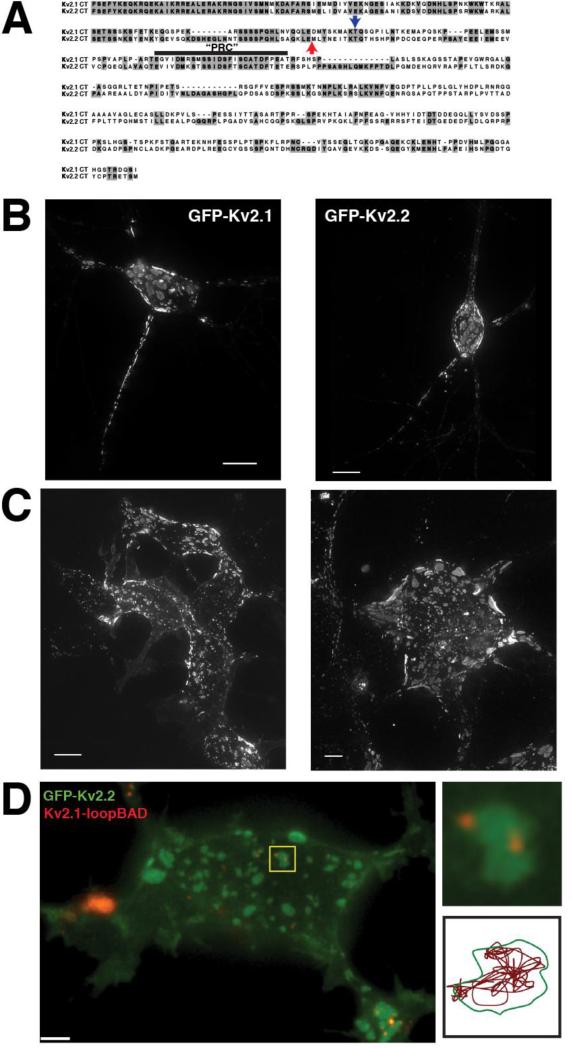
Figure 2. Clustering of Kv2.1 and Kv2.2 is governed by a mechanism common to both channels
A. Sequence alignment of the C-termini of Kv2.1 and Kv2.2. The blue arrow indicates the point at which Kv2.1 is truncated in the Kv2.1ΔC318 construct. There are 98 residues remaining past the S6 domain (of a total of 416). The red arrow indicates the beginning of the sequence of the soluble Kv2.2CT. B. Expression of GFP-Kv2.1 (left) and GFP-Kv2.2 (right) in cultured rat hippocampal neurons. C. Expression of GFP-Kv2.1 (left) and GFP-Kv2.2 (right) in HEK293 cells. Images in B and C are maximum intensity projections of XYZ stacks. D. (left) Coexpression of GFP-Kv2.2 and Kv2.1-loopBAD (red) in HEK293 cell. Kv2.1-loopBAD was visualized by labeling with streptavidin-conjugated QD605. Image is a single Z-section of the basal surface of the cell. (Top right) Enlarged image of the cluster highlighted by the yellow box illustrating a GFP-Kv2.1 cluster containing 2 QD-labeled Kv2.1 channels. (Bottom right) Single particle track of one of the QD in the cluster illustrating that Kv2.1 channels obey the same cluster boundary as Kv2.2.
Figure 3
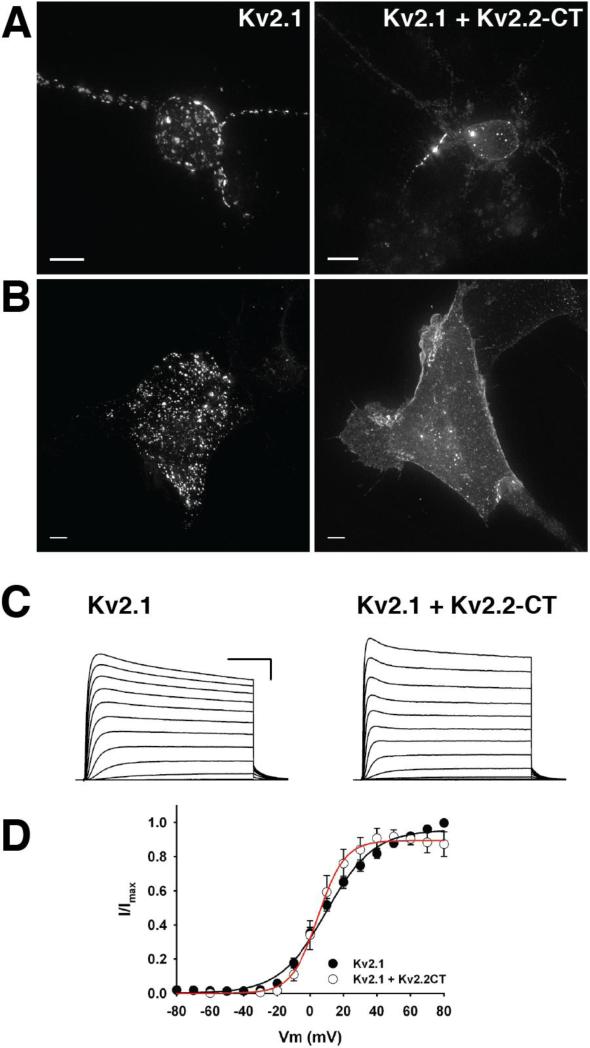
Figure 3. The soluble C-terminus of Kv2.2 displaces full-length Kv2.1 from cell-surface clusters but does not affect the steady-state voltage-dependence of Kv2.1
A. Representative maximum intensity projections of cultured hippocampal neurons expressing either full-length GFP-Kv2.1 only (left) or GFP-Kv2.1 + Kv2.2CT (right). B. Maximum intensity projections of either GFP-Kv2.1 only (left) or GFP-Kv2.1 + Kv2.2CT (right) expressed in HEK293 cells. C. Representative whole-cell recordings from HEK293 cells expressing either full-length GFP-Kv2.1 (left) or GFP-Kv2.1 + Kv2.2CT (right). Scale bars: 50 ms, 1 nA. D. Average normalized I-V relationships for full-length Kv2.1 and Kv2.1 + Kv2.2CT.
Figure 4
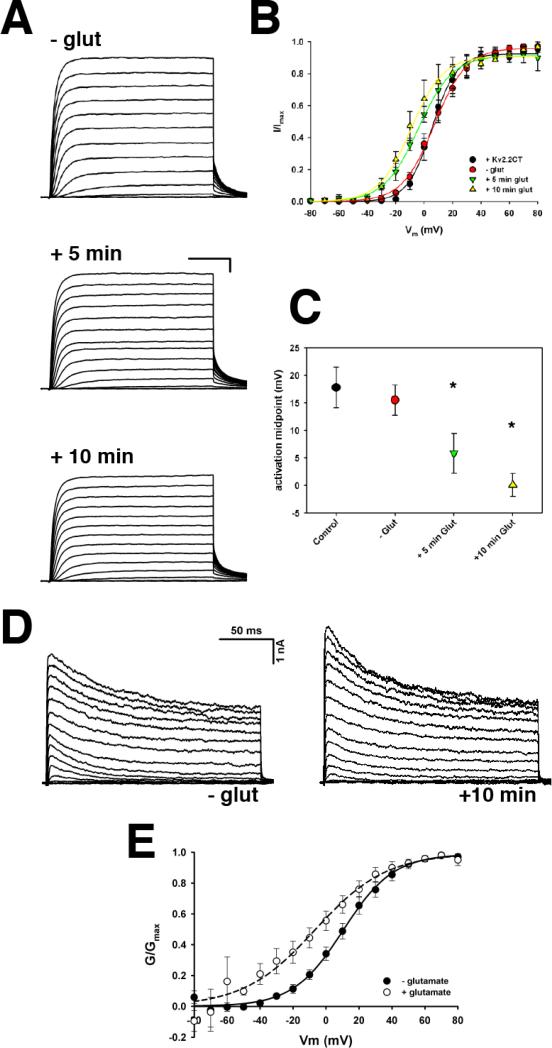
Figure 4. Disruption of Kv2.1 clustering by the soluble C-terminus of Kv2.2 has no effect on Kv2.1 channel modulation by NMDAR activation
A. Representative whole-cell currents from HEK293 cells expressing full-length GFP-Kv2.1 + Kv2.2CT plus NMDAR, either before (- glut) or at the indicated time following addition of 10 μM glutamate. B. Average normalized I-V relationship illustrating that even in the presence of Kv2.2CT, NMDAR activation induces a hyperpolarizing shift in the voltage-dependence of activation of Kv2.1. The average V1/2 for all conditions is presented in panel C. D. Whole-cell K+ currents from a representative rHN transfected with Kv2.2CT before (left) and 10 minutes after the addition of 10 μM glutamate+50 μM glycine (right). E. Average normalized G-V relationship for all neurons before (closed symbols) and after (open symbols) glutamate addition.
Figure 5
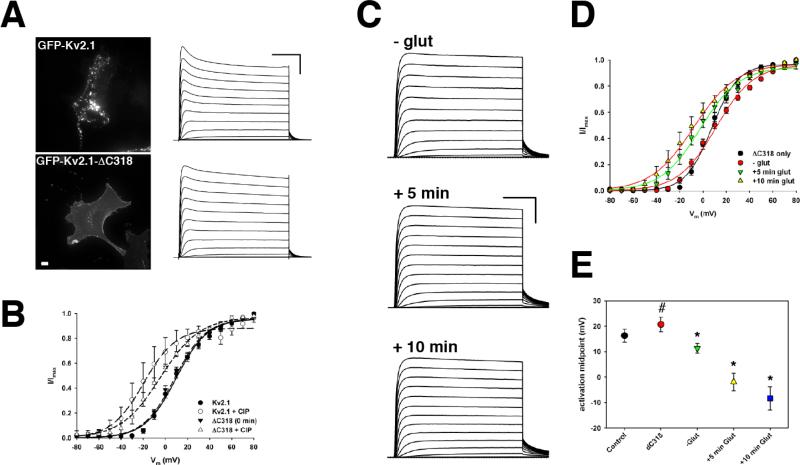
Figure 5. The distal C-terminus of Kv2.1 is required for clustering but not for modulation by NMDARs
A. (Left) Maximum intensity projections of HEK293 cells expressing either full-length GFP-Kv2.1 or GFP-Kv2.1-ΔC318. (Right) Representative whole cell currents from GFP-Kv2.1 or GFL-Kv2.1-ΔC318 expressing HEK293 cells. Scale bars: 50 ms, 1 nA. B. Average normalized I-V curves for Kv2.1 and Kv2.1-ΔC318 ± calf intestinal phosphatase (CIP), illustrating that Kv2.1-ΔC318 retains functional sensitivity to phosphorylation state. C. Representative whole-cell currents from HEK293 cell expressing GFP-Kv2.1-ΔC318 plus NMDAR at the indicated time points before and after the addition of 10 μM glutamate. Average normalized I-V curves (D) and V1/2 (E) for Kv2.1-ΔC318 before and after activation of NMDAR. #, p < 0.05, compared to Control; *, p < 0.001, compared to –glut.

References

    1. Antonucci DE, Lim ST, Vassanelli S, Trimmer JS. Dynamic localization and clustering of dendritic Kv2.1 voltage-dependent potassium channels in developing hippocampal neurons. Neuroscience. 2001;108:69–81. - PubMed
    1. Bentley GN, Brooks MA, O'Neill CA, Findlay JB. Determinants of potassium channel assembly localised within the cytoplasmic C-terminal domain of Kv2.1. Biochim Biophys Acta. 1999;1418:176–184. - PubMed
    1. Brewer GJ. Isolation and culture of adult rat hippocampal neurons. J Neurosci Methods. 1997;71:143–155. - PubMed
    1. Dai XQ, Kolic J, Marchi P, Sipione S, Macdonald PE. SUMOylation regulates Kv2.1 and modulates pancreatic beta-cell excitability. J Cell Sci. 2009;122:775–779. - PubMed
    1. Du J, Haak LL, Phillips-Tansey E, Russell JT, McBain CJ. Frequency-dependent regulation of rat hippocampal somato-dendritic excitability by the K+ channel subunit Kv2.1. J Physiol. 2000;522(Pt 1):19–31. - PMC - PubMed

Publication types

Substances