Review
. 2012 Mar-Apr;3(2):71-87.
doi: 10.4161/gmic.19182. Epub 2012 Mar 1.

Infection strategies of enteric pathogenic Escherichia coli

Affiliations
Review

Infection strategies of enteric pathogenic Escherichia coli

Abigail Clements et al. Gut Microbes. 2012 Mar-Apr.

Abstract

Enteric Escherichia coli (E. coli) are both natural flora of humans and important pathogens causing significant morbidity and mortality worldwide. Traditionally enteric E. coli have been divided into 6 pathotypes, with further pathotypes often proposed. In this review we suggest expansion of the enteric E. coli into 8 pathotypes to include the emerging pathotypes of adherent invasive E. coli (AIEC) and Shiga-toxin producing enteroaggregative E. coli (STEAEC). The molecular mechanisms that allow enteric E. coli to colonize and cause disease in the human host are examined and for two of the pathotypes that express a type 3 secretion system (T3SS) we discuss the complex interplay between translocated effectors and manipulation of host cell signaling pathways that occurs during infection.


Figures
None
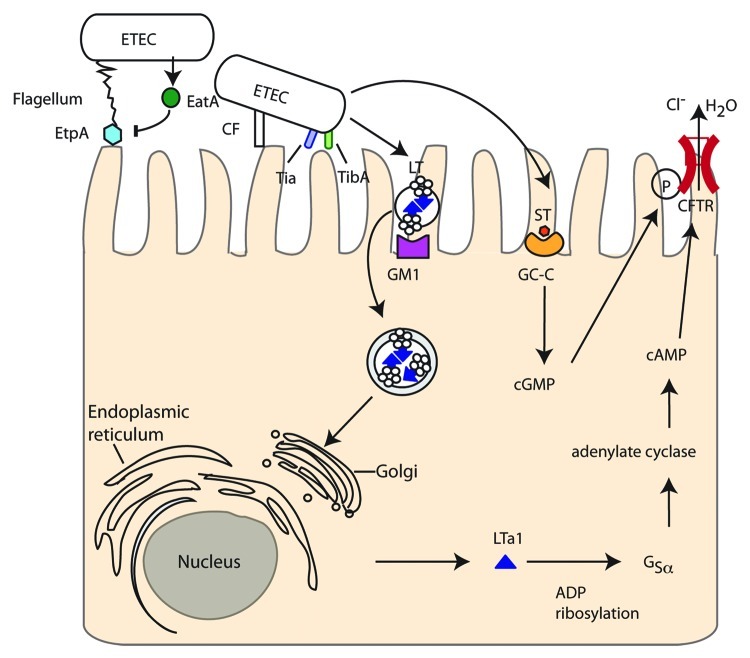
Figure 1. Enterotoxigenic E. coli (ETEC). EtpA located on the tip of flagella attaches to host cells but is then degraded by the SPATE EatA. Adherence is maintained by colonization factors (CF) and intimate attachment achieved with Tia and the autotransporter TibB. Heat stable toxin (ST) is secreted by ETEC and binds to guanylate cyclase-C receptor increasing cGMP and cGMP-dependent protein kinase II. Heat labile toxin (LT) is contained in outer membrane vesicles, which are endocytosed after interaction with ganglioside receptors (GM1). Retrograde transport through the Golgi and ER leads to the A1 subunit being released in the cytosol where it can ADP ribosylate mammalian guanine nucleotide binding protein α-subunit (G) inhibiting the GTPase activity of G and activating adenylate cyclase resulting in uncontrolled cAMP levels. cAMP and cGMP both contribute to phosphorylation of the cystic fibrosis transmembrane regulator (CFTR) chloride channel and modulation of other ion channels leading to osmotic diarrhea.
None
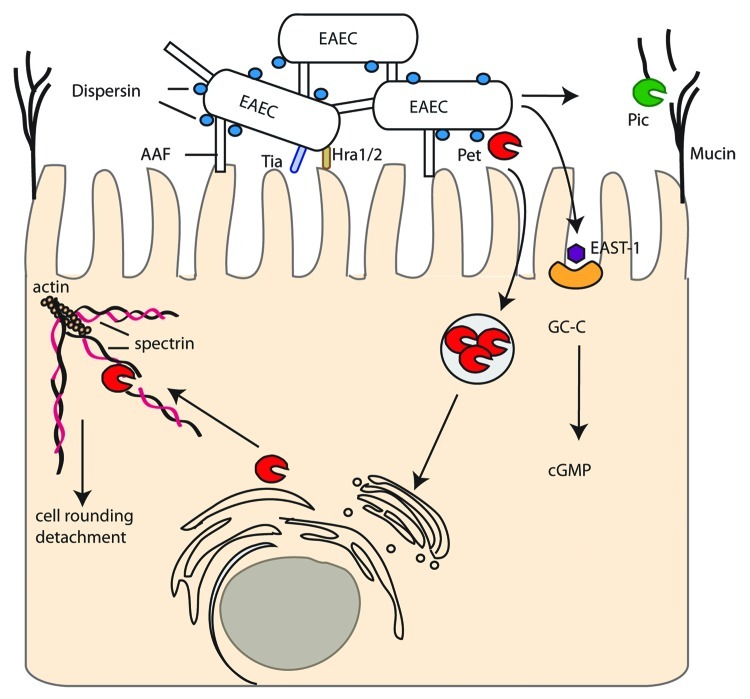
Figure 2. Enteroaggregative E. coli (EAEC). EAEC attach to host cells and each other by Aggregative Adherence Fimbriae (AAF) that are kept extended from the bacterial cell by dispersin. Adhesins Tia and Hra1/2 also contribute to intimate attachment. SPATEs include Pic, which digests mucin on host cells, and Pet which is endocytosed, undergoes retrograde trafficking and cleaves spectrin disrupting the actin cytoskeleton and inducing cell rounding and detachment. EAST-1 binds to and activates GC-C resulting in increased cGMP.
None
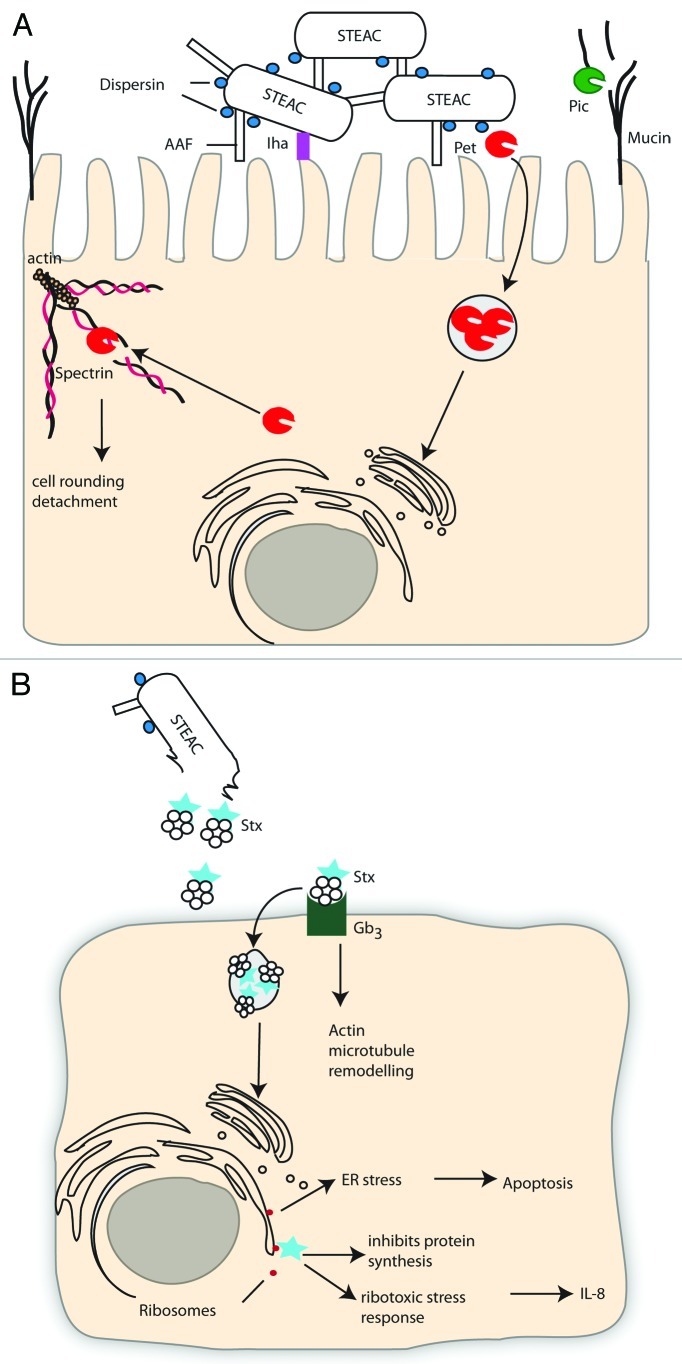
Figure 3. (See opposite page). Shiga Toxin producing Enteroaggregative E. coli (STEAEC). (A) STEAEC attach to each other and to enterocytes by AAF and dispersin, as for EAEC. STEAEC also encodes the Iha adhesin and SPATES Pet and Pic, although their contribution to infection is unknown. The action of shiga toxin (Stx) on an endothelial, toxin sensitive cell is shown in (B). The B subunit of Stx interacts with Gb3 on the host cell and Stx is endocytosed and undergoes retrograde trafficking through the Golgi and ER, the A subunit then cleaves an adenine residue from the 28S rRNA of eukaryotic ribosomes inhibiting protein synthesis and leading to cell death. Stx can also cause cells to undergo a ribotoxic stress response, which leads to release of IL-8, or to undergo ER-dependent apoptosis.
None
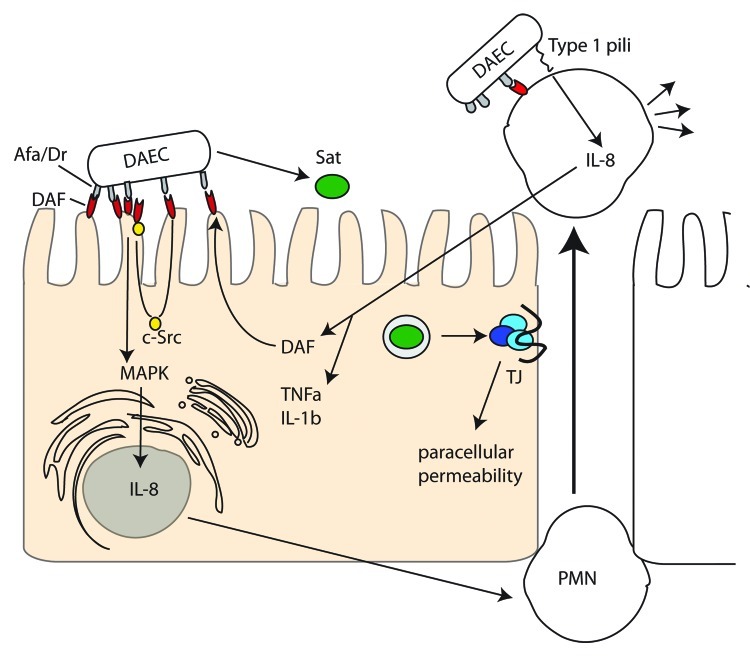
Figure 4. Diffusely Adherent E. coli (DAEC). AFA/Dr adhesins interact with the decay-accelerating factor (DAF) on host cells. Src kinase activation mobilizes DAF around the attachment site mediating stronger attachment and MAPK and PI3K pathway activation culminating in IL-8 synthesis, which induces transmigration of PMNs. PMN transmigration stimulates upregulation of DAF and TNFα and Il-1β synthesis. DAEC Type 1 pili induces IL-8 release from PMNs and apoptosis. Sat induces rearrangement of the tight junction proteins ZO-1, ZO-2 and occludin leading to paracellular permeability.
None
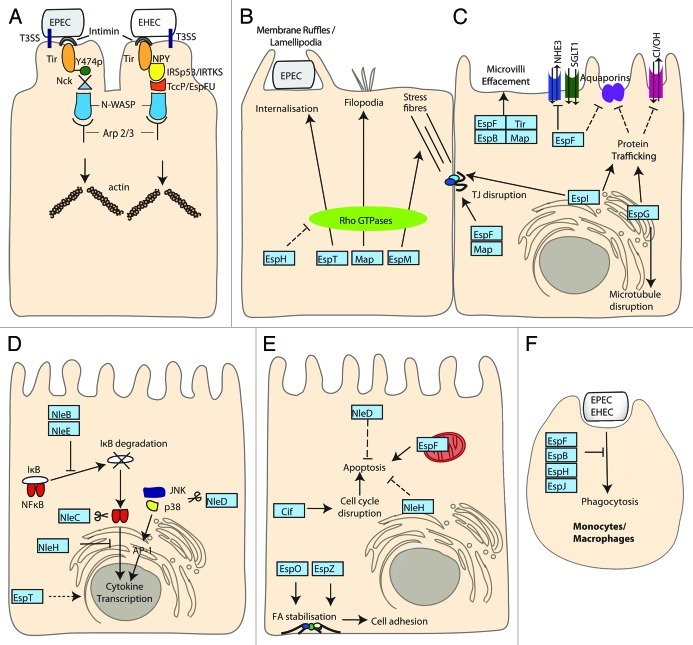
Figure 5. Enteropathogenic E. coli and Enterohamerrhagic E. coli (EPEC and EHEC). EPEC/EHEC inject an array of T3SS effector proteins to mediate intimate attachment and subvert host cell processes. In addition EHEC produces Stx, the action of which is described in Figure 3B. (A) Intimate adherence. The translocated intimin receptor (Tir) binds intimin on the bacterial surface to initiate intimate attachment, actin accumulation and pedestal formation. TirEPEC is phosphorylated at Y474 resulting in Nck and N-WASP recruitment. TirEHEC signaling proceeds independently of Nck via the T3SS effector TccP/EspFU that interacts with IRTKS/IRSp53 and N-WASP. Both pathways lead to Arp2/3 mediated initiation of actin polymerization. (B) Actin remodeling. Map, EspM and EspT activate Rho GTPases leading to filopodia, stress fibers and ruffles/lamellipodia respectively. Additionally, EspT can induce internalization of EPEC. EspH disrupts Rho GTPase signaling by targeting host DH-PH GEFs. (C) Disruption of gut integrity. Tir, Map, EspF and EspB contribute to effacement of the normal absorptive microvilli. Map, EspF and EspI disrupt tight junction (TJ) integrity and epithelial barrier function. EspG disrupts microtubules while EspI and EspG both modulate protein trafficking and affect TJs and the DRA Cl/OH exchanger respectively. EspG and EspF alter aquaporin levels disrupting water and ion absorption. EspF reduces the activity of the NHE3 Na+/H+ exchanger and multiple effectors target the SGLT1 Na+/glucose co-transporter. (D) Manipulating immune responses. NleB, NleC, NleD NleE and NleH inhibit inflammatory responses through targeting NFκB, JNK and p38 pathways. NleB and NleE inhibit IκB degradation and subsequent nuclear translocation of NFκB. NleH can also block NFκB nuclear translocation. NleC and NleD function as metalloproteases acting on NFκB and JNK/p38 respectively blocking transcription of pro-inflammatory genes initiated by NFκB and AP-1 transcription factors. EspT promotes expression of inflammatory genes through Erk, JNK and NFκB pathways. (E) Balancing apoptosis and survival. Pro-apoptotic EspF causes mitochondrial dysfunction leading to activation of apoptotic pathways while Cif causes cell cycle disruption. Anti-apoptotic NleH interacts with BI-1 at the ER and NleD inhibition of AP-1 dependent gene expression (shown in C) reduces pro-apoptotic gene expression. EspO and EspZ promote integrin mediated cell adhesion and survival through interacting with ILK and CD98 respectively. (F) Inhibiting phagocytosis. EspF, EspB, EspH and EspJ inhibit phagocytosis by macrophages through disruption of PI3K signaling, myosin-actin interactions, Rho GTPase signaling and an unknown mechanism respectively.

References

    1. Nataro JP, Kaper JB. Diarrheagenic Escherichia coli. Clin Microbiol Rev. 1998;11:142–201. - PMC - PubMed
    1. Kaper JB, Nataro JP, Mobley HL. Pathogenic Escherichia coli. Nat Rev Microbiol. 2004;2:123–40. doi: 10.1038/nrmicro818. - DOI - PubMed
    1. Croxen MA, Finlay BB. Molecular mechanisms of Escherichia coli pathogenicity. Nat Rev Microbiol. 2010;8:26–38. - PubMed
    1. Wolf MK. Occurrence, distribution, and associations of O and H serogroups, colonization factor antigens, and toxins of enterotoxigenic Escherichia coli. Clin Microbiol Rev. 1997;10:569–84. - PMC - PubMed
    1. Berger CN, Sodha SV, Shaw RK, Griffin PM, Pink D, Hand P, et al. Fresh fruit and vegetables as vehicles for the transmission of human pathogens. Environ Microbiol. 2010;12:2385–97. doi: 10.1111/j.1462-2920.2010.02297.x. - DOI - PubMed

MeSH terms

Substances