


Clostridium difficile infection: toxins and non-toxin virulence factors, and their contributions to disease establishment and host response
- PMID: 22555464
- PMCID: PMC3370945
- DOI: 10.4161/gmic.19399
Clostridium difficile infection: toxins and non-toxin virulence factors, and their contributions to disease establishment and host response
Abstract
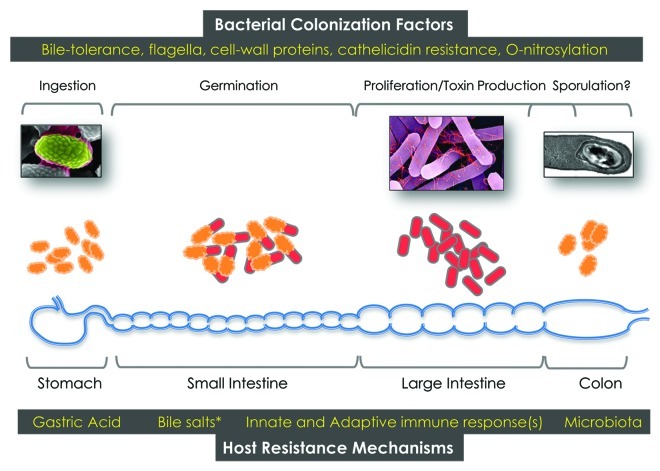
Clostridium difficile infection is the leading cause of antibiotic- and healthcare-associated diarrhea, and its containment and treatment imposes a significant financial burden, estimated to be over $3 billion in the USA alone. Since the year 2000, CDI epidemics/outbreaks have occurred in North America, Europe and Asia. These outbreaks have been variously associated with, or attributed to, the emergence of Clostridium difficile strains with increased virulence, an increase in resistance to commonly used antimicrobials such as the fluoroquinolones, or host susceptibilities, including the use of gastric acid suppressants, to name a few. Efforts to elucidate C. difficile pathogenic mechanisms have been hampered by a lack of molecular tools, manipulatable animal models, and genetic intractability of clinical C. difficile isolates. However, in the past 5 y, painstaking efforts have resulted in the unraveling of multiple C. difficile virulence-associated pathways and mechanisms. We have recently reviewed the disease, its associated risk factors, transmission and interventions (Viswanathan, Gut Microbes 2010). This article summarizes genetics, non-toxin virulence factors, and host-cell biology associated with C. difficile pathogenesis as of 2011, and highlights those findings/factors that may be of interest as future intervention targets.
Figures
References
-
- Killgore G, Thompson A, Johnson S, Brazier J, Kuijper E, Pepin J, et al. Comparison of seven techniques for typing international epidemic strains of Clostridium difficile: restriction endonuclease analysis, pulsed-field gel electrophoresis, PCR-ribotyping, multilocus sequence typing, multilocus variable-number tandem-repeat analysis, amplified fragment length polymorphism, and surface layer protein A gene sequence typing. J Clin Microbiol. 2008;46:431–7. doi: 10.1128/JCM.01484-07. - DOI - PMC - PubMed
Publication types
MeSH terms
Substances
Grants and funding
LinkOut - more resources
Full Text Sources
Other Literature Sources
Medical
Miscellaneous
