


The many roles of the eukaryotic elongation factor 1 complex
- PMID: 22555874
- PMCID: PMC3374885
- DOI: 10.1002/wrna.1118
The many roles of the eukaryotic elongation factor 1 complex
Abstract
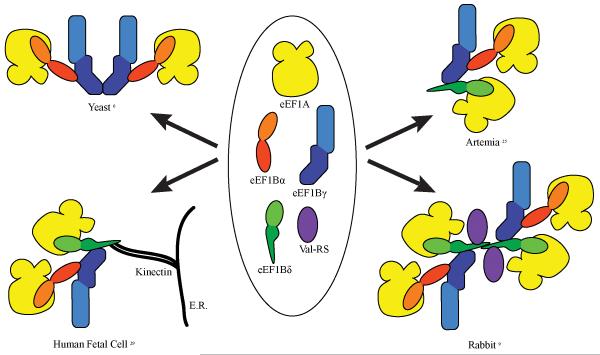
The vast majority of proteins are believed to have one specific function. Throughout the course of evolution, however, some proteins have acquired additional functions to meet the demands of a complex cellular milieu. In some cases, changes in RNA or protein processing allow the cell to make the most of what is already encoded in the genome to produce slightly different forms. The eukaryotic elongation factor 1 (eEF1) complex subunits, however, have acquired such moonlighting functions without alternative forms. In this article, we discuss the canonical functions of the components of the eEF1 complex in translation elongation as well as the secondary interactions they have with other cellular factors outside of the translational apparatus. The eEF1 complex itself changes in composition as the complexity of eukaryotic organisms increases. Members of the complex are also subject to phosphorylation, a potential modulator of both canonical and non-canonical functions. Although alternative functions of the eEF1A subunit have been widely reported, recent studies are shedding light on additional functions of the eEF1B subunits. A thorough understanding of these alternate functions of eEF1 is essential for appreciating their biological relevance.
Copyright © 2012 John Wiley & Sons, Ltd.
Figures
References
-
- Le Sourd F, Boulben S, Le Bouffant R, Cormier P, Morales J, Belle R, Mulner-Lorillon O. eEF1B: At the dawn of the 21st century. Biochim Biophys Acta. 2006;1759:13–31. - PubMed
-
- Carvalho MD, Carvalho JF, Merrick WC. Biological characterization of various forms of elongation factor 1 from rabbit reticulocytes. Arch Biochem Biophys. 1984;234:603–611. - PubMed
-
- Taylor DR, Frank J, Kinzy TG. Structure and Function of the Eukaryotic Ribosome and Elongation Factors. In: Sonenberg N, Hershey JWB, Mathews MB, editors. Translational Control in Biology and Medicine. Cold Spring Harbor Laboratory Press; Cold Spring Harbor: 2007. pp. 59–85.
-
- Pittman YR, Valente L, Jeppesen MG, Andersen GR, Patel S, Kinzy TG. Mg2+ and a key lysine modulate exchange activity of eukaryotic translation elongation factor 1B alpha. J Biol Chem. 2006;281:19457–19468. - PubMed
-
- Janssen GM, Moller W. Kinetic studies on the role of elongation factors 1 beta and 1 gamma in protein synthesis. J Biol Chem. 1988;263:1773–1778. - PubMed
Publication types
MeSH terms
Substances
Grants and funding
LinkOut - more resources
Full Text Sources
Other Literature Sources
Miscellaneous
