Review
. 2012 Sep;21(9):1402-8.
doi: 10.1158/1055-9965.EPI-11-1158. Epub 2012 May 3.

Prevention of invasive cervical cancer in the United States: past, present, and future

Affiliations
Review

Prevention of invasive cervical cancer in the United States: past, present, and future

Christine M Pierce Campbell et al. Cancer Epidemiol Biomarkers Prev. 2012 Sep.

Abstract

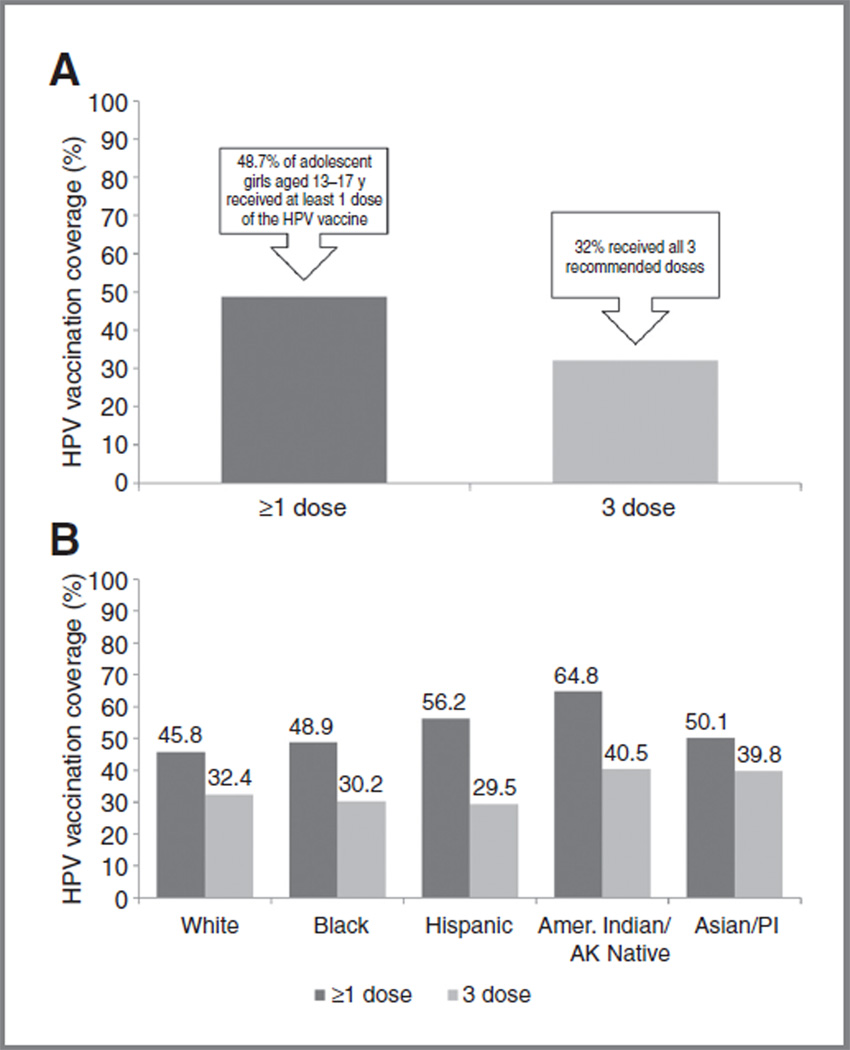
Over the past several decades, invasive cervical cancer (ICC) incidence in the United States has declined dramatically. Much of this decline has been attributed to widespread use of cytology screening followed by treatment of precancerous lesions. Despite available technologies to prevent ICC and screening programs targeting high-risk women, certain populations in the United States experience disproportionately high rates of ICC (e.g., racial/ethnic minorities and rural women). Limited access to and use of screening/follow-up services underlie this disparity. The licensure of the human papillomavirus (HPV) vaccine in 2006 introduced an additional method of ICC prevention. Unfortunately, dissemination of the vaccine to age-eligible females has been lower than expected (32% have received all 3 recommended doses). Decreasing the burden of HPV infection and HPV-related diseases in the United States will require greater dissemination of the HPV vaccine to adolescents and young adults, along with successful implementation of revised ICC screening guidelines that incorporate HPV and cytology cotesting. While a future without ICC is possible, we will need a comprehensive national health care program and innovative approaches to reduce ICC burden and disparities.


Conflict of interest statement

Disclosure of Potential Conflicts of Interest

E.D. Paskett received commercial research support from Merck. A.R. Giuliano received a commercial research grant from Merck and commercial research support from GSK. A.R. Giuliano received an honoraria from Speaker’s bureau and is a consultant/advisory board member in Merck. No potential conflicts of interest were disclosed by the other authors.

Figures
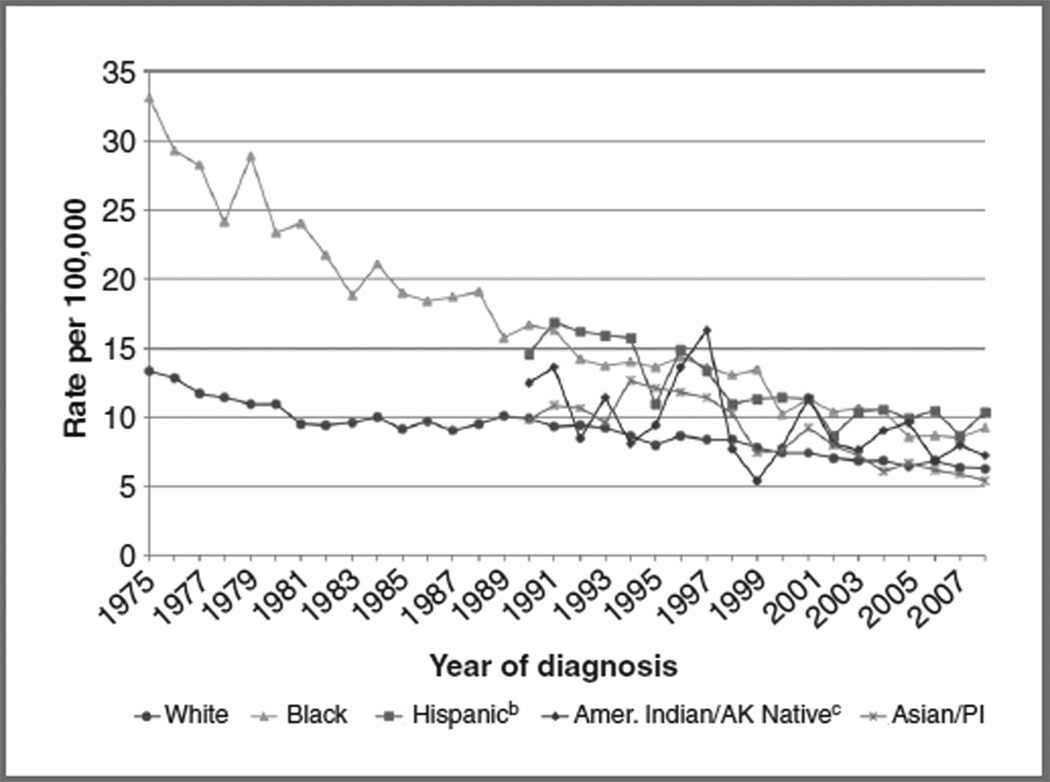
Figure 1
Figure 1
Time trends in age-adjusted incidencea of ICC in the United States, 1975–2008, by race/ethnicity. aRates are age-adjusted to the 2000 United States standard population. Incidence data for whites and blacks are from the Surveillance Epidemiology and End Results (SEER) 9 areas (San Francisco, Connecticut, Detroit, Hawaii, Iowa, New Mexico, Seattle, Utah, and Atlanta). Incidence data for Asian/Pacific Islanders, American Indians/Alaska Natives, and Hispanics are from the SEER 13 Areas (SEER 9 Areas, San Jose-Monterey, Los Angeles, Alaska Native Registry, and Rural Georgia). bHispanic is not mutually exclusive from whites, blacks, Asian/Pacific Islanders, and American Indians/Alaska Natives. Incidence data for Hispanics are based on North American Association of Central Cancer Registries Hispanic Identification Algorithm (NHIA) and exclude cases from the Alaska Native Registry. cRates for American Indian/Alaska Native are based on the CHSDA (Contract Health Service Delivery Area) counties. Notes: SEER 9 and SEER 13 cancer incidence data are collected from population-based cancer registries covering 9.5% and 13.8% of the U.S. population, respectively. Source: SEER (4). AK, Alaskan; Amer, American; PI, Pacific Islanders.
Figure 2
Figure 2
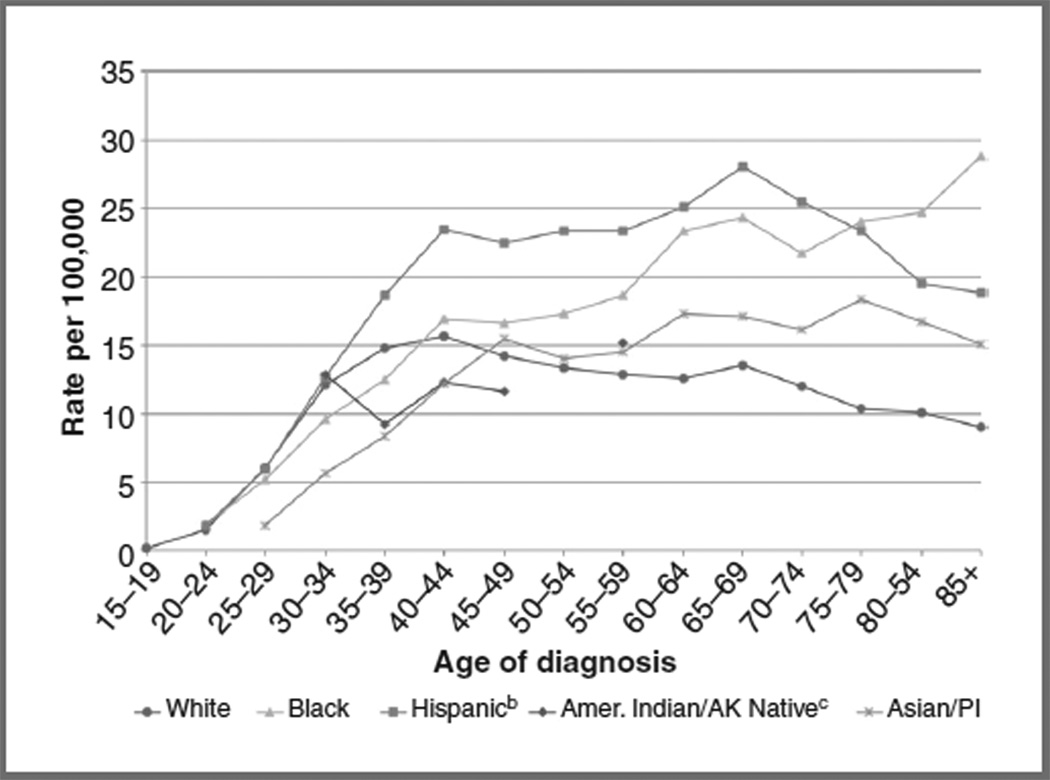
Age-specific incidencea of ICC in the United States, 2000 to 2008, by race/ethnicity. aIncidence data are from the SEER 17 areas (San Francisco, Connecticut, Detroit, Hawaii, Iowa, New Mexico, Seattle, Utah, Atlanta, San Jose-Monterey, Los Angeles, Alaska Native Registry, Rural Georgia, California excluding San Francisco/San Jose-Monterey/ Los Angeles, Kentucky, Louisiana, and New Jersey). bHispanic is not mutually exclusive from whites, blacks, Asian/Pacific Islanders, and American Indians/Alaska Natives. Incidence data for Hispanics are based on NHIA and exclude cases from the Alaska Native Registry. cRates for American Indian/Alaska Native are based on the CHSDA(Contract Health Service Delivery Area) counties. Notes: SEER 17 cancer incidence data are collected from population-based cancer registries covering 26.2% of the U.S. population. Source: SEER (9). AK, Alaskan; Amer, American; PI, Pacific Islanders.
Figure 3
Figure 3
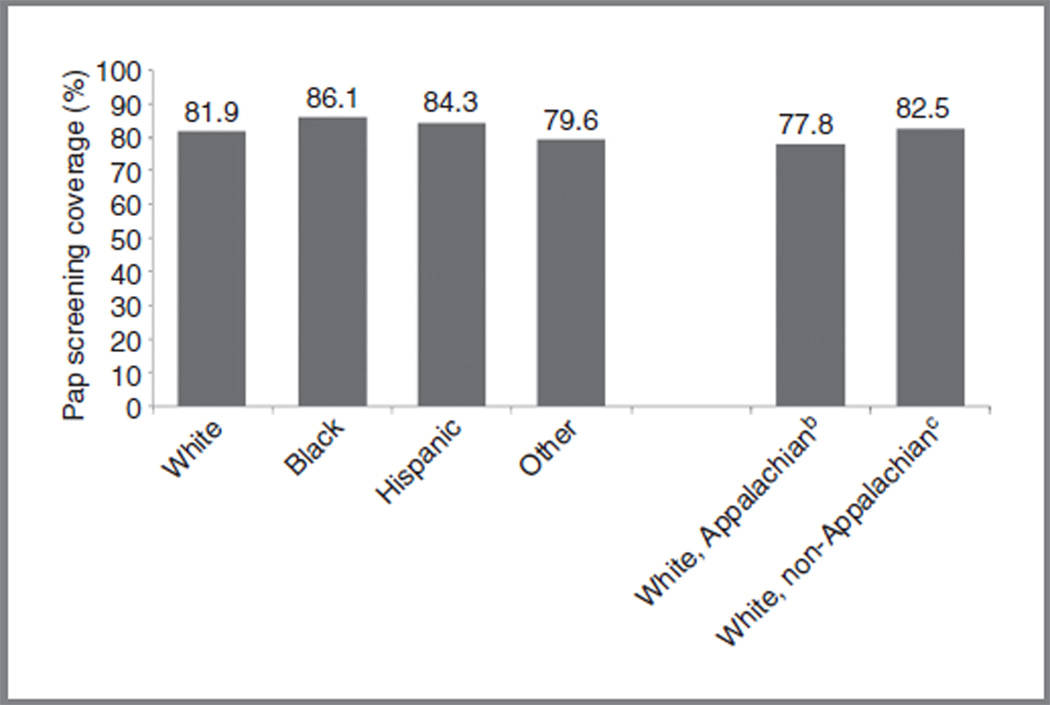
Estimates of recent, self-reported Pap screening among adult womena in the United States, 2010. aWomen 18 years of age and older with an intact cervix who have had a Pap test within the past 3 years. bEstimates are from Ohio counties considered part of the Appalachian region. cEstimates are from Ohio counties not considered part of the Appalachian region. Notes: BRFSS data are collected by each state via landline telephone survey. The median response rate for the 2010 BRFSS (all states combined) was 54.6%. BRFSS prevalence estimates are overestimated when compared with National Health Interview Survey (NHIS) estimates. Sources: BRFSS, United States, 2010 (15).
Figure 4
Figure 4
A, estimates of HPV vaccinationa coverage among adolescent girls (13–17 years) in the United States, 2010. B, estimates of HPV vaccinationa coverage among adolescent girls (13–17 years) in the United States, 2010, by race/ethnicity. aQuadrivalent or bivalent vaccine. Source: NIS-Teen, United States, 2010 (22). AK, Alaskan; Amer, American; PI, Pacific Islanders.
Figure 5
Figure 5
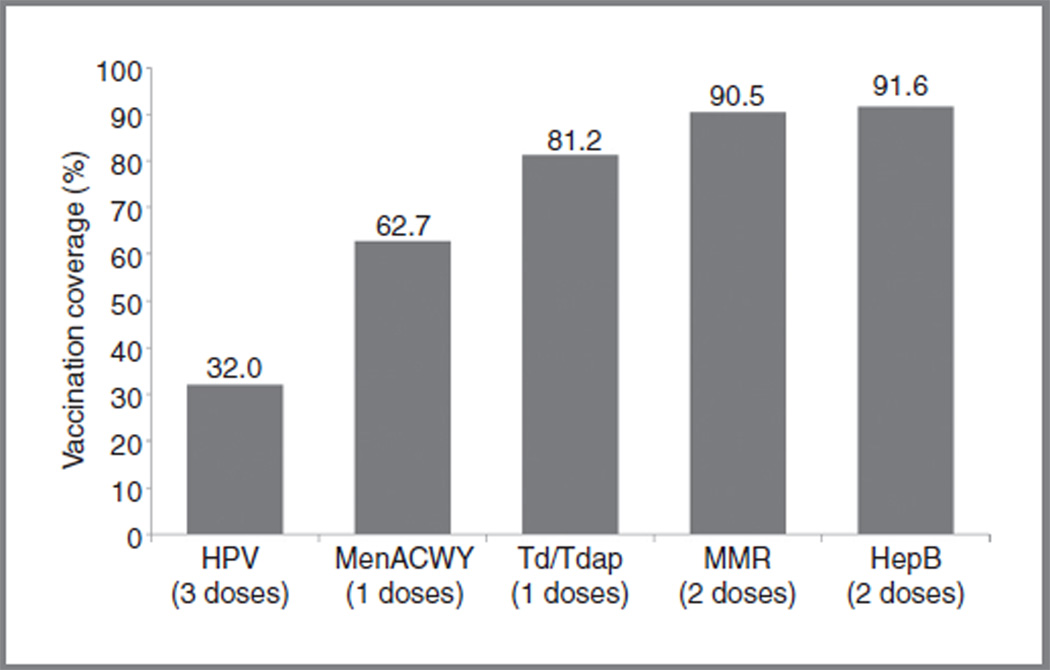
Estimates of childhood vaccination coverage among adolescents (13–17 years) in the United States, 2010. HepB, hepatitis B vaccine; MenACWY, meningococcal vaccine; MMR, measles, mumps, rubella vaccine; Td/Tdap, tetanus toxoid-diphtheria vaccine (Td) or tetanus toxoid, diphtheria, pertussis vaccine (Tdap). Notes: HPV vaccine (quadrivalent or bivalent) reported among females only. Source: NIS-Teen, United States, 2010 (22).

References

    1. American Cancer Society. Cancer facts & figures 2011. Atlanta, GA: American Cancer Society; 2011.
    1. Kohler BA, Ward E, McCarthy BJ, Schymura MJ, Ries LA, Eheman C, et al. Annual report to the nation on the status of cancer, 1975–2007, featuring tumors of the brain and other nervous system. J Natl Cancer Inst. 2011;103:714–736. - PMC - PubMed
    1. Scarinci IC, Garcia FA, Kobetz E, Partridge EE, Brandt HM, Bell MC, et al. Cervical cancer prevention: new tools and old barriers. Cancer. 2010;116:2531–2542. - PMC - PubMed
    1. Howlader N, Noone A, Krapcho M, Neyman N, Aminou R, Waldron W, et al. SEER cancer statistics review, 1975–2008. Bethesda, MD: National Cancer Institute; 2011. [cited 2011 Nov 29]. Available from: http://seer.cancer.gov/csr/1975_2008.
    1. Patel NR, Rollison DE, Barnholtz-Sloan J, Mackinnon J, Green L, Giuliano AR. Racial and ethnic disparities in the incidence of invasive cervical cancer in Florida. Cancer. 2009;115:3991–4000. - PubMed

Publication types

Substances