Addition of home-based cognitive retraining to treatment as usual in first episode schizophrenia patients: a randomized controlled study
- PMID: 22556432
- PMCID: PMC3339213
- DOI: 10.4103/0019-5545.94640
Addition of home-based cognitive retraining to treatment as usual in first episode schizophrenia patients: a randomized controlled study
Abstract
Objective: We examined the effectiveness of a 2-month-long home-based cognitive retraining program together with treatment as usual (TAU; psychoeducation and drug therapy) on neuropsychological functions, psychopathology, and global functioning in patients with first episode schizophrenia (FES) as well as on psychological health and perception of level of family distress in their caregivers.
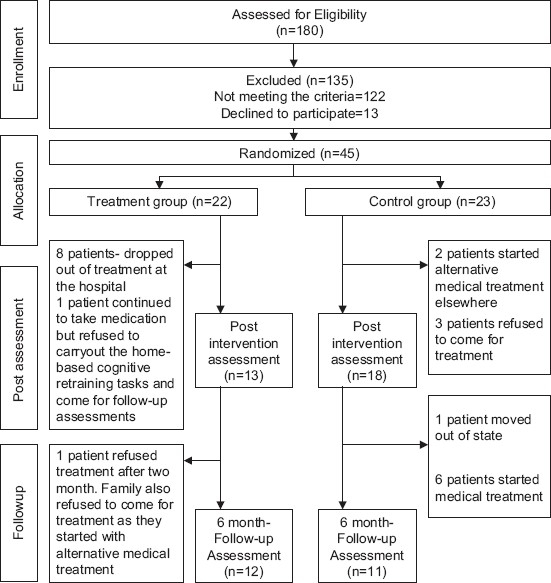
Materials and methods: Forty-five FES patients were randomly assigned to either treatment group receiving home-based cognitive retraining along with TAU (n=22) or to control group receiving TAU alone (n=23). Patients and caregivers received psychoeducation. Patients and one of their caregivers were assessed for the above parameters at baseline, post-assessment (2 months) and at 6-months follow-up assessment.
Results: Of the 45 patients recruited, 12 in the treatment group and 11 in the control group completed post-intervention and follow-up assessments. Addition of home-based cognitive retraining along with TAU led to significant improvement in neuropsychological functions of divided attention, concept formation and set-shifting ability, and planning. Effect sizes were large, although the sample size was small.
Conclusions: Home-based cognitive retraining program has shown promise. However, further studies examining this program on a larger cohort with rigorous design involving independent raters are suggested.
Keywords: Cognitive retraining; first-episode schizophrenia; global functioning; psychoeducation; psychopathology.
Conflict of interest statement
Figures
References
-
- Bilder, Goldman R, Robinson D, Reiter G, Bell L, Bates JA, et al. First-episode schizophrenia: Characterization and clinical correlates. Neuropsychological Trends. 2007;2:7–30.
-
- Bilder RM, Goldman RS, Robinson D, Reiter G, Bell L, Bates JA, et al. Neuropsychology of first-episode schizophrenia: Initial characterization and clinical correlates. Am J Psychiatry. 2000;157:549–59. - PubMed
-
- Goldberg W. The course of cognitive impairment in patients with schizophrenia. In: Sharma T, editor. Cognition in Schizophrenia. Oxford: Oxford University Press; 2000. pp. 3–15.
-
- Rund BR, Melle I, Friis S, Johannessen JO, Larsen TK, Midboe LJ, et al. The course of neurocognitive functioning in first-episode psychosis and its relation to premorbid adjustment, duration of untreated psychosis, and relapse. Schizophr Res. 2007;91:132–40. - PubMed
-
- Green MF. What are the functional consequences of neurocognitive deficits in schizophrenia? Am J Psychiatry. 1996;153:321–30. - PubMed
LinkOut - more resources
Full Text Sources
Miscellaneous