Anesthesia and perioperative management of colorectal surgical patients - A clinical review (Part 1)
- PMID: 22557737
- PMCID: PMC3339719
- DOI: 10.4103/0970-9185.94831
Anesthesia and perioperative management of colorectal surgical patients - A clinical review (Part 1)
Abstract
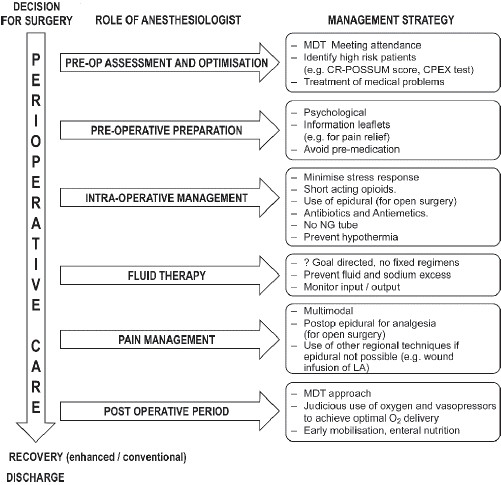
Colorectal surgery is commonly performed for colorectal cancer and other pathology such as diverticular and inflammatory bowel disease. Despite significant advances, such as laparoscopic techniques and multidisciplinary recovery programs, morbidity and mortality remain high and vary among surgical centers. The use of scoring systems and assessment of functional capacity may help in identifying high-risk patients and predicting complications. An understanding of perioperative factors affecting colon blood flow and oxygenation, suppression of stress response, optimal fluid therapy, and multimodal pain management are essential. These fundamental principles are more important than any specific choice of anesthetic agents. Anesthesiologists can significantly contribute to enhance recovery and improve the quality of perioperative care.
Keywords: Analgesia; anesthesia; colorectal; intestinal; perioperative.
Conflict of interest statement
Figures
References
-
- Gilmour DG, Douglas IH, Aitkenhead AR, Hothersall AP, Horton PW, Ledingham IM. Colon blood flow in the dog: Effects of changes in arterial carbon dioxide tension. Cardiovasc Res. 1980;14:11–20. - PubMed
-
- Gilmour DG, Aitkenhead AR, Hothersall AP, Ledingham IM. The effect of hypovolaemia on colonic blood flow in the dog. Br J Surg. 1980;67:82–4. - PubMed
-
- Diebel LN, Dulchavsky SA, Wilson RF. Effect of increased intra-abdominal pressure on mesenteric arterial and intestinal mucosal blood flow. J Trauma. 1992;33:45–8. - PubMed
-
- Kimberger O, Arnberger M, Brandt S, Plock J, Sigurdsson GH, Kurz A, et al. Goal-directed colloid administration improves the microcirculation of healthy and perianastomotic colon. Anesthesiology. 2009;110:496–504. - PubMed