


Executive control of attention in narcolepsy
- PMID: 22558075
- PMCID: PMC3338809
- DOI: 10.1371/journal.pone.0033525
Executive control of attention in narcolepsy
Abstract
Background: Narcolepsy with cataplexy (NC) is a disabling sleep disorder characterized by early loss of hypocretin neurons that project to areas involved in the attention network. We characterized the executive control of attention in drug-free patients with NC to determine whether the executive deficits observed in patients with NC are specific to the disease itself or whether they reflect performance changes due to the severity of excessive daytime sleepiness.
Methodology: Twenty-two patients with NC compared to 22 patients with narcolepsy without cataplexy (NwC) matched for age, gender, intellectual level, objective daytime sleepiness and number of sleep onset REM periods (SOREMPs) were studied. Thirty-two matched healthy controls were included. All participants underwent a standardized interview, completed questionnaires, and neuropsychological tests. All patients underwent a polysomnography followed by multiple sleep latency tests (MSLT), with neuropsychological evaluation performed the same day between MSLT sessions.
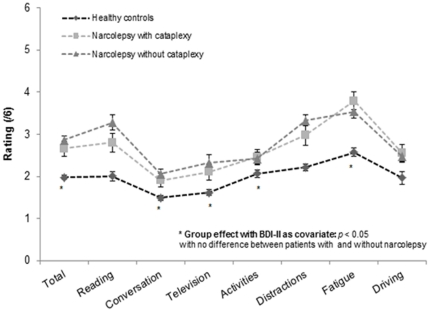
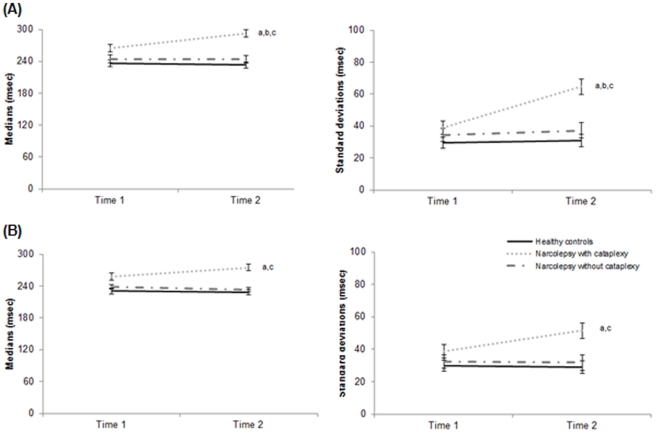
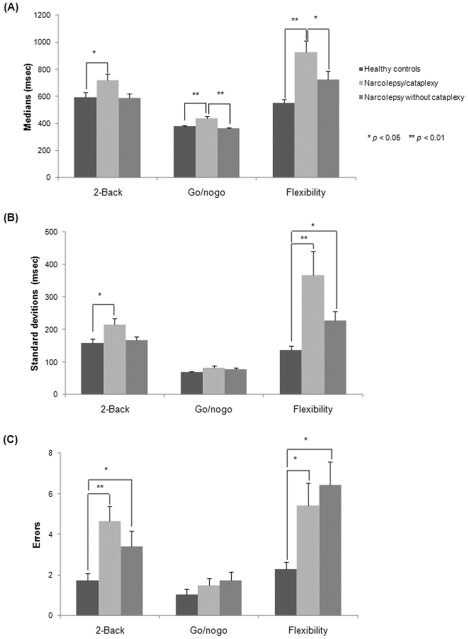
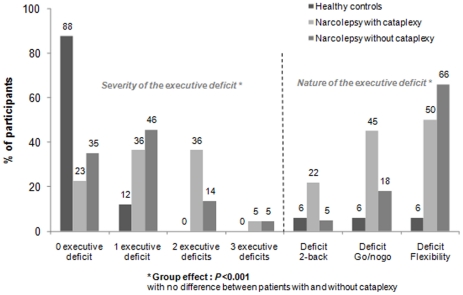
Principal findings: Irrespective of diagnosis, patients reported higher self-reported attentional complaints associated with the intensity of depressive symptoms. Patients with NC performed slower and more variably on simple reaction time tasks than patients with NwC, who did not differ from controls. Patients with NC and NwC generally performed slower, reacted more variably, and made more errors than controls on executive functioning tests. Individual profile analyses showed a clear heterogeneity of the severity of executive deficit. This severity was related to objective sleepiness, higher number of SOREMPs on the MSLT, and lower intelligence quotient. The nature and severity of the executive deficits were unrelated to NC and NwC diagnosis.
Conclusions: We demonstrated that drug-free patients with NC and NwC complained of attention deficit, with altered executive control of attention being explained by the severity of objective sleepiness and global intellectual level. Further studies are needed to explore whether medications that promote wakefulness can improve the executive functions in narcolepsy.
Conflict of interest statement
Figures
References
-
- Dauvilliers Y, Arnulf I, Mignot E. Narcolepsy with cataplexy. Lancet. 2007;369:499–511. - PubMed
-
- Nishino S, Ripley B, Overeem S, Lammers GJ, Mignot E. Hypocretin (orexin) deficiency in human narcolepsy. Lancet. 2000;355:39–40. - PubMed
-
- Ripley B, Overeem S, Fujiki N, Nevsimalova S, Uchino M, et al. CSF ypocretin/orexin levels in narcolepsy and other neurological conditions. Neurology. 2001;57:2253–2258. - PubMed
-
- Mignot E, Lammers GJ, Ripley B, Okun M, Nevsimalova S, et al. The role of cerebrospinal fluid hypocretin measurement in the diagnosis of narcolepsy and other hypersomnias. Arch Neurol. 2002;59:1553–1562. - PubMed
-
- Ervik S, Abdelnoor M, Heier MS, Ramberg M, Strand Health-related quality of life in narcolepsy. Acta Neurol Scand. 2006;114:198–204. - PubMed
Publication types
MeSH terms
LinkOut - more resources
Full Text Sources
