. 2012;7(4):e35497.
doi: 10.1371/journal.pone.0035497. Epub 2012 Apr 27.

Antibody repertoires in humanized NOD-scid-IL2Rγ(null) mice and human B cells reveals human-like diversification and tolerance checkpoints in the mouse

Affiliations

Antibody repertoires in humanized NOD-scid-IL2Rγ(null) mice and human B cells reveals human-like diversification and tolerance checkpoints in the mouse

Gregory C Ippolito et al. PLoS One. 2012.

Abstract

Immunodeficient mice reconstituted with human hematopoietic stem cells enable the in vivo study of human hematopoiesis. In particular, NOD-scid-IL2Rγ(null) engrafted mice have been shown to have reasonable levels of T and B cell repopulation and can mount T-cell dependent responses; however, antigen-specific B-cell responses in this model are generally poor. We explored whether developmental defects in the immunoglobulin gene repertoire might be partly responsible for the low level of antibody responses in this model. Roche 454 sequencing was used to obtain over 685,000 reads from cDNA encoding immunoglobulin heavy (IGH) and light (IGK and IGL) genes isolated from immature, naïve, or total splenic B cells in engrafted NOD-scid-IL2Rγ(null) mice, and compared with over 940,000 reads from peripheral B cells of two healthy volunteers. We find that while naïve B-cell repertoires in humanized mice are chiefly indistinguishable from those in human blood B cells, and display highly correlated patterns of immunoglobulin gene segment use, the complementarity-determining region H3 (CDR-H3) repertoires are nevertheless extremely diverse and are specific for each individual. Despite this diversity, preferential D(H)-J(H) pairings repeatedly occur within the CDR-H3 interval that are strikingly similar across all repertoires examined, implying a genetic constraint imposed on repertoire generation. Moreover, CDR-H3 length, charged amino-acid content, and hydropathy are indistinguishable between humans and humanized mice, with no evidence of global autoimmune signatures. Importantly, however, a statistically greater usage of the inherently autoreactive IGHV4-34 and IGKV4-1 genes was observed in the newly formed immature B cells relative to naïve B or total splenic B cells in the humanized mice, a finding consistent with the deletion of autoreactive B cells in humans. Overall, our results provide evidence that key features of the primary repertoire are shaped by genetic factors intrinsic to human B cells and are principally unaltered by differences between mouse and human stromal microenvironments.


Conflict of interest statement

Competing Interests: The authors have declared that no competing interests exist.

Figures

Figure 1
Figure 1. Human B lineage cells generated in humanized NOD-scid-IL2Rγnull mice.
NOD-scid-IL2Rγnull mice were engrafted with CD34+ stem cells obtained from human umbilical cord blood. Cells were recovered from bone marrow and spleen 16–18 weeks post-engraftment and examined by flow cytometry. (A) Total mononuclear cells isolated from the spleen (SPL) of a humanized NOD-scid-IL2Rγnull mouse show the presence of 15% human CD45+ leukocytes in which CD19+ B lymphocytes comprise nearly one-fourth of the compartment. B cells were predominantly CD20+ CD38int/lo and were chiefly IgD+ naïve cells (>90% on average in all three humanized mice). Results shown are representative of n = 3 humanized mice. (B) Figures depict the schemes used for sorting newly formed immature B cells (CD24high CD38+ IgM+ IgD) in bone marrow (BM), and naïve B cells (CD19+ IgD+ CD27) in spleen. Boxes indicate the B cell compartments that were sorted for immunoglobulin gene sequencing.
Figure 2
Figure 2. Human B cells generated in NOD-scid-IL2Rγnull mice produce a globally diverse VH immunoglobulin repertoire that is indistinguishable from normal human peripheral blood B cells.
B lymphocytes were obtained for high-throughput 454 GS-FLX immunoglobulin cDNA gene sequencing. The samples included peripheral blood B cells from two human donors (HuPBC-1, HuPBC-2), naïve B cells (CD19+IgD+CD27) enriched from two humanized mouse spleens (HuMs-1NSpl and HuMs-2NSpl), total splenic B cells from one humanized mouse (HuMs-3TSpl), and newly formed immature B cells (CD24highCD38+IgM+IgD) pooled from the bone marrow of all three mice (HuMs-ImmB). (A) Engrafted HuMs cells use the full range of IGHV families and display a pattern of utilization similar to control HuPBC samples. Frequencies of IGHV family member use by B cells arising in HuPBC, HuMs, and HuMs-ImmB are comparable between any two samples examined across all IGHV gene families (rs0.89 for all comparisons). One intrafamily statistical difference was discerned, however, for the IGHV4 family (*** P<0.0001; χ2). (B) Frequencies of IGHD family use are highly similar between HuMs and HuPBC (rs0.86 for all comparisons), although a subtle yet significant trend in elevated IGHD7 family use was discerned among HuMs samples (see text). (C) Frequencies of IGHJ use, like IGHV and IGHD, are statistically similar (rs0.71).
Figure 3
Figure 3. Human B cells generated in NOD-scid-IL2Rγnull mice produce a globally diverse VL immunoglobulin repertoire that is highly similar to normal human peripheral blood B cells.
Engrafted HuMs cells use the full range of IGHK and IGHL families and with a pattern of utilization similar to control HuPBC samples. Frequencies of IGHK and IGHL family member use by B cells arising in HuPBC, HuMs, and HuMs-ImmB are comparable between any two samples examined across all gene families: rs0.86 for IGKV (A); rs0.7 for IGKJ (B); rs0.85 for IGLV (C); rs0.75 for IGLJ (D). Although highly similar overall, an overrepresentation of the IGKV4 family occurred among HuMs-ImmB sequences when compared to HuPBC-2 or any other sample (***P<0.0001; χ2).
Figure 4
Figure 4. Deletion of autoreactive V genes during transit from bone marrow to the periphery.
(A) Immature bone marrow B cells (HuMs-ImmB) were highly enriched for use of the inherently autoreactive IGHV4-34 element compared to HuMs peripheral B cells obtained from sorted spleen naïve cells (HuMs-1NSpl, HuMs-2NSpl) or from total spleen cells (HuMs-3TSpl) (*** P<0.0001; χ2). (B) HuMs-ImmB were also highly enriched for utilization of the SLE-associated IGKV4-1 light chain gene compared to HuMs peripheral B cells which had been depleted for this gene (*** P<0.0001; χ2).
Figure 5
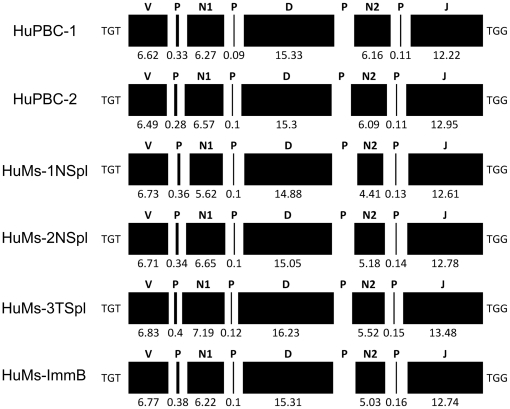
Figure 5. DNA deconstruction reveals IgM CDR-H3 repertoires that are normally diversified and indistinguishable between humanized NOD-scid-IL2Rγnull mice and normal human B cells.
The germline contribution of IGHV, IGHD, and IGHJ elements is illustrated. Shown are IgM CDR-H3 sequences containing an identifiable IGHD segment located between the IGHV conserved cysteine codon (TGT) and the conserved tryptophan codon (TGG) encoded by IGHJ elements. All components are shown to scale. Data comprises functional IgM sequences derived from unique CDR-H3s isolated from HuPBC-1, HuPBC-2, HuMs-1NSpl, HuMs-2NSpl, HuMs-3TSpl, and HuMs-ImmB using a previously published algorithm . Preservation of IGHV, IGHD, and IGHJ germline sequences were statistically similar across all samples (Student’s t test). The degree of nontemplated N-region [N] additions, palindromic [P] nucleotide additions, and total CDR-H3 length were also statistically indistinguishable, except for a subtle increase in 3′ N-region addition among HuPBC (P = 0.03).
Figure 6
Figure 6. CDR-H3 physicochemical properties imply a normal antibody repertoire in humanized mice devoid of autoimmune signatures.
(A) The average hydropathic index of the CDR-H3 interval was calculated using a normalized Kyte-Doolittle scale . The average hydropathy for all samples was centered about the neutral, slightly hydrophilic zero value and all were depleted of either highly charged (≤–0.7) or highly hydrophobic (≥0.7) CDR-H3s. (B) Pie charts showing the statistically similar proportion CDR-H3s with ≥0,1,2,3, or 4 positive charges, namely, the cationic residues arginine (R, top row) and lysine (K, bottom row). (C) Similarity of individual a.a. distributions within CDR-H3.
Figure 7
Figure 7. CDR-H3 amino acid patterning.
Positional amino acid frequencies in CDR-H3s of the same length. Length n = 15 was the approximate mean length of CDR-H3 observed in all data sets. Positional biases are generally preserved in all sets.
Figure 8
Figure 8. Pairwise preferential D-J joins are observed in both humanized mice and human peripheral B cell immunoglobulin repertoires.
Heatmaps of D-J rearrangements for IgM transcripts are shown. Several pairwise associations are overrepresented (D6-19 with J4, D3-22 with J4, and D3-22 with J3) and at comparable frequencies in all of the repertoires. Nonrandom patterns of D-J rearrangement established in the primary repertoire of newly generated IgM+IgD immature B cells of humanized bone marrow (HuMs-ImmB) are chiefly preserved among peripheral humanized B cells (HuMs) which closely resemble those patterns seen in the peripheral blood human B cells (HuPBC).
Figure 9
Figure 9. Somatic mutation in IgM primary repertoires.
The ratio of replacement mutations in CDR-H1 and CDR-H2 (R CDR) to the total number of mutations (M v) is plotted on the y-axis versus M v on the x-axis. The 95% confidence limit for the probability of random mutations is shaded in gray. Data points falling outside this limit represent IgM sequences with a significant occurrence of replacement mutations in the CDRs and are considered indicative of antigen selection. Data points are numbered according to their observed frequency. The overall paucity of somatic mutation in the VH gene among humanized B cells is visually apparent. Replacement mutations in CDR-H1 or CDR-H2 are rare. Whereas this result is expected for humanized samples HuMs-1 and HuMs-2 (naïve CD19+IgD+CD27 splenic B cells), and expected for HuMs-ImmB (newly formed, immature bone marrow B cells), HuMs-3 was prepared from bulk spleen and could conceivably have captured a subpopulation of somatically mutated human IgM+ memory cells. Whereas greater than 99% of humanized HuMs B cells show no evidence for antigen selection (nonrandom mutation), HuPBC cells show an approximately ten-fold (4.83%) to twenty-fold (7.65%) greater proportion of antigen-selected sequences.

References

    1. Ishikawa F, Niiro H, Iino T, Yoshida S, Saito N, et al. The developmental program of human dendritic cells is operated independently of conventional myeloid and lymphoid pathways. Blood. 2007;110:3591–3660. - PMC - PubMed
    1. Giassi LJ, Pearson T, Shultz LD, Laning J, Biber K, et al. Expanded CD34+ human umbilical cord blood cells generate multiple lymphohematopoietic lineages in NOD-scid IL2rgamma(null) mice. Exp Biol Med (Maywood) 2008;233:997–1012. - PMC - PubMed
    1. Manz MG. Human-hemato-lymphoid-system mice: opportunities and challenges. Immunity. 2007;26:537–541. - PubMed
    1. Shultz LD, Ishikawa F, Greiner DL. Humanized mice in translational biomedical research. Nat Rev Immunol. 2007;7:118–130. - PubMed
    1. Ishikawa F, Yasukawa M, Lyons B, Yoshida S, Miyamoto T, et al. Development of functional human blood and immune systems in NOD/SCID/IL2 receptor {gamma} chain(null) mice. Blood. 2005;106:1565–1573. - PMC - PubMed

Publication types

MeSH terms