


Distinctive gut microbiota of honey bees assessed using deep sampling from individual worker bees
- PMID: 22558460
- PMCID: PMC3338667
- DOI: 10.1371/journal.pone.0036393
Distinctive gut microbiota of honey bees assessed using deep sampling from individual worker bees
Abstract
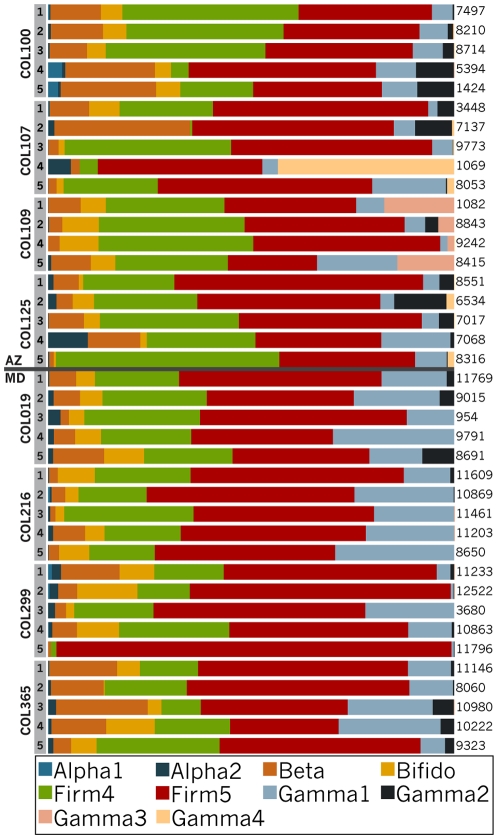
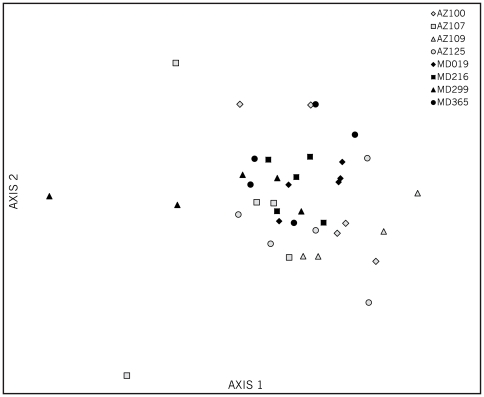
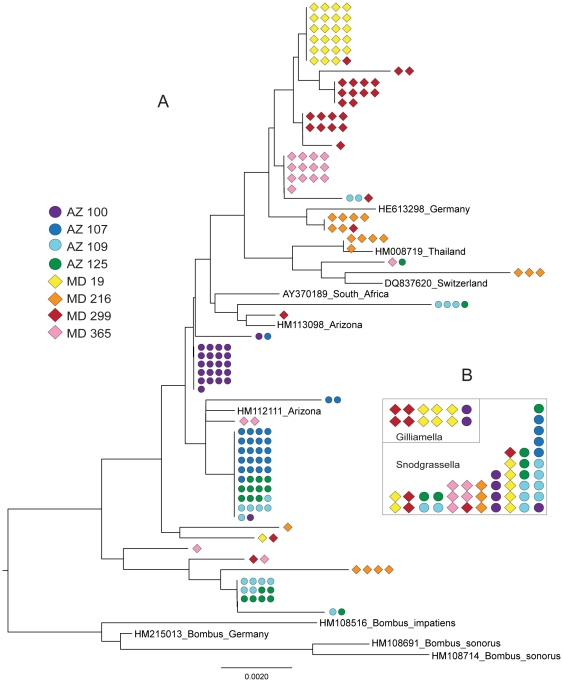
Surveys of 16S rDNA sequences from the honey bee, Apis mellifera, have revealed the presence of eight distinctive bacterial phylotypes in intestinal tracts of adult worker bees. Because previous studies have been limited to relatively few sequences from samples pooled from multiple hosts, the extent of variation in this microbiota among individuals within and between colonies and locations has been unclear. We surveyed the gut microbiota of 40 individual workers from two sites, Arizona and Maryland USA, sampling four colonies per site. Universal primers were used to amplify regions of 16S ribosomal RNA genes, and amplicons were sequenced using 454 pyrotag methods, enabling analysis of about 330,000 bacterial reads. Over 99% of these sequences belonged to clusters for which the first blastn hits in GenBank were members of the known bee phylotypes. Four phylotypes, one within Gammaproteobacteria (corresponding to "Candidatus Gilliamella apicola") one within Betaproteobacteria ("Candidatus Snodgrassella alvi"), and two within Lactobacillus, were present in every bee, though their frequencies varied. The same typical bacterial phylotypes were present in all colonies and at both sites. Community profiles differed significantly among colonies and between sites, mostly due to the presence in some Arizona colonies of two species of Enterobacteriaceae not retrieved previously from bees. Analysis of Sanger sequences of rRNA of the Snodgrassella and Gilliamella phylotypes revealed that single bees contain numerous distinct strains of each phylotype. Strains showed some differentiation between localities, especially for the Snodgrassella phylotype.
Conflict of interest statement
Figures
References
-
- Cox-Foster DL, Conlan S, Holmes EC, Palacios G, Evans JD, et al. A metagenomic survey of microbes in honey bee colony collapse disorder. Science. 2007;318:283–287. - PubMed
-
- Jeyaprakash A, Hoy MA, Allsopp MH. Bacterial diversity in worker adults of Apis mellifera capensis and Apis mellifera scutellata (Insecta: Hymenoptera) assessed using 16S rRNA sequences. J Invert Path. 2003;84:96–103. - PubMed
-
- Mohr KI, Tebbe CC. Diversity and phylotype consistency of bacteria in the guts of three bee species (Apoidea) at an oilseed rape field. Environ Microbiol. 2006;8:258–272. - PubMed
Publication types
MeSH terms
Substances
LinkOut - more resources
Full Text Sources
Molecular Biology Databases
