. 2012 Jul 1;206(1):91-8.
doi: 10.1093/infdis/jis310. Epub 2012 May 4.

B Lymphocytes provide an infection niche for intracellular bacterium Brucella abortus

Affiliations

B Lymphocytes provide an infection niche for intracellular bacterium Brucella abortus

Radhika Goenka et al. J Infect Dis. .

Abstract

Background: Brucella spp. are intracellular bacteria that establish lifelong infections whose mechanisms of chronicity are poorly understood. Notably, B cells facilitate the establishment of the high infection plateau that persists for months.

Methods: We evaluated the contribution of murine B cells toward providing infection niches for Brucella by using flow cytometry and microscopy and by determining live bacterial counts associated with B cells both in vivo and in vitro.

Results: Herein we demonstrate that immunoglobulin M and complement-opsonized Brucella abortus infects and survives inside primary murine B cells protected from bactericidal effects of gentamicin. The entry was dependent on microfilaments for internalization and subsequently brucellae reside in a late endosomal/lysosomal compartment. Throughout the infection, 10% of colony-forming units from infected mice was associated with B cells, and these cells transferred disease to naive hosts. Furthermore, Brucella-positive cells were positive for transforming growth factor (TGF) β1, and about 10% of such cells were B cells, similar to rates found for other intracellular pathogens that induce their hosts cells to produce TGF-β1.

Conclusions: To conclude, infected B cells contribute to chronic bacterial infections by providing an intracellular niche that may exert an immunoregulatory role. Although professional phagocytic cells harbor intracellular bacteria including Brucella, infection of lymphocytes by bacteria has not been previously appreciated.


Figures

Figure 1.
Figure 1.
Brucella-specific antibodies facilitate uptake of Brucella abortus into B cells. A, CD19+ cells were incubated with green fluorescent protein (GFP)–Brucella opsonized with pooled nonimmune or immune serum for 2 hours. B, Splenocytes were infected with GFP-Brucella opsonized with immune serum harvested from wild-type (WT) mice (n = 3) at various times after infection. C, D, Splenocytes were infected with GFP-Brucella opsonized with 1-week-postinfection immune serum obtained from WT or Jh−/− mice (n = 4), with representative staining shown in C. Results are representative of 2 experiments. *.01 < < .05; **P < .01.
Figure 2.
Figure 2.
Immune immunoglobulin (Ig) M and bioactive complement facilitate uptake of Brucella abortus into B cells. A, Anti-Brucella IgM and IgG titers in infected wild-type (WT) mice (n = 3). B, Splenocytes were infected with green fluorescent protein (GFP)–Brucella opsonized with Jh−/− immune serum alone (Jh) or supplemented with 0.25 μg of nonimmune or immune IgM antibodies (Jh-/- + IgM), nonimmune or immune IgG antibodies (Jh-/- + IgG), or WT immune serum alone (WT). C, Purified immune IgM (0.5 μg) was added to nonimmune serum harvested from WT mice with or without Mg/EGTA (Mg/Ethylene glycol tetraacetic acid) and used for opsonization. D, B cells were incubated with inhibitors 30 minutes before infection and infected with opsonized Brucella. After 1 hour incubation with gentamicin, B cells were lysed to release the intracellular brucellae and CFU counts determined. Data represent the percentage of inhibition of uptake relative to dimethyl sulfoxide control. Results are representative of 2 experiments. **P < .01.
Figure 3.
Figure 3.
Brucella abortus survives inside B cells. CD19+ cells were infected with Brucella opsonized with 1–2-week-postinfection immune serum. A, B, Purified CD19+ cells were infected for 5 minutes (A) or 2 hours (B) with immune serum–opsonized Brucella. The cells were washed to remove free brucellae and fixed with 2.5% glutaraldehyde in phosphate-buffered saline–sucrose for scanning (A) or transmission (B) electron microscopy. Scale bar equals 1 μm, and arrows indicate the presence of Brucella. C, Confocal micrographs depicting the presence of green fluorescent protein–Brucella inside CD19+ cells after in vitro infection. Cholera toxin was used to stain lipid rafts. The flourescent images were merged with differential interference contrast (DIC) image. D, CD19+ cells infected with opsonized Brucella were lysed at 1, 24, or 48 hours after addition of gentamicin to determine colony-forming unit (CFU) counts. In panel A, membrane veils are indicated by thick arrows while small pseudopodia are indicated by thin arrows. In panel B, arrows indicate brucella.
Figure 4.
Figure 4.
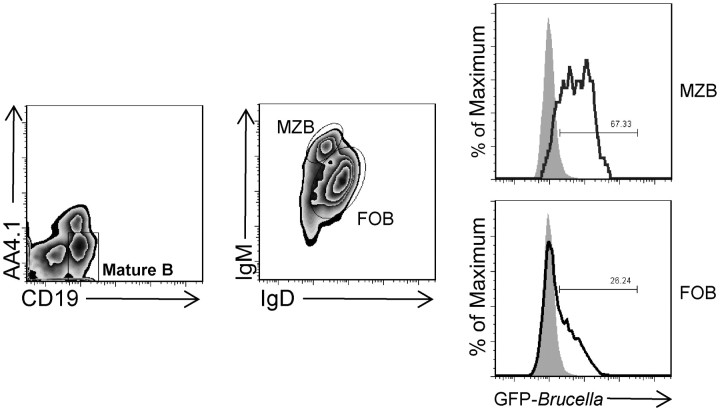
Marginal zone B (MZB) cells are more permissive to Brucella infection than follicular B (FOB) cells. Splenocytes were infected with immune serum–opsonized green fluorescent protein (GFP)–Brucella. To identify mature B-cell subsets, we gated on CD19+ AA4.1 that were further parsed into MZB (immunoglobulin [Ig] MhiIgDlo) and FOB (IgMloIgDhi) cells. Representative histogram overlay of GFP expression in MZB (top panel, gray line histogram) and FOB (bottom panel; black line histogram) cells shown from 2 independent experiments. Percentages of GFP-Brucella–positive cells in each subset are shown in the gate, compared with background of uninfected splenocytes (filled histogram). Results are representative of 2 independent experiments.
Figure 5.
Figure 5.
Brucella abortus infects B cells in vivo. A, Total Brucella colony-forming unit (CFU) counts associated with CD19+ cells in the spleens of wild-type (WT) mice (n = 3) at the indicated times after infection. Results are representative of 2 experiments. B, Splenic CD19+ cells (dose, 3.84 log10 CFU) or CD19 cells (dose, 2.94 log10 CFU) were obtained at 3 weeks after infection from WT mice and transferred intraperitoneally into naive mice (n = 4). CFU counts in recipient mice were determined at 3 weeks after infection C, Confocal micrographs of Brucella, CD19, and lysosome-associated membrane protein 1 (LAMP1) in splenocytes harvested 3 weeks after infection. D, Flow cytometric analysis of transforming growth factor (TGF) β1 and brucellae was conducted on splenocytes obtained from mice that were either uninfected or infected with Brucella for 4 weeks (n = 3) along with CD19. Results are representative of 2 experiments. *.01 < P < .05.

References

    1. Celli J, de Chastellier C, Franchini DM, Pizarro-Cerda J, Moreno E, Gorvel JP. Brucella evades macrophage killing via VirB-dependent sustained interactions with the endoplasmic reticulum. J Exp Med. 2003;198:545–56. - PMC - PubMed
    1. Billard E, Cazevieille C, Dornand J, Gross A. High susceptibility of human dendritic cells to invasion by the intracellular pathogens Brucella suis, B. abortus, and B. melitensis. Infect Immun. 2005;73:8418–24. - PMC - PubMed
    1. Anderson TD, Cheville NF. Ultrastructural morphometric analysis of Brucella abortus-infected trophoblasts in experimental placentitis. Bacterial replication occurs in rough endoplasmic reticulum. Am J Pathol. 1986;124:226–37. - PMC - PubMed
    1. Jiang X, Baldwin CL. Effects of cytokines on intracellular growth of Brucella abortus. Infect Immun. 1993;61:124–34. - PMC - PubMed
    1. Bellaire BH, Roop RM, 2nd, Cardelli JA. Opsonized virulent Brucella abortus replicates within nonacidic, endoplasmic reticulum-negative, LAMP-1-positive phagosomes in human monocytes. Infect Immun. 2005;73:3702–13. - PMC - PubMed

Publication types

MeSH terms

Substances