. 2012 Jul 1;303(1):L12-9.
doi: 10.1152/ajplung.00375.2011. Epub 2012 May 4.

IQGAP1 is necessary for pulmonary vascular barrier protection in murine acute lung injury and pneumonia

Affiliations

IQGAP1 is necessary for pulmonary vascular barrier protection in murine acute lung injury and pneumonia

M Bhattacharya et al. Am J Physiol Lung Cell Mol Physiol. .

Abstract

We recently reported that integrin α(v)β(3) is necessary for vascular barrier protection in mouse models of acute lung injury and peritonitis. Here, we used mass spectrometric sequencing of integrin complexes to isolate the novel β(3)-integrin binding partner IQGAP1. Like integrin β(3), IQGAP1 localized to the endothelial cell-cell junction after sphingosine-1-phosphate (S1P) treatment, and IQGAP1 knockdown prevented cortical actin formation and barrier enhancement in response to S1P. Furthermore, knockdown of IQGAP1 prevented localization of integrin α(v)β(3) to the cell-cell junction. Similar to β(3)-null animals, IQGAP1-null mice had increased pulmonary vascular leak compared with wild-type controls 3 days after intratracheal LPS. In an Escherichia coli pneumonia model, IQGAP1 knockout mice had increased lung weights, lung water, and lung extravascular plasma equivalents of (125)I-labeled albumin compared with wild-type controls. Taken together, these experiments indicate that IQGAP1 is necessary for S1P-mediated vascular barrier protection during acute lung injury and is required for junctional localization of the barrier-protective integrin α(v)β(3).


Figures
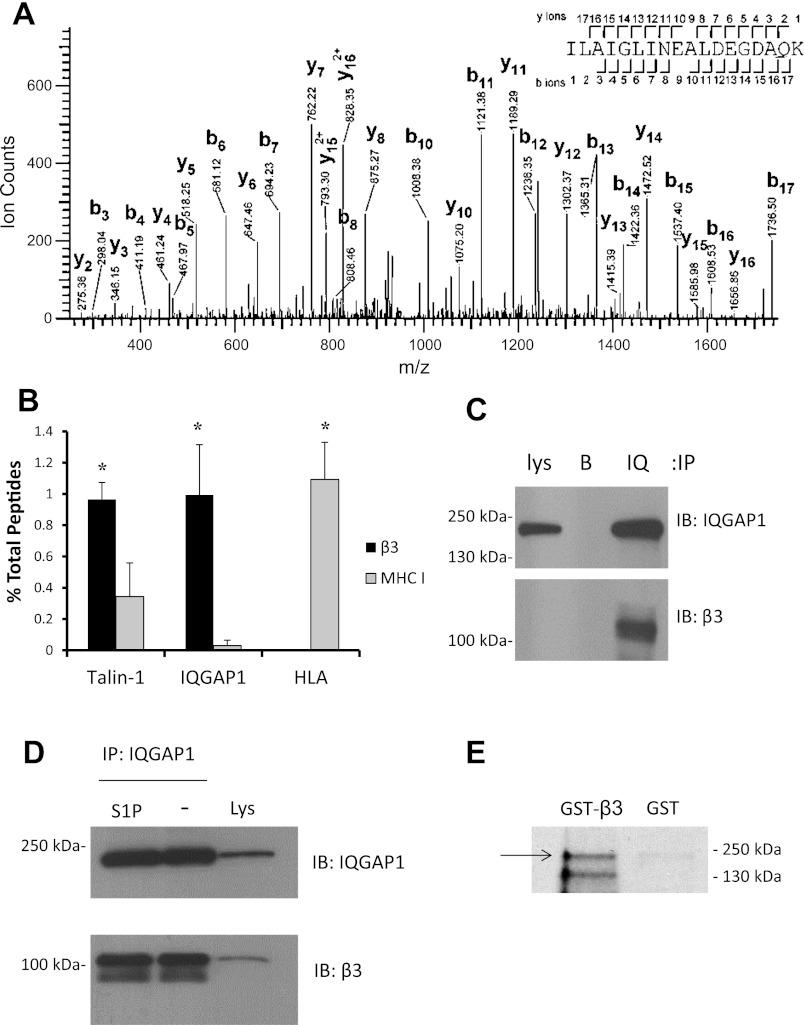
Fig. 1.
Fig. 1.
Proteomic screen of novel integrin binding partners. A: confluent human pulmonary artery endothelial cells (HPAEC) were serum starved overnight, treated with saline for 5 min, immunoprecipitated as described in materials and methods for β3 or major histocompatibility complex (MHC) I control, and submitted for 1D SDS-PAGE. Individual lanes were sliced and submitted for sample preparation and mass spectrometric (MS) analysis. The data presented is a collision-induced dissociation tandem MS (MS/MS) obtained in a LTQ-Orbitrap XL from a precursor ion with mass-to-charge ratio (m/z) = 942.0156+2, observed in the tryptic digests of β3 integrin immunoprecipitations. This ion corresponds to a peptide spanning residues I539 to K556 of human Ras GTPase-activating-like protein IQGAP1 (theoretical m/z = 942.0097+2; error 6.3 ppm). Sequence ions are labeled. Expectation value for this peptide is 1.1E-7. B: relative abundance of 3 representative proteins identified by tandem mass spectrometry of protein complexes immunoprecipitated with either β3 integrin antibody or MHC I control. The data represent means (± SE) for 4 (for MHC I) or 6 (for β3) experiments of protein abundance quantified as the number of peptides identified for a given protein divided by the total peptide count for all proteins identified in the immunoprecipitate. *P < 0.05. C: immunoprecipitation (IP) of IQGAP1 from HPAEC lysates (lys) followed by immunoblot for IQGAP1 and integrin β3. B, beads alone; IQ, IQGAP1. D: immunoprecipitation of IQGAP1 and immunoblot (IB) of IQGAP1 and integrin β3, with and without sphingosine-1-phosphate (S1P) treatment. E: glutathione S-transferase (GST) pull-down assay with the β3 cytoplasmic domain fused to GST, or GST alone, incubated with wild-type IQGAP1 protein produced by in vitro transcription and translation (IVTT) of full-length IQGAP1 plasmid DNA in the presence of [35S]methionine. Bound proteins were separated by 10% SDS-PAGE and analyzed by autoradiography. Arrow indicates 190-kDa band corresponding to full-length IQGAP1. The second, lower-molecular-weight band is expected to have resulted from cleavage of IQGAP1 by proteases contained within the reticulocyte lysate used for IVTT.
Fig. 2.
Fig. 2.
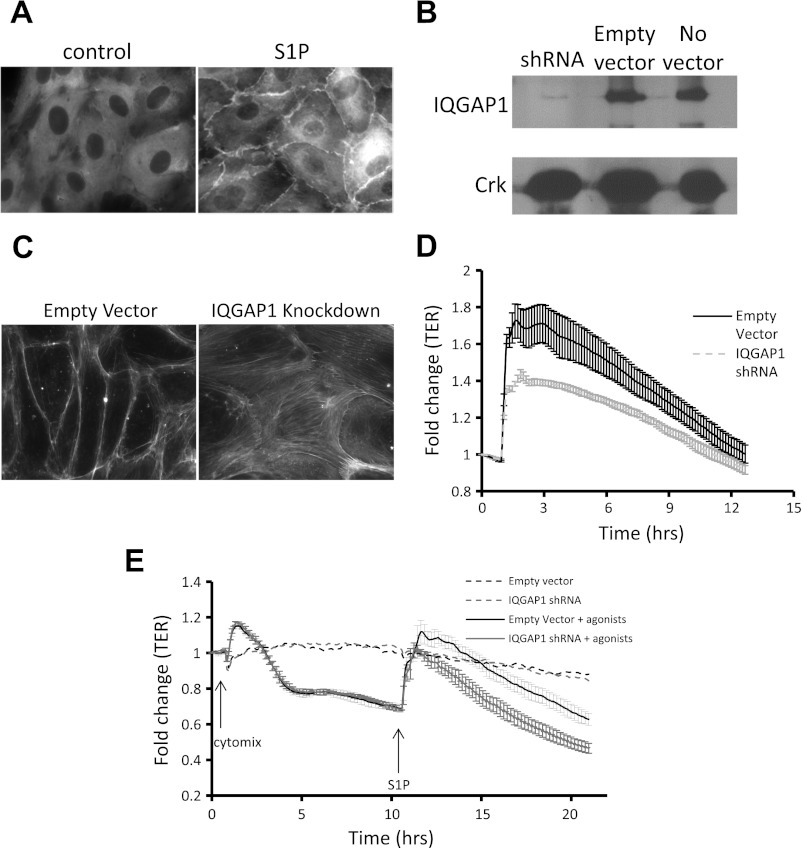
Effects of S1P on cellular localization of IQGAP1 and on barrier function after IQGAP1 knockdown. A: HPAEC were grown to confluence on glass coverslips, serum starved for 2 h, treated with S1P (0.5 μM) or vehicle for 5 min, and fixed and labeled with IQGAP1 antibody (×40). B: Western blot demonstrating short hairpin RNA (shRNA) knockdown of IQGAP1 in HPAEC. C: HPAEC were infected with lentivirus, sorted for green fluorescent protein (GFP) positivity marking viral infection, grown to confluence on glass coverslips, serum starved for 2 h, treated with S1P (0.5 μM) or vehicle for 5 min, and stained with rhodamine phalloidin for visualization of filamentous actin (×40). D: HPAEC were sorted for GFP marking shRNA infection and were seeded in a 96-well plate for measurement of transendothelial electrical resistance (TER) increase in response to S1P (0.5 μM) or vehicle by electrical cell-substrate impedance sensing (ECIS). Data for either condition are means for 6 wells normalized to baseline prior to addition of S1P (± SE). P < 0.01 for peak difference. E: HPAEC were sorted for GFP marking shRNA infection and were seeded in a 96-well plate for measurement of TER increase in response to cytomix (a combination of TNF-α, IL-1β, and IFN-γ, each at 50 ng/ml) followed by S1P (0.5 μM) as indicated by arrows. P < 0.05 for peak difference after S1P treatment. Results depicted in A, B, and C are representative of 3 experiments.
Fig. 3.
Fig. 3.
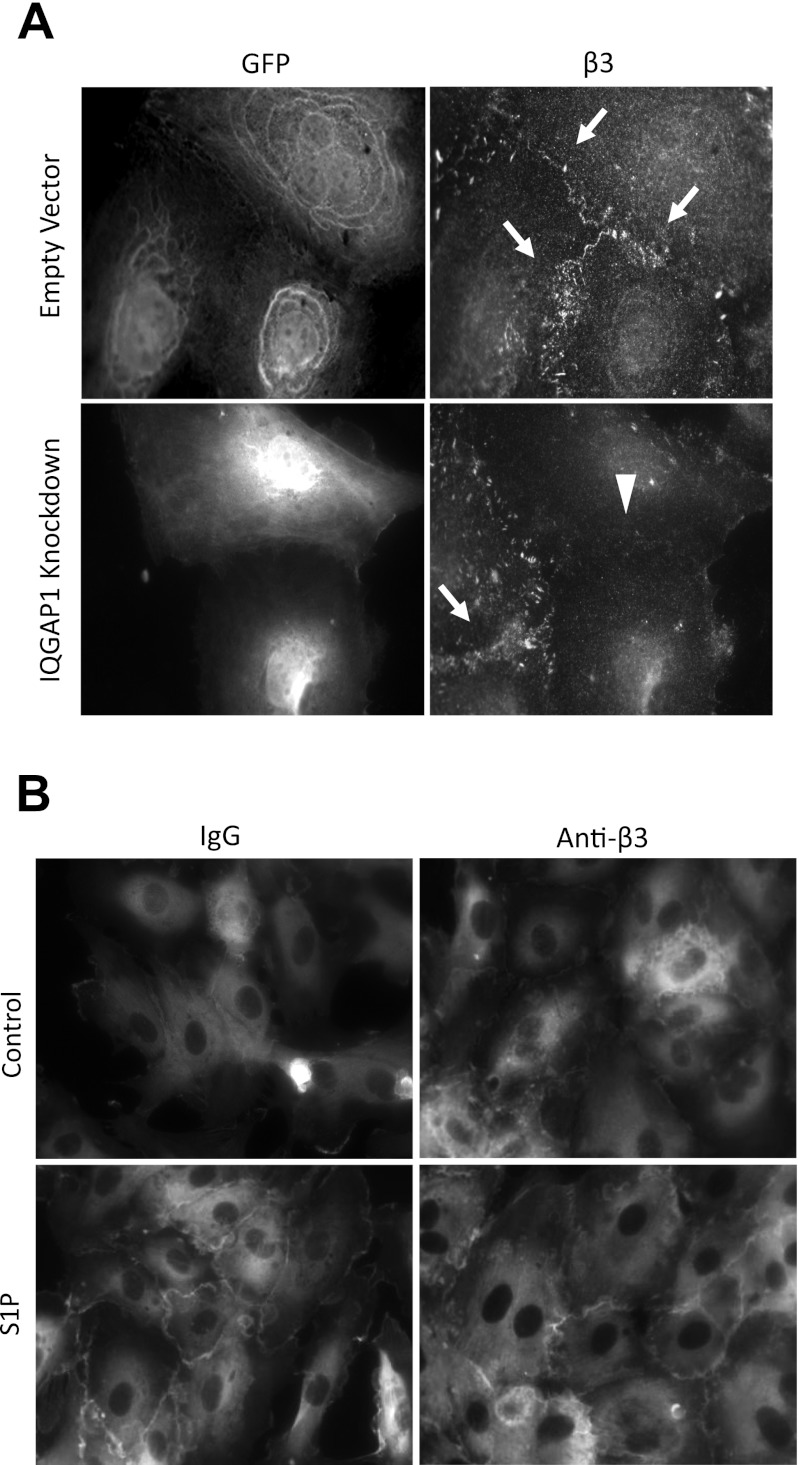
Effect of IQGAP1 knockdown on junctional localization of integrin β3. A: HPAEC were infected with shRNA virus, grown to confluence, serum starved for 2 h, and treated with S1P for 5 min (0.5 μM). Adjacent panels are the same microscopic field (×63) viewed with alternative filters for dual immunofluorescent staining of GFP and integrin β3. GFP positivity marks only cells infected with either shRNA virus for IQGAP1 knockdown or virus containing empty shRNA vector. β3 staining is seen at cell-cell junctions (arrows) except in cells with IQGAP1 knockdown (arrowhead). B: IQGAP1 immunofluorescence (×40). HPAEC were grown to confluence and serum starved for 1 h, followed by treatment with either blocking antibody to integrin β3 or mouse IgG control, for 1 h. Coverslips were then treated with either S1P (0.5 μM) or vehicle for 5 min. Results are representative of 3 experiments.
Fig. 4.
Fig. 4.
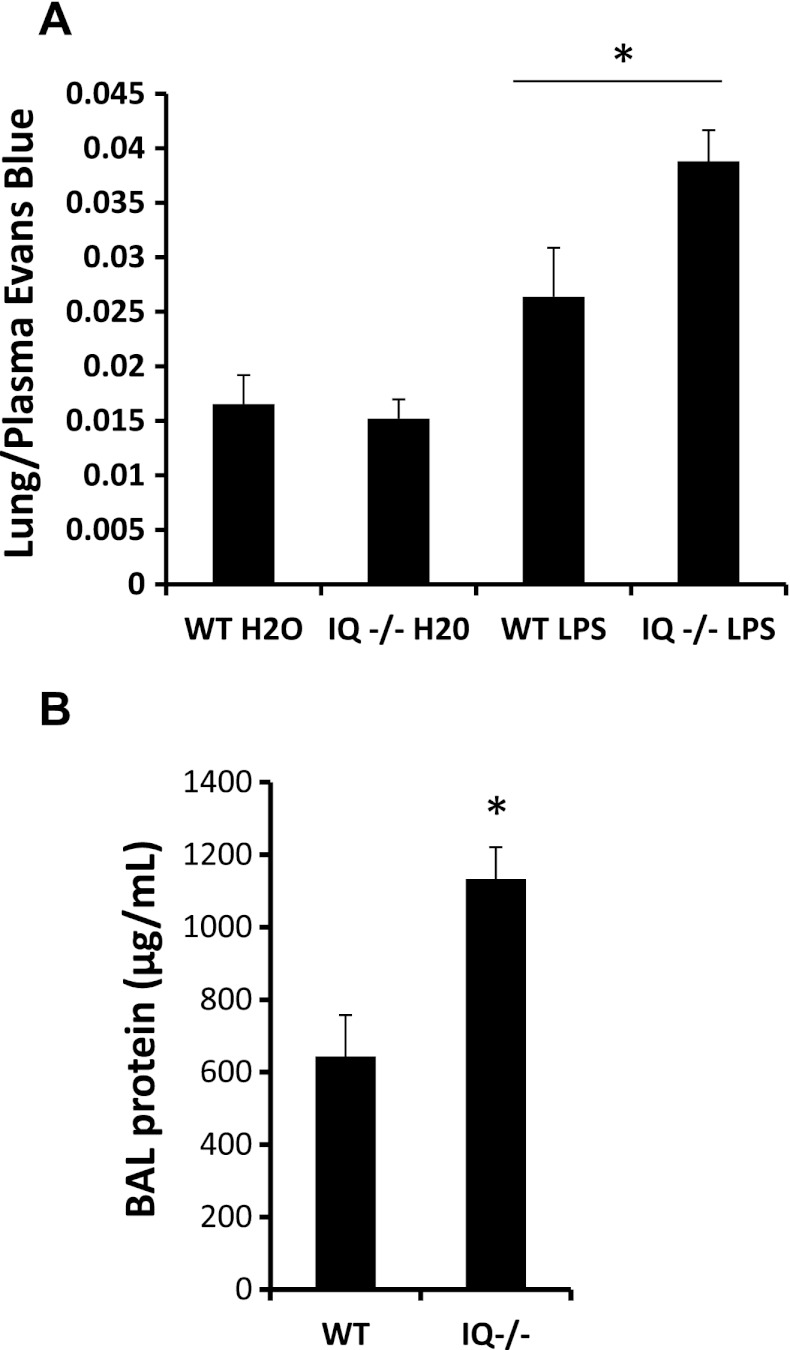
Effect of absence of IQGAP1 on intratracheal LPS-induced pulmonary vascular leak in mice. A: pulmonary Evans blue extravasation 3 days after intratracheal LPS or water (100 μg; n = 7 for all conditions except IQGAP1 H2O-treated, where n = 6). B: bronchoalveolar lavage (BAL) protein at 3 days after LPS (n = 5 in either group). WT, wild type. *P < 0.05.
Fig. 5.
Fig. 5.
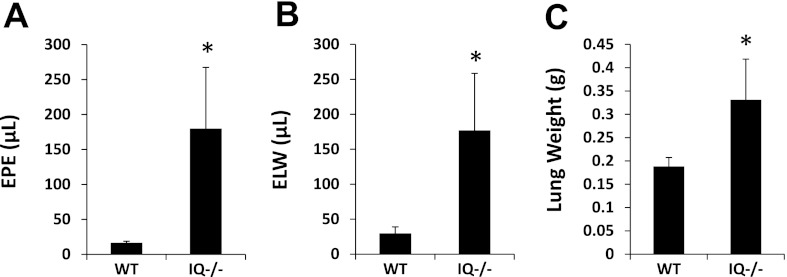
Effect of absence of IQGAP1 on intratracheal E. coli-induced pulmonary vascular leak. Mice were euthanized at 5 h after intratracheal inoculation of bacteria. A: lung extravascular plasma equivalents (EPE). B: excess lung water (ELW). C: lung weight (n = 4 IQGAP1 knockout; n = 5 wild type). *P ≤ 0.05.

References

    1. Bashour AM, Fullerton AT, Hart MJ, Bloom GS GS. IQGAP1, a Rac- and CDC42-binding protein, directly binds and crosslinks actin filaments. J Cell Biol 137: 1555–1566, 1997 - PMC - PubMed
    1. Berdyshev EV, Gorshkova I, Usatyuk P, Kalari S, Zhao Y, Pyne NJ, Pyne S, Sabbadini RA, Garcia JG, Natarajan V. Intracellular S1P generation is essential for S1P-induced motility of human lung endothelial cells: role of sphingosine kinase 1 and S1P lyase. PLoS One 6: e16571, 2011 - PMC - PubMed
    1. Brandt DT, Grosse R. Get to grips: steering local actin dynamics with IQGAPs. EMBO Rep 8: 1019–1923, 2007 - PMC - PubMed
    1. Camerer E, Regard JB, Cornelissen I, Srinivasan Y, Duong DN, Palmer D, Pham TH, Wong JS, Pappu R, Coughlin SR. Sphingosine-1-phosphate in the plasma compartment regulates basal and inflammation-induced vascular leak in mice. J Clin Invest 119: 1871–1879, 2009 - PMC - PubMed
    1. Clauser KR, Baker PR, Burlingame AL. Role of accurate mass measurement (+/- 10 ppm) in protein identification strategies employing MS or MS/MS and database searching. Anal Chem 71: 2871–2873, 1999 - PubMed

Publication types

MeSH terms