


Alcohol consumption and social inequality at the individual and country levels--results from an international study
- PMID: 22562712
- PMCID: PMC3610336
- DOI: 10.1093/eurpub/cks044
Alcohol consumption and social inequality at the individual and country levels--results from an international study
Abstract
Background: International comparisons of social inequalities in alcohol use have not been extensively investigated. The purpose of this study was to examine the relationship of country-level characteristics and individual socio-economic status (SES) on individual alcohol consumption in 33 countries.
Methods: Data on 101,525 men and women collected by cross-sectional surveys in 33 countries of the GENACIS study were used. Individual SES was measured by highest attained educational level. Alcohol use measures included drinking status and monthly risky single occasion drinking (RSOD). The relationship between individuals' education and drinking indicators was examined by meta-analysis. In a second step the individual level data and country data were combined and tested in multilevel models. As country level indicators we used the Purchasing Power Parity of the gross national income, the Gini coefficient and the Gender Gap Index.
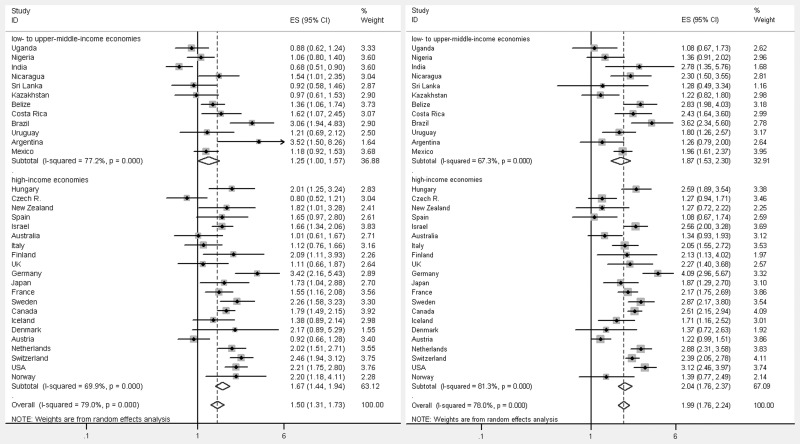
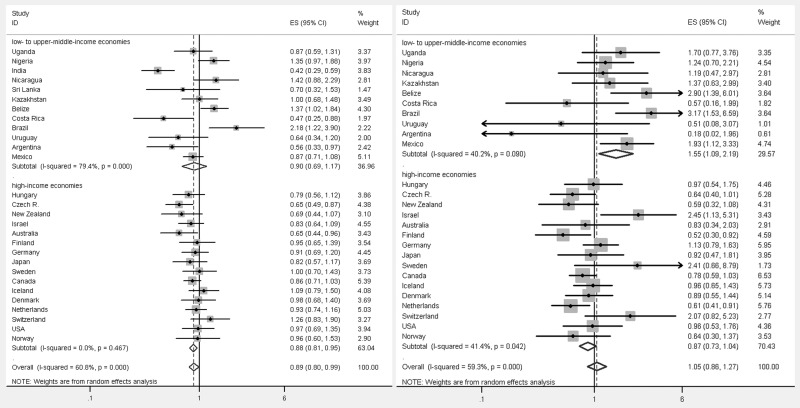
Results: For both genders and all countries higher individual SES was positively associated with drinking status. Also higher country level SES was associated with higher proportions of drinkers. Lower SES was associated with RSOD among men. Women of higher SES in low income countries were more often RSO drinkers than women of lower SES. The opposite was true in higher income countries.
Conclusion: For the most part, findings regarding SES and drinking in higher income countries were as expected. However, women of higher SES in low and middle income countries appear at higher risk of engaging in RSOD. This finding should be kept in mind when developing new policy and prevention initiatives.
Figures
References
-
- Dow WH, Rehkopf DH. Socioeconomic gradients in health in international and historical context. Ann N Y Acad Sci. 2010;1186:24–36. - PubMed
-
- Mackenbach JP, Stirbu I, Roskam AJ, et al. Socioeconomic inequalities in health in 22 European countries. N Engl J Med. 2008;358:2468–81. - PubMed
-
- Bambra C, Pope D, Swami V, et al. Gender, health inequalities and welfare state regimes: a cross-national study of 13 European countries. J Epidemiol Community Health. 2009;63:38–44. - PubMed
-
- Bloomfield K, Grittner U, Kramer S, Gmel G. Social inequalities in alcohol consumption and alcohol-related problems in the study countries of the EU concerted action ‘Gender, Culture and Alcohol Problems: a Multi-national Study’. Alcohol Alcohol Suppl. 2006;41:i26–36. - PubMed
-
- Schaap MM, Kunst AE, Leinsalu M, et al. Female ever-smoking, education, emancipation and economic development in 19 European countries. Soc Sci Med. 2009;68:1271–8. - PubMed
Publication types
MeSH terms
Grants and funding
LinkOut - more resources
Full Text Sources
Medical
Research Materials
Miscellaneous
