


Circulating metabolite predictors of glycemia in middle-aged men and women
- PMID: 22563043
- PMCID: PMC3402262
- DOI: 10.2337/dc11-1838
Circulating metabolite predictors of glycemia in middle-aged men and women
Abstract
Objective: Metabolite predictors of deteriorating glucose tolerance may elucidate the pathogenesis of type 2 diabetes. We investigated associations of circulating metabolites from high-throughput profiling with fasting and postload glycemia cross-sectionally and prospectively on the population level.
Research design and methods: Oral glucose tolerance was assessed in two Finnish, population-based studies consisting of 1,873 individuals (mean age 52 years, 58% women) and reexamined after 6.5 years for 618 individuals in one of the cohorts. Metabolites were quantified by nuclear magnetic resonance spectroscopy from fasting serum samples. Associations were studied by linear regression models adjusted for established risk factors.
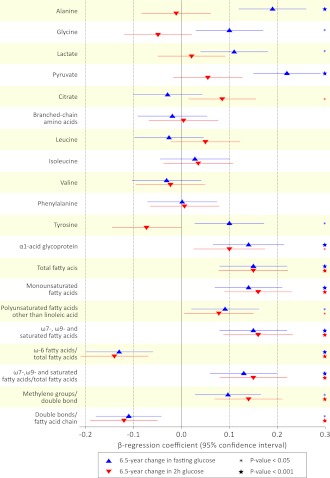
Results: Nineteen circulating metabolites, including amino acids, gluconeogenic substrates, and fatty acid measures, were cross-sectionally associated with fasting and/or postload glucose (P < 0.001). Among these metabolic intermediates, branched-chain amino acids, phenylalanine, and α1-acid glycoprotein were predictors of both fasting and 2-h glucose at 6.5-year follow-up (P < 0.05), whereas alanine, lactate, pyruvate, and tyrosine were uniquely associated with 6.5-year postload glucose (P = 0.003-0.04). None of the fatty acid measures were prospectively associated with glycemia. Changes in fatty acid concentrations were associated with changes in fasting and postload glycemia during follow-up; however, changes in branched-chain amino acids did not follow glucose dynamics, and gluconeogenic substrates only paralleled changes in fasting glucose.
Conclusions: Alterations in branched-chain and aromatic amino acid metabolism precede hyperglycemia in the general population. Further, alanine, lactate, and pyruvate were predictive of postchallenge glucose exclusively. These gluconeogenic precursors are potential markers of long-term impaired insulin sensitivity that may relate to attenuated glucose tolerance later in life.
Figures
References
-
- Faerch K, Borch-Johnsen K, Holst JJ, Vaag A. Pathophysiology and aetiology of impaired fasting glycaemia and impaired glucose tolerance: does it matter for prevention and treatment of type 2 diabetes? Diabetologia 2009;52:1714–1723 - PubMed
-
- Nóvoa FJ, Boronat M, Saavedra P, et al. Differences in cardiovascular risk factors, insulin resistance, and insulin secretion in individuals with normal glucose tolerance and in subjects with impaired glucose regulation: the Telde Study. Diabetes Care 2005;28:2388–2393 - PubMed
Publication types
MeSH terms
Substances
LinkOut - more resources
Full Text Sources
Other Literature Sources
Medical
