. 2012;10(5):e1001318.
doi: 10.1371/journal.pbio.1001318. Epub 2012 May 1.

A genetic basis for mechanosensory traits in humans

Affiliations

A genetic basis for mechanosensory traits in humans

Henning Frenzel et al. PLoS Biol. 2012.

Abstract

In all vertebrates hearing and touch represent two distinct sensory systems that both rely on the transformation of mechanical force into electrical signals. There is an extensive literature describing single gene mutations in humans that cause hearing impairment, but there are essentially none for touch. Here we first asked if touch sensitivity is a heritable trait and second whether there are common genes that influence different mechanosensory senses like hearing and touch in humans. Using a classical twin study design we demonstrate that touch sensitivity and touch acuity are highly heritable traits. Quantitative phenotypic measures of different mechanosensory systems revealed significant correlations between touch and hearing acuity in a healthy human population. Thus mutations in genes causing deafness genes could conceivably negatively influence touch sensitivity. In agreement with this hypothesis we found that a proportion of a cohort of congenitally deaf young adults display significantly impaired measures of touch sensitivity compared to controls. In contrast, blind individuals showed enhanced, not diminished touch acuity. Finally, by examining a cohort of patients with Usher syndrome, a genetically well-characterized deaf-blindness syndrome, we could show that recessive pathogenic mutations in the USH2A gene influence touch acuity. Control Usher syndrome cohorts lacking demonstrable pathogenic USH2A mutations showed no impairment in touch acuity. Our study thus provides comprehensive evidence that there are common genetic elements that contribute to touch and hearing and has identified one of these genes as USH2A.


Conflict of interest statement

The authors have declared that no competing interests exist.

Figures

Figure 1
Figure 1. Cross-twin correlations and heritability estimates of touch sensitivity traits.
For both vibration detection threshold (A) and tactile acuity (B) cross-twin correlations were higher in monozygotic (MZ) than in dizygotic (DZ) twins and significant heritability values could be estimated. r, intra-class correlation; h2, heritability estimate; 95% confidence interval in brackets; AE, preferred model used to estimate heritability.
Figure 2
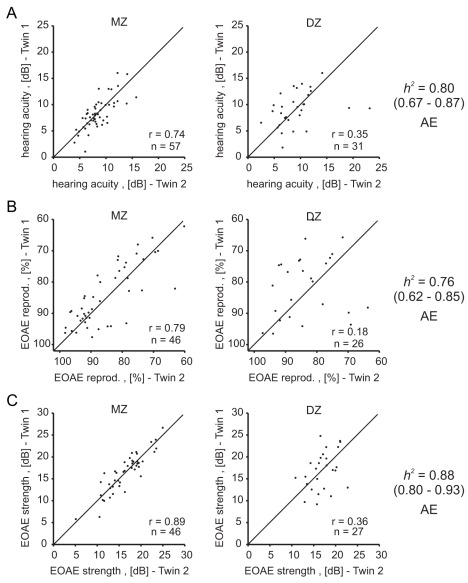
Figure 2. Cross-twin correlations and heritability estimates of hearing traits.
For all three hearing traits—pure tone thresholds (A), otoacoustic emission reproducibility (B), and otoacoustic emission strength (C)—cross-twin correlations were higher in MZ than in DZ twins, and very high heritability values could be estimated. r, intra-class correlation; h2, heritability estimate; 95% confidence interval in brackets; AE, preferred model used to estimate heritability.
Figure 3
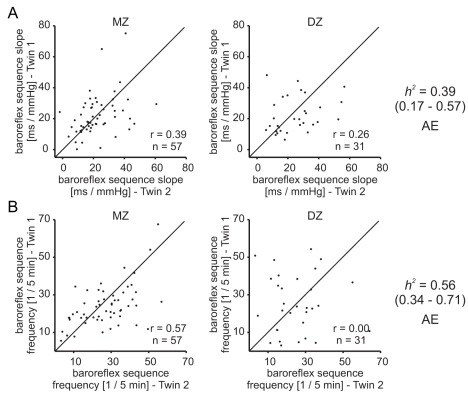
Figure 3. Cross-twin correlations and heritability estimates of baroreflex traits.
For both baroreflex traits—baroreflex sequence slope (A) and baroreflex sequence frequency (B)—the cross-twin correlations were higher in MZ than in DZ twins. Significant heritability estimates could be calculated. r, intra-class correlation; h2, heritability estimate; 95% confidence interval in brackets; AE, preferred model used to estimate heritability.
Figure 4
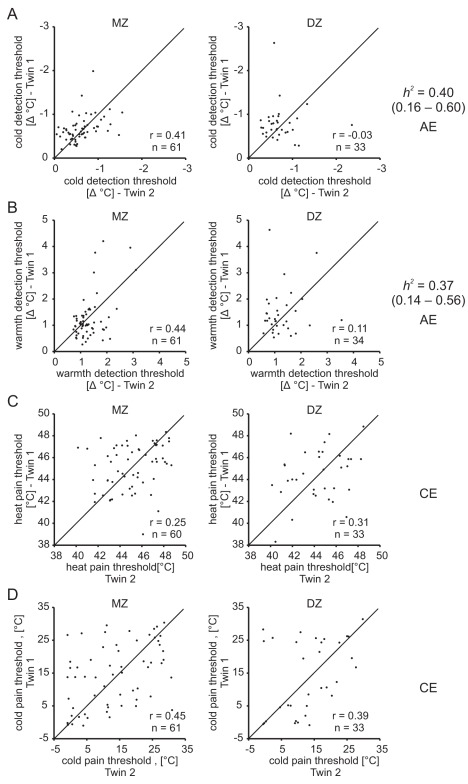
Figure 4. Cross-twin correlations and heritability estimates (where applicable) of temperature sensitivity traits.
For all traits except the cold pain threshold, the cross-twin correlations were higher in MZ than in DZ twins. Significant heritability estimates could be calculated for cold (A) and warmth (B) detection thresholds, whereas for the heat (C) and cold (D) pain thresholds, the CE model, not containing a heritable component, was preferred. r, intra-class correlation; h2, heritability estimate; 95% confidence interval in brackets; AE/CE, preferred model used to estimate heritability.
Figure 5
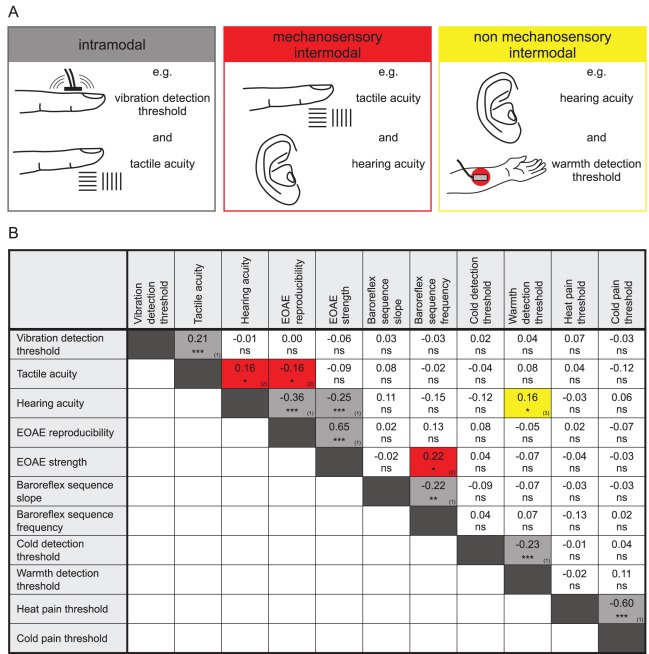
Figure 5. Cross-correlations between the investigated sensory traits.
Three different types of intramodal and intermodal correlations were distinguished (A). Three mechanosensory and one non-mechanosensory intermodal correlation were detected (B). ns, not significant; * p<0.05; ** p<0.01; *** p<0.001. False discovery rates for p value cutoff at 0.05 for (1) intramodal correlations: 0.004, (2) mechanosensory intermodal correlations: 0.14, and (3) non-mechanosensory intermodal correlations: 0.83. Values were corrected for age before analysis.
Figure 6
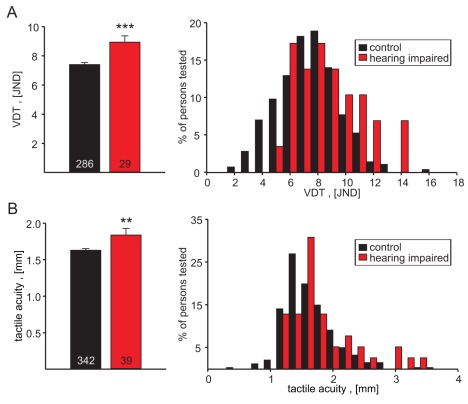
Figure 6. Touch sensitivity in a cohort of hearing impaired individuals compared to a cohort of normal hearing individuals.
Mean performances in the mean vibration detection threshold test as well as in the tactile acuity test were poorer in the hearing impaired cohort. ** p<0.01; *** p<0.001; t test.
Figure 7
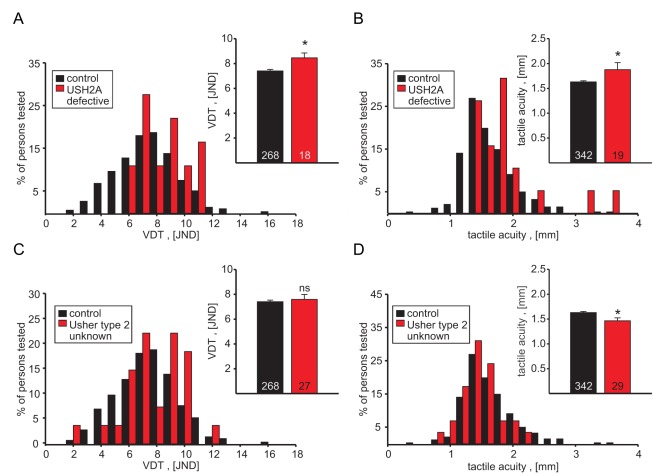
Figure 7. Touch sensitivity in different cohorts of people suffering from the Usher syndrome.
The mean tactile acuity and vibration detection thresholds were elevated in the group of people carrying pathogenic mutations in the gene USH2A (A, B) but not in a cohort of Usher syndrome type II patients with unknown genotype where tactile acuity thresholds were lower than in the control cohort (D), and vibration detection thresholds were not significantly different (C). ns, not significant; * p<0.05 Student's t test.
Figure 8
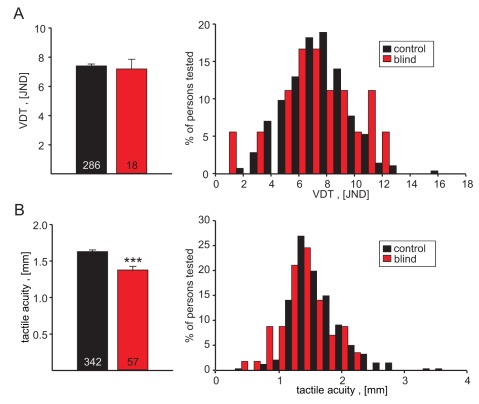
Figure 8. Touch sensitivity in a cohort of Braille reading blind people.
The vibration detection threshold was not different in comparison to a control cohort, but the tactile acuity was significantly higher in the blind cohort. *** p<0.001; t test.

Comment in

References

    1. Dror A. A, Avraham K. B. Hearing impairment: a panoply of genes and functions. Neuron. 2010;68:293–308. - PubMed
    1. Richardson G. P, de Monvel J. B, Petit C. How the genetics of deafness illuminates auditory physiology. Annu Rev Physiol. 2011;73:311–334. - PubMed
    1. Schwander M, Kachar B, Müller U. The cell biology of hearing. J Cell Biol. 2010;190:9–20. - PMC - PubMed
    1. Gillespie P. G, Müller U. Mechanotransduction by hair cells: models, molecules, and mechanisms. Cell. 2009;139:33–44. - PMC - PubMed
    1. Wende H, Lechner S. G, Cheret C, Bourane S, Kolanczyk M. E, et al. The transcription factor c-maf controls touch receptor development and function. 2012. Science (New York, NY). Available at http://www.ncbi.nlm.nih.gov/pubmed/22345400. Accessed February 27, 2012. - PubMed

Publication types

Substances

Supplementary concepts