. 2012;7(4):e34464.
doi: 10.1371/journal.pone.0034464. Epub 2012 Apr 26.

The cGMP signaling pathway affects feeding behavior in the necromenic nematode Pristionchus pacificus

Affiliations

The cGMP signaling pathway affects feeding behavior in the necromenic nematode Pristionchus pacificus

Silvina M Kroetz et al. PLoS One. 2012.

Abstract

Background: The genetic tractability and the species-specific association with beetles make the nematode Pristionchus pacificus an exciting emerging model organism for comparative studies in development and behavior. P. pacificus differs from Caenorhabditis elegans (a bacterial feeder) by its buccal teeth and the lack of pharyngeal grinders, but almost nothing is known about which genes coordinate P. pacificus feeding behaviors, such as pharyngeal pumping rate, locomotion, and fat storage.

Methodology/principal findings: We analyzed P. pacificus pharyngeal pumping rate and locomotion behavior on and off food, as well as on different species of bacteria (Escherichia coli, Bacillus subtilis, and Caulobacter crescentus). We found that the cGMP-dependent protein kinase G (PKG) Ppa-EGL-4 in P. pacificus plays an important role in regulating the pumping rate, mouth form dimorphism, the duration of forward locomotion, and the amount of fat stored in intestine. In addition, Ppa-EGL-4 interacts with Ppa-OBI-1, a recently identified protein involved in chemosensation, to influence feeding and locomotion behavior. We also found that C. crescentus NA1000 increased pharyngeal pumping as well as fat storage in P. pacificus.

Conclusions: The PKG EGL-4 has conserved functions in regulating feeding behavior in both C. elegans and P. pacificus nematodes. The Ppa-EGL-4 also has been co-opted during evolution to regulate P. pacificus mouth form dimorphism that indirectly affect pharyngeal pumping rate. Specifically, the lack of Ppa-EGL-4 function increases pharyngeal pumping, time spent in forward locomotion, and fat storage, in part as a result of higher food intake. Ppa-OBI-1 functions upstream or parallel to Ppa-EGL-4. The beetle-associated omnivorous P. pacificus respond differently to changes in food state and food quality compared to the exclusively bacteriovorous C. elegans.


Conflict of interest statement

Competing Interests: The authors have declared that no competing interests exist.

Figures

Figure 1
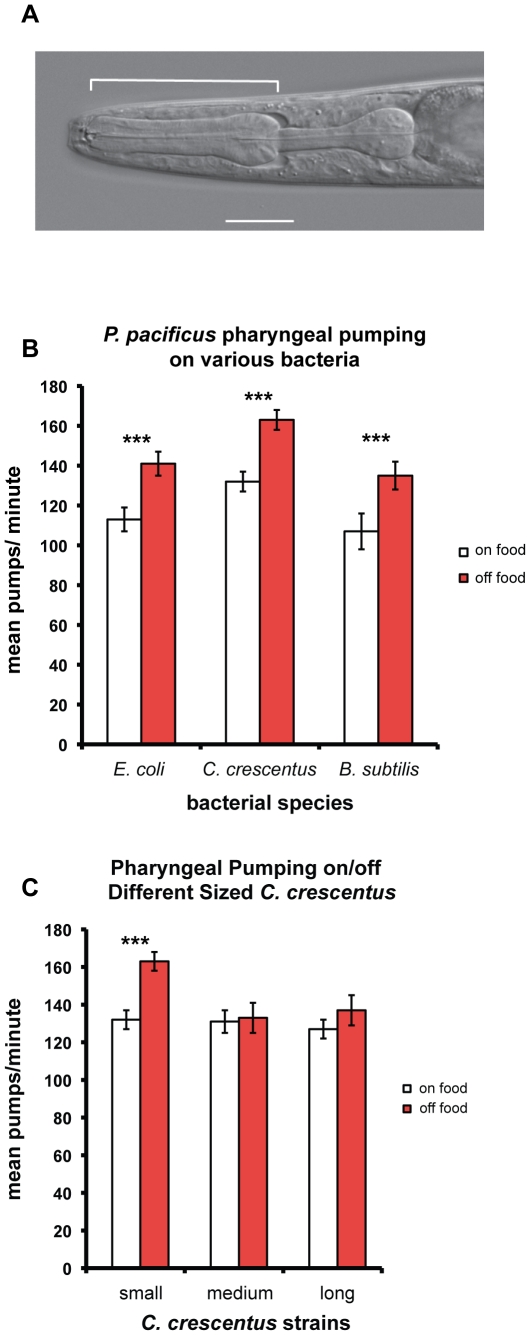
Figure 1. P. pacificus pharynx and pharyngeal pumping rate on various bacteria species and strains (mean±SEM).
(A) Wild-type PS312 pharynx (Nomarski DIC). Pharyngeal pumping is visible as contractions of the muscles of the corpus (bracketed, anterior is right). The isthmus and the terminal bulb are visible on the right. The scale bar represents 20 µm. (B) Pumping rates of P. pacificus wild-type PS312 cultured on E. coli OP50 (n = 25–36), C. crescentus NA1000 (n = 35–38), or B. subtilis PY79 (n = 20–31) were measured on food or off food. The rate difference between on/off food states on each bacterial strain is significant. (C) Pharyngeal pumping rate of P. pacificus PS312 cultured on different sizes of C. crescentus strains. Small wild-type NA1000 (n = 35–38), medium SM921 (n = 13–20), large LS2195 (n = 18–21) strains were used as the food source. Only the rate difference between on/off food states on the smallest strain (wild-type NA1000) is significant. (Two tailed t-test, P<0.001).
Figure 2
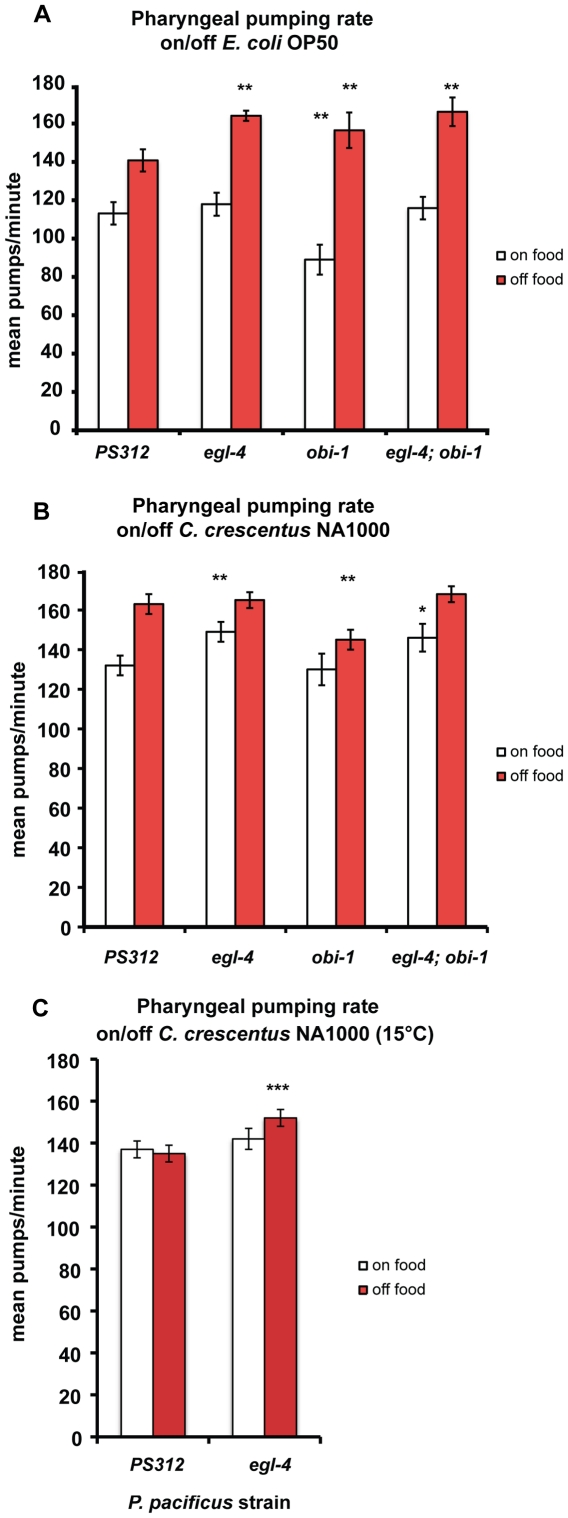
Figure 2. Pharyngeal pumping rate of P. pacificus mutants on/off OP50 E. coli and NA1000 C. crescentus (mean±SEM).
(A) Pumping on/off OP50 E. coli. Wild-type PS312 (n = 25–36), Ppa-egl-4(tu374) (n = 17–32), Ppa-obi-1(tu404) (n = 13–20), Ppa-egl-4; Ppa-obi-1 (n = 15). The difference in pumping between on/off food states for each nematode strain is significant (not indicated; two tailed t-test, P<0.001). Pumping rate on food is significantly slower in Ppa-obi-1(tu404) compared to the other 3 genotypes, whereas pumping rate off food is significantly faster in all mutants compared to wild-type PS312 (Dunnett’s Multiple comparisons test, P<0.01). (B) Pumping on/off NA1000 C. crescentus. PS312 (n = 35–38), Ppa-egl-4 (n = 16–18), Ppa-obi-1(tu404) (n = 14–18), Ppa-egl-4; Ppa-obi-1 (n = 14–18). The difference between on/off food states for each nematode strain is significant (two tailed t-test, P<0.001). Pumping rate off food is significantly slower in Ppa-obi-1(tu404) compared to the other 3 genotypes, whereas Ppa-egl-4 and Ppa-egl-4; Ppa-obi-1 pump faster than wild-type (Dunnett’s Multiple comparisons test, P<*0.05,**0.01). (C) Pumping on/off on C. crescentus NA1000 at 15°C. PS312 (n = 26-32), Ppa-egl-4 (n = 22–24). The rate difference between on/off food states for Ppa-egl-4 is significant (two tailed t-test, P<0.001). Ppa-egl-4 pumps faster than wild-type on C. crescentus (Dunnett’s Multiple comparisons test, P<***0.001).
Figure 3
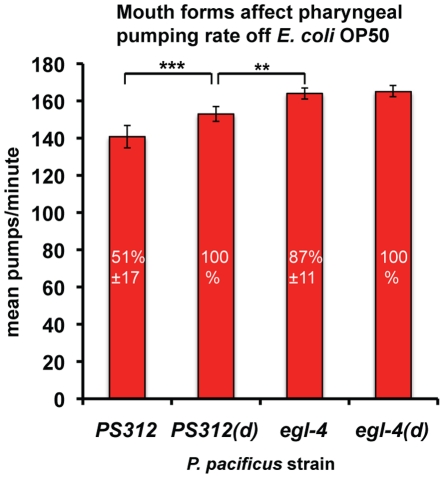
Figure 3. Mouth form affect pharyngeal pumping rate off OP50 E. coli.
The proportion of young adult hermaphrodites with stenostomatous mouth form changes in the population with dauer passage (d) (percentage of stenostomatous indicated inside the bars). The pumping rate of stenostomatous dauer passaged wild-type is intermediate between not-dauer passaged wild-type and the mostly stenostomatous Ppa-egl-4 mutants, regardless of dauer passage (Dunnett’s Multiple comparisons test, P<**0.01,***0.001).
Figure 4
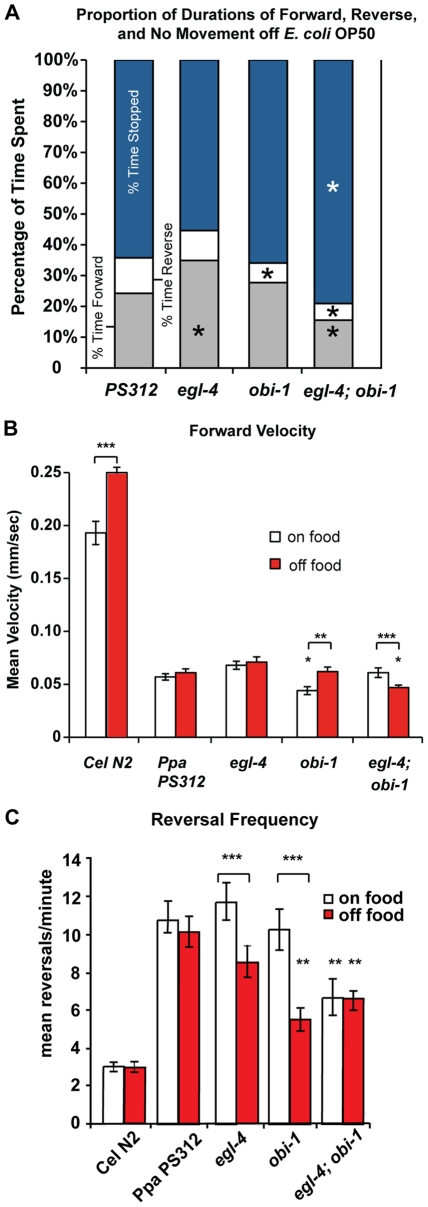
Figure 4. Locomotion of P. pacificus mutants (mean±SEM).
(A) Proportion of durations P. pacificus mutants spent off food (E. coli OP50) moving forward, moving backwards, and not moving. PS312 (n = 7), Ppa-egl-4 (n = 20), Ppa-obi-1 (n = 18), Ppa-egl-4;Ppa-obi-1 (n = 9). The percentage time spent is significantly different between wild-type and the mutant strains (Dunnett’s Multiple Comparisons Test *P<0.05). (B) Forward velocities of C. elegans N2 and P. pacificus strains measured on or off food. Velocity is in millimeters per second cultured on E. coli OP50. C. elegans wild-type N2 (n = 31–94), P. pacificus wild-type PS312 (n = 16–25), Ppa-egl-4 (n = 16–24), Ppa-obi-1 (n = 20–22), Ppa-egl-4; Ppa-obi-1 (n = 11–27). The differences between on and off food states for C. elegans N2, Ppa-obi-1 and Ppa-egl-4; Ppa-obi-1 are significant (two-tailed t-test, P<***0.001, <**0.01). Forward velocities are significantly different from wild-type on food for Ppa-obi-1 as well as off food for Ppa-egl-4; Ppa-obi-1 (Dunnett’s Multiple Comparisons test, P<0.05). (C) Reversal frequencies of C. elegans and P. pacificus mutants. Reversals frequencies of nematodes cultured on E. coli OP50 were measured on or off food. C. elegans wild-type N2 (n = 25–51), P. pacificus wild-type PS312 (n = 16–25), Ppa-egl-4 (n = 16–24), Ppa-obi-1 (n = 20–22), and Ppa-egl-4; Ppa-obi-1 (n = 11–27). Reversal frequencies between on and off food states for Ppa-egl-4 and Ppa-obi-1 strains are significantly different (two-tailed t-test, P<***0.001). Reversal frequencies on food are significantly different between wild-type and Ppa-egl-4; Ppa-obi-1. Reversal frequencies off food are significantly different between wild-type and Ppa-obi-1 as well as Ppa-egl-4; Ppa-obi-1 (Dunnet’s Multiple Comparisons test, P<0.01).
Figure 5
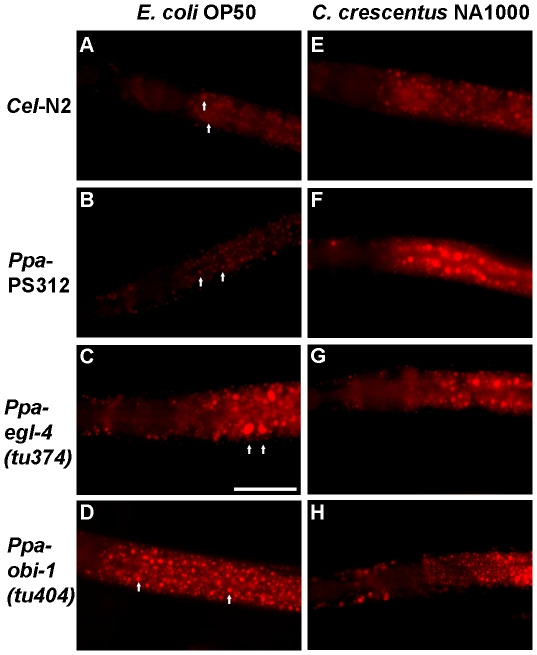
Figure 5. Representative Nile Red staining of fixed nematodes.
The diameters of the two largest stained lipid droplets in the anterior intestine were measured for fat quantification and are indicated with arrows for the OP50-fed worms as examples. Anterior is to the left and the scale bar for (C) represents 25 µm. Images on the left column (A-D) show nematodes cultured on E. coli OP50 while images (E-H) on right column show nematodes cultured on C. crescentus NA1000. Nematodes were fixed in paraformaldehyde and stained with Nile Red.
Figure 6
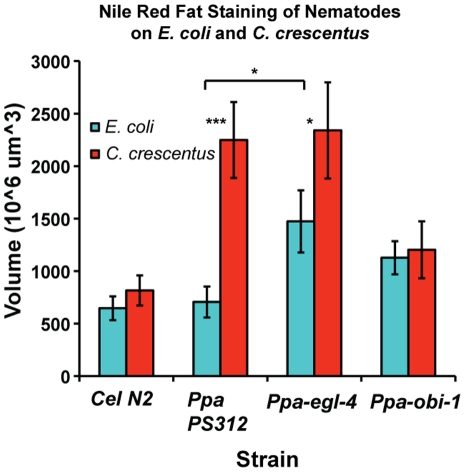
Figure 6. Comparisons of fat storage in the intestines of fixed nematodes.
The diameters of the two largest stained bodies per animal in the anterior intestine between the end of the pharynx and the invaginating vulva of L4 or J4 stage animals were measured to calculate the average volume based on spherical geometry (mean±SEM). Comparable gain and exposure settings were used. C. elegans wild-type N2 (n = 38–52), P. pacificus wild-type PS312 (n = 34–45), Ppa-egl-4 (n = 37–55), Ppa-obi-1 (n = 36–52). Fat storage on E. coli OP50 was higher in Ppa-egl-4 than in wild-type PS312. Fat storage in both PS312 and Ppa-egl-4 was higher when cultured on E. coli than on C. crescentus (***P<0.001; *P<0.05). Fat storage was higher on C. crescentus in both PS312 and Ppa-egl-4 than in C. elegans N2 and Ppa-obi-1 (not indicated; P<0.01). (Tukey-Kramer Multiple comparisons test, P<0.05).
Figure 7
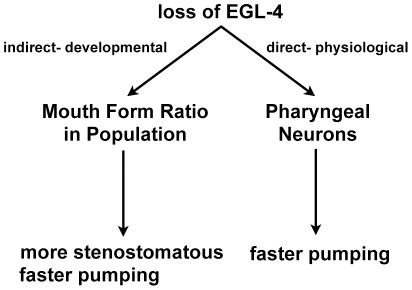
Figure 7. Model for direct and indirect Ppa-EGL-4 regulation of pharyngeal pumping rate on E. coli OP50.
The loss of Ppa-EGL-4 increases pumping rate directly by regulating pharyngeal neurons, as well as indirectly by increasing the number of animals with the narrower stenostomatous mouth form in the population.

References

    1. Avery L, Bargmann CI, Horvitz HR. The Caenorhabditis elegans unc-31 gene affects multiple nervous system-controlled functions. Genetics. 1993;134:455–464. - PMC - PubMed
    1. Raizen DM, Lee RY, Avery L. Interacting genes required for pharyngeal excitation by motor neuron MC in Caenorhabditis elegans. Genetics. 1995;141:1365–1382. - PMC - PubMed
    1. Avery L, Shtonda BB. Food transport in the C. elegans pharynx. J Exp Biol. 2003;206:2441–2457. - PMC - PubMed
    1. Hong RL, Sommer RJ. Pristionchus pacificus: a well-rounded nematode. Bioessays. 2006;28:651–659. - PubMed
    1. Herrmann M, Mayer WE, Sommer RJ. Nematodes of the genus Pristionchus are closely associated with scarab beetles and the Colorado potato beetle in Western Europe. Zoology. 2006;109:96–108. - PubMed

Publication types

MeSH terms

Substances