. 2012;7(4):e35744.
doi: 10.1371/journal.pone.0035744. Epub 2012 Apr 26.

The impact of social disparity on prefrontal function in childhood

Affiliations

The impact of social disparity on prefrontal function in childhood

Margaret A Sheridan et al. PLoS One. 2012.

Abstract

The prefrontal cortex (PFC) develops from birth through late adolescence. This extended developmental trajectory provides many opportunities for experience to shape the structure and function of the PFC. To date, a few studies have reported links between parental socioeconomic status (SES) and prefrontal function in childhood, raising the possibility that aspects of environment associated with SES impact prefrontal function. Considering that behavioral measures of prefrontal function are associated with learning across multiple domains, this is an important area of investigation. In this study, we used fMRI to replicate previous findings, demonstrating an association between parental SES and PFC function during childhood. In addition, we present two hypothetical mechanisms by which SES could come to affect PFC function of this association: language environment and stress reactivity. We measured language use in the home environment and change in salivary cortisol before and after fMRI scanning. Complexity of family language, but not the child's own language use, was associated with both parental SES and PFC activation. Change in salivary cortisol was also associated with both SES and PFC activation. These observed associations emphasize the importance of both enrichment and adversity-reduction interventions in creating good developmental environments for all children.


Conflict of interest statement

Competing Interests: The authors have declared that no competing interests exist.

Figures

Figure 1
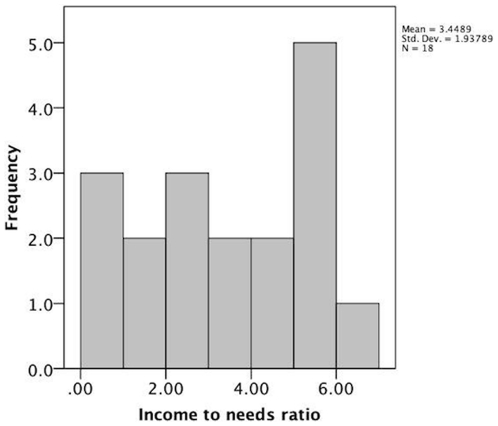
Figure 1. Distribution of income to needs ratio for the parents of children included in this study.
Figure 2
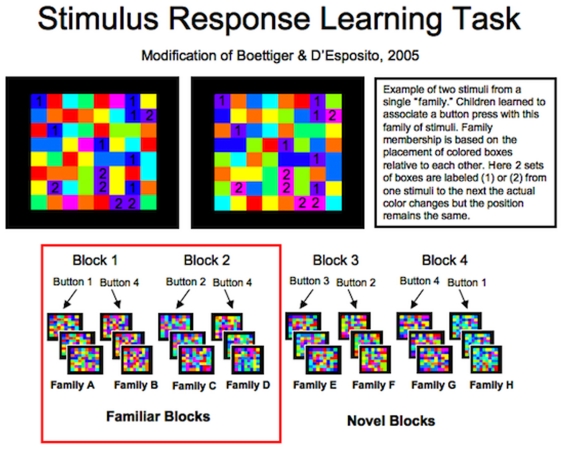
Figure 2. Example of stimuli used in task.
(Top) Two stimuli from the same family: although the colors change from one exemplar of a family category to another, the pattern of colors remain the same. In the left exemplar, the “1” blocks are blue, but in the right exemplar, these same blocks are purple. Similarly, the blocks which are purple in the left exemplar are “2” blocks, but these same blocks are pink in the right exemplar. (Bottom) Examples of all the families of stimuli used in this task. During each block, participants were taught to distinguish between 2 families of stimuli. They were taught to press one button when shown exemplars from one family and another button when shown exemplars of the other families. All together 4 possible button presses were used during the course of the task (1, 2, 3, or 4); chance performance was 25%.
Figure 3
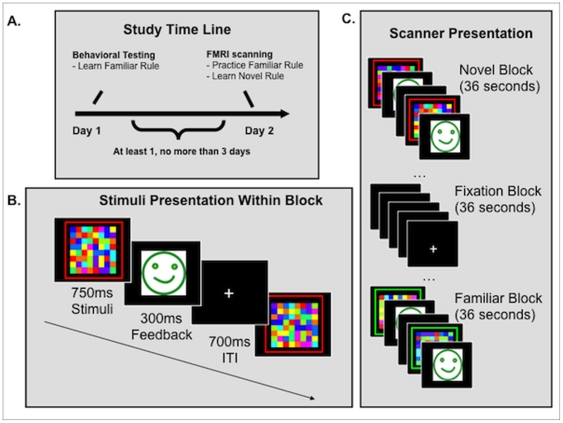
Figure 3. Depiction of study timing across days.
A. Time line of study. All subjects participated in a behavioral session before the fMRI session where they learned two rules to criterion (80% accuracy). In each rule (presented as 1 block), they distinguished with a button press between 2 families of stimuli. These rules are designated Familiar Rules. During the fMRI session, they practiced these rules on some blocks and on other blocks learned 2 new rules, designated Novel Rules. B. Task presentation during behavioral training and fMRI scanning. Each exemplar of a family was presented for 750 ms, during which time participants responded with a button press indicating which family it belonged to. Their response was followed by feedback indicating if this response was correct or not. Feedback was either a green smiley face or a red frowny face. Finally, this was followed by a 700 ms intertrial interval (ITI) C. Scanner Presentation. Stimuli were presented in a blocked design. Outline (here in red or green) indicates the kind of rule being performed (Familiar 1 or 2 or Novel 1 or 2).
Figure 4
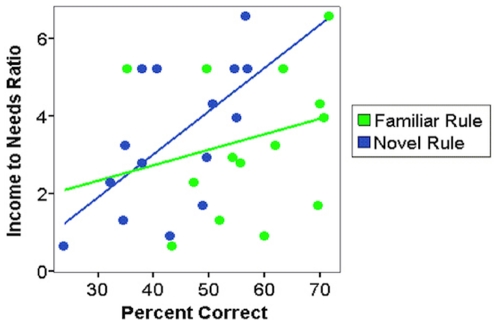
Figure 4. The association between income-to-needs ratio and accuracy on the behavioral task.
A significant association exists for novel rule accuracy (blue), whereas for familiar rule accuracy (green) the association is non-significant, which is consistent with the fact that both groups were trained to 80% accuracy prior to scanning.
Figure 5
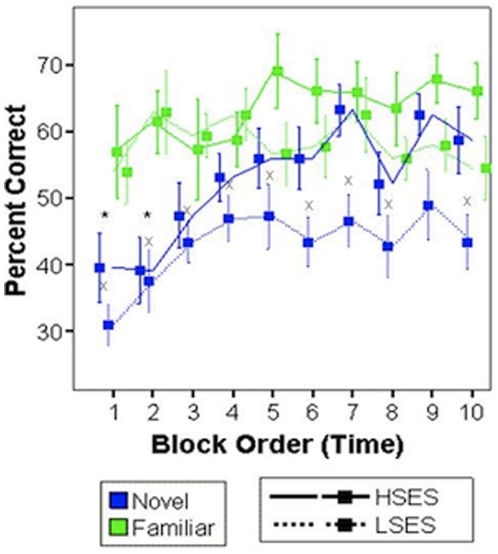
Figure 5. Learning curves for children from high and low SES families for accuracy performance on both Novel (blue) and Familiar (green) rules.
Data at each time point is collapsed across instances of Familiar (A/B) and instances of Novel (A/B) rules, yielding 10 time points from an original 20 if instances of rules were viewed separately. HSES children performed significantly less accurately on Novel compared to Familiar rules during early blocks of the scanner task (asterisks) whereas LSES children performed more poorly on the Novel compared to Familiar rule throughout the scan. (*) indicates a significant difference for Familiar Rule Accuracy > Novel Rule Accuracy for HSES participants (solid lines); (x) indicates a significant Familiar Rule Accuracy > Novel Rule Accuracy for LSES participants (dotted lines).
Figure 6
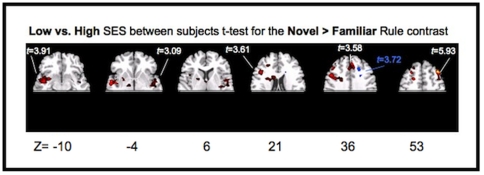
Figure 6. Significantly active areas (p<.05, cluster level corrected) for the two sample t-test comparing children from low socioeconomic status families to children from high socioeconomic status families for the novel rule > familiar rule contrast.
Activation in red represents areas that were more active for children from low socioeconomic status families during learning. Activation in blue represents areas more active for children from high socioeconomic status families during learning. Circled in red is the RMFG, which survived further correction at p<.001 cluster level correction.
Figure 7
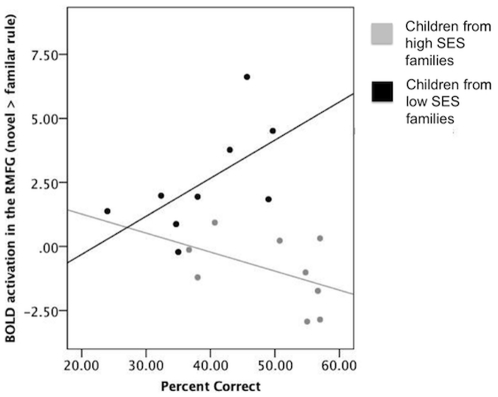
Figure 7. Non-significant associations between BOLD activity in the RMFG to learning and behavioral performance for HSES and LSES children separately.

References

    1. Hensch TK. Critical period regulation. Annu Rev Neurosci. 2004;27:549–579. doi: 10.1146/annurev.neuro.27.070203.144327. - DOI - PubMed
    1. Sowell ER, Thompson PM, Tessner KD, Toga AW. Mapping continued brain growth and gray matter density reduction in dorsal frontal cortex: Inverse relationships during postadolescent brain maturation. J Neurosci. 2001;21:8819–8829. - PMC - PubMed
    1. Gottlieb G, Blair C. How early experience matters in intellectual development in the case of poverty. Prev Sci. 2004;5:245–252. - PubMed
    1. Adler NE, Boyce WT, Chesney MA, Cohen S, Folkman S, et al. Socioeconomic status and health: The challenge of the gradient. American Psychologist. 1994;49:15–24. - PubMed
    1. Marmot MG, Smith GD, Stansfeld S, Patel C, North F, et al. Health inequalities among British civil servants: the Whitehall II study. Lancet. 1991;337:1387–1393. - PubMed

Publication types