


In vitro proliferation of adult human beta-cells
- PMID: 22563404
- PMCID: PMC3338526
- DOI: 10.1371/journal.pone.0035801
In vitro proliferation of adult human beta-cells
Abstract
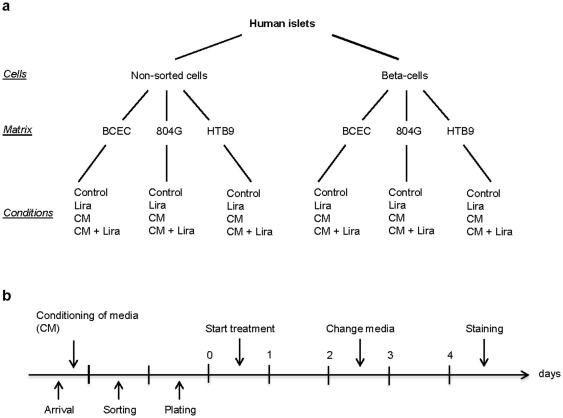
A decrease in functional beta-cell mass is a key feature of type 2 diabetes. Glucagon-like peptide 1 (GLP-1) analogues induce proliferation of rodent beta-cells. However, the proliferative capacity of human beta-cells and its modulation by GLP-1 analogues remain to be fully investigated. We therefore sought to quantify adult human beta-cell proliferation in vitro and whether this is affected by the GLP-1 analogue liraglutide.Human islets from 7 adult cadaveric organ donors were dispersed into single cells. Beta-cells were purified by FACS. Non-sorted cells and the beta-cell enriched ("beta-cells") population were plated on extracellular matrix from rat (804G) and human bladder carcinoma cells (HTB9) or bovine corneal endothelial ECM (BCEC). Cells were maintained in culture+/-liraglutide for 4 days in the presence of BrdU.Rare human beta-cell proliferation could be observed either in the purified beta-cell population (0.051±0.020%; 22 beta-cells proliferating out of 84'283 beta-cells counted) or in the non-sorted cell population (0.055±0.011%; 104 proliferating beta-cells out of 232'826 beta-cells counted), independently of the matrix or the culture conditions. Liraglutide increased human beta-cell proliferation on BCEC in the non-sorted cell population (0.082±0.034% proliferating beta-cells vs. 0.017±0.008% in control, p<0.05).These results indicate that adult human beta-cell proliferation can occur in vitro but remains an extremely rare event with these donors and particular culture conditions. Liraglutide increases beta-cell proliferation only in the non-sorted cell population and only on BCEC. However, it cannot be excluded that human beta-cells may proliferate to a greater extent in situ in response to natural stimuli.
Conflict of interest statement
Figures
References
-
- Donath MY, Halban PA. Decreased beta-cell mass in diabetes: significance, mechanisms and therapeutic implications. Diabetologia. 2004;47:581–589. - PubMed
-
- Lee YC, Nielsen JH. Regulation of beta cell replication. Mol Cell Endocrinol. 2009;297:18–27. - PubMed
-
- Parnaud G, Bosco D, Berney T, Pattou F, Kerr-Conte J, et al. Proliferation of sorted human and rat beta cells. Diabetologia. 2008;51:91–100. - PubMed
Publication types
MeSH terms
Substances
LinkOut - more resources
Full Text Sources
