


Repeatability of corticospinal and spinal measures during lengthening and shortening contractions in the human tibialis anterior muscle
- PMID: 22563418
- PMCID: PMC3338551
- DOI: 10.1371/journal.pone.0035930
Repeatability of corticospinal and spinal measures during lengthening and shortening contractions in the human tibialis anterior muscle
Abstract
Elements of the human central nervous system (CNS) constantly oscillate. In addition, there are also methodological factors and changes in muscle mechanics during dynamic muscle contractions that threaten the stability and consistency of transcranial magnetic stimulation (TMS) and perpherial nerve stimulation (PNS) measures.
Purpose: To determine the repeatability of TMS and PNS measures during lengthening and shortening muscle actions in the intact human tibialis anterior.
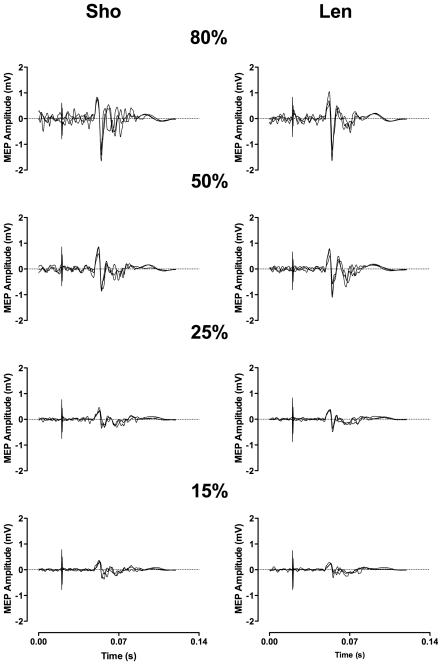
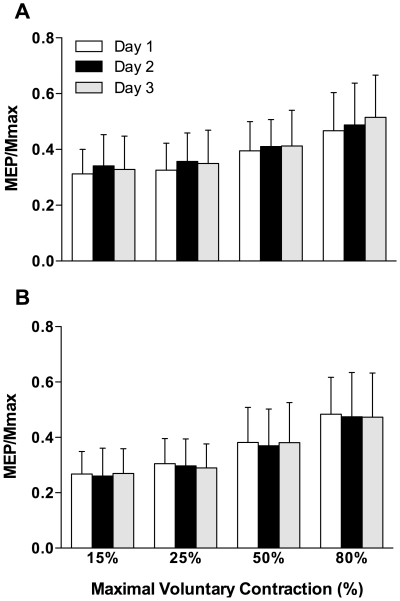
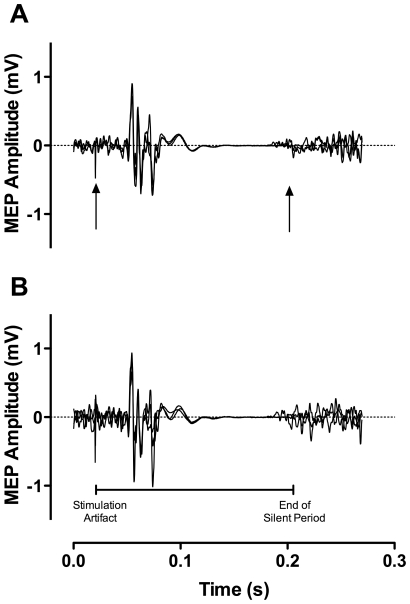
Methods: On three consecutive days, 20 males performed lengthening and shortening muscle actions at 15, 25, 50 and 80% of maximal voluntary contraction (MVC). The amplitude of the Motor Evoked Potentials (MEPs) produced by TMS was measured at rest and during muscle contraction at 90° of ankle joint position. MEPs were normalised to Mmax determined with PNS. The corticospinal silent period was recorded at 80% MVC. Hoffman reflex (H-reflex) at 10% isometric and 25% shortening and lengthening MVCs, and V-waves during MVCs were also evoked on each of the three days.
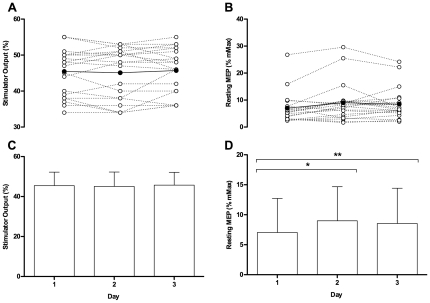
Results: With the exception of MEPs evoked at 80% shortening MVC, all TMS-derived measures showed good reliability (ICC = 0.81-0.94) from days 2 to 3. Confidence intervals (CI, 95%) were lower between days 2 and 3 when compared to days 1 and 2. MEPs significantly increased at rest from days 1 to 2 (P = 0.016) and days 1 to 3 (P = 0.046). The H-reflex during dynamic muscle contraction was reliable across the three days (ICC = 0.76-0.84). V-waves (shortening, ICC = 0.77, lengthening ICC = 0.54) and the H-reflex at 10% isometric MVC (ICC = 0.66) was generally less reliable over the three days.
Conclusion: Although it is well known that measures of the intact human CNS exhibit moment-to-moment fluctuations, careful experimental arrangements make it possible to obtain consistent and repeatable measurements of corticospinal and spinal excitability in the actively lengthening and shortening human TA muscle.
Conflict of interest statement
Figures
References
-
- Barker AT, Jalinous R, Freeston IL. Non-invasive magnetic stimulation of human motor cortex. The Lancet. 1985;325:1106–1107. - PubMed
-
- Hallett M. Transcranial magnetic stimulation and the human brain. Nature. 2000;406:147–150. - PubMed
-
- Cacchio A, Paoloni M, Cimini N, Mangone M, Liris G, et al. Reliability of TMS-related measures of tibialis anterior muscle in patients with chronic stroke and healthy subjects. Journal of the Neurological Sciences. 2011;303:90–94. - PubMed
-
- Kamen G. Reliability of motor-evoked potentials during resting and active contraction conditions. Med Sci Sports Exerc. 2004;36:1574–1579. - PubMed
MeSH terms
LinkOut - more resources
Full Text Sources
