Single-color multitarget flow cytometry using monoclonal antibodies labeled with different intensities of the same fluorochrome
- PMID: 22563550
- PMCID: PMC3339295
- DOI: 10.3343/alm.2012.32.3.171
Single-color multitarget flow cytometry using monoclonal antibodies labeled with different intensities of the same fluorochrome
Abstract
Background: We developed a single-color multitarget flow cytometry (SM-FC) assay, a single-tube assay with graded mean fluorescence intensities (MFIs). We evaluated the repeatability of SM-FC, and its correlation with multicolor flow cytometry (MFC), to assess its application as a routine FC assay.
Methods: We selected CD19, CD3, CD4, and CD8 as antigen targets to analyze a lymphocyte subset. MFIs were graded by adjusting monoclonal antibody (mAb) volumes to detect several cell populations. Dimly labeled mAb was prepared by decreasing mAb volume and the optimum diluted volume was determined by serial dilution. SM-FC repeatability was analyzed 10 times in 2 normal controls. The correlation between SM-FC and MFC was evaluated in 20 normal and 23 patient samples.
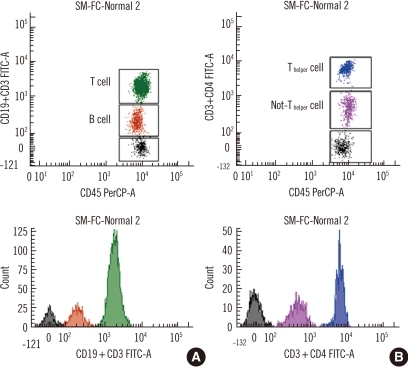
Results: CV values (0.8-5.0% and 1.3-4.1% in samples 1 and 2, respectively) acquired by SM-FC with CD3-fluorescein α-isothyocyanate (FITC)(dim)+CD4-FITC(bright) and with CD19-FITC(dim)+CD3-FITC(bright) showed good repeatability, comparable to that acquired by MFC (1.6-3.7% and 1.0-4.8% in samples 1 and 2, respectively). Excellent correlation was observed between the 2 methods in the 20 normal samples (B cells, T cells, non-T(helper) cells, and T(helper) cells; r(2)=0.87, 0.97, 0.97, and 0.98, respectively; P<0.05). There were also linear relationships between SM-FC with CD19-FITC(dim)+CD3-FITC(bright) and CD8-PE(dim)+CD4-PE(bright), and MFC, in the 23 patient samples (B cells, T cells, T(cytotoxic) cells, and T(helper) cells; r(2)≥0.98, 0.99, 0.99, and 0.99, respectively; P<0.05).
Conclusions: The multicolor, single-tube SM-FC technique is a potential alternative tool for identifying a lymphocyte subset.
Keywords: Lymphocyte subset; Monoclonal antibody cocktail; Single-color multitarget flow cytometry.
Conflict of interest statement
No potential conflict of interest relevant to this article was reported.
Figures

References
-
- Hengel RL, Nicholson JK. An update on the use of flow cytometry in HIV infection and AIDS. Clin Lab Med. 2001;21:841–856. - PubMed
-
- Illoh OC. Current applications of flow cytometry in the diagnosis of primary immunodeficiency diseases. Arch Pathol Lab Med. 2004;128:23–31. - PubMed
-
- Mandy FF. Twenty-five years of clinical flow cytometry: AIDS accelerated global instrument distribution. Cytometry A. 2004;58:55–56. - PubMed
-
- Braylan RC. Impact of flow cytometry on the diagnosis and characterization of lymphomas, chronic lymphoproliferative disorders and plasma cell neoplasias. Cytometry A. 2004;58:57–61. - PubMed
-
- Orfao A, Ortuño F, de Santiago M, Lopez A, San Miguel J. Immunophenotyping of acute leukemias and myelodysplastic syndromes. Cytometry A. 2004;58:62–71. - PubMed
MeSH terms
Substances
LinkOut - more resources
Full Text Sources
Research Materials