Oophorectomy after menopause and the risk of breast cancer in BRCA1 and BRCA2 mutation carriers
- PMID: 22564871
- PMCID: PMC3593267
- DOI: 10.1158/1055-9965.EPI-12-0201
Oophorectomy after menopause and the risk of breast cancer in BRCA1 and BRCA2 mutation carriers
Abstract
Background: To evaluate the effect of the cumulative number of ovulatory cycles and its contributing components on the risk of breast cancer among BRCA mutation carriers.
Methods: We conducted a matched case-control study on 2,854 pairs of women with a BRCA1 or BRCA2 mutation. Conditional logistic regression was used to estimate the association between the number of ovulatory cycles and various exposures and the risk of breast cancer. Information from a subset of these women enrolled in a prospective cohort study was used to calculate age-specific breast cancer rates.
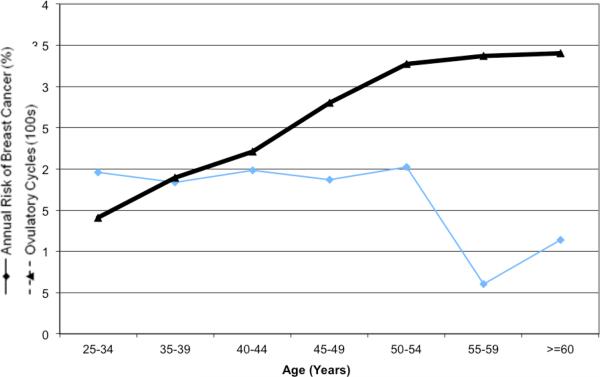
Results: The annual risk of breast cancer decreased with the number of ovulatory cycles experienced (ρ = -0.69; P = 0.03). Age at menarche and duration of breastfeeding were inversely related with risk of breast cancer among BRCA1 (P(trend) < 0.0001) but not among BRCA2 (P(trend) ≥ 0.28) mutation carriers. The reduction in breast cancer risk associated with surgical menopause [OR, 0.52; 95% confidence interval (CI), 0.40-0.66; P(trend) < 0.0001] was greater than that associated with natural menopause (OR, 0.81; 95% CI, 0.62-1.07; P(trend) = 0.14). There was a highly significant reduction in breast cancer risk among women who had an oophorectomy after natural menopause (OR, 0.13; 95% CI, 0.02-0.54; P = 0.006).
Conclusions: These data challenge the hypothesis that breast cancer risk can be predicted by the lifetime number of ovulatory cycles in women with a BRCA mutation. Both pre- and postmenopausal oophorectomy protect against breast cancer.
Impact: Understanding the basis for the protective effect of oophorectomy has important implications for chemoprevention.
©2012 AACR
Figures
Comment in
-
Oophorectomy and breast cancer in BRCA mutation carriers--letter.Cancer Epidemiol Biomarkers Prev. 2012 Aug;21(8):1389. doi: 10.1158/1055-9965.EPI-12-0603. Epub 2012 Jun 4. Cancer Epidemiol Biomarkers Prev. 2012. PMID: 22665575 No abstract available.
References
-
- Bernstein L. Epidemiology of endocrine-related risk factors for breast cancer. J Mammary Gland Biol Neoplasia. 2002;7:3–15. - PubMed
-
- Henderson BE, Ross RK, Judd HL, Krailo MD, Pike MC. Do regular ovulatory cycles increase breast cancer risk? Cancer. 1985;56:1206–8. - PubMed
-
- Russo J, Rivera R, Russo IH. Influence of age and parity on the development of the human breast. Breast Cancer Res Treat. 1992;23:211–8. - PubMed
-
- Kotsopoulos J, Lubinski J, Lynch HT, Neuhausen SL, Ghadirian P, Isaacs C, et al. Age at menarche and the risk of breast cancer in BRCA1 and BRCA2 mutation carriers. Cancer Causes Control. 2005;16:667–74. - PubMed
-
- Gronwald J, Byrski T, Huzarski T, Cybulski C, Sun P, Tulman A, et al. Influence of selected lifestyle factors on breast and ovarian cancer risk in BRCA1 mutation carriers from Poland. Breast Cancer Res Treat. 2006;95:105–9. - PubMed
Publication types
MeSH terms
Substances
Grants and funding
LinkOut - more resources
Full Text Sources
Other Literature Sources
Medical
Miscellaneous