


Nonadherence to oral mercaptopurine and risk of relapse in Hispanic and non-Hispanic white children with acute lymphoblastic leukemia: a report from the children's oncology group
- PMID: 22564992
- PMCID: PMC3601449
- DOI: 10.1200/JCO.2011.38.9924
Nonadherence to oral mercaptopurine and risk of relapse in Hispanic and non-Hispanic white children with acute lymphoblastic leukemia: a report from the children's oncology group
Abstract
Purpose: Systemic exposure to mercaptopurine (MP) is critical for durable remissions in children with acute lymphoblastic leukemia (ALL). Nonadherence to oral MP could increase relapse risk and also contribute to inferior outcome in Hispanics. This study identified determinants of adherence and described impact of adherence on relapse, both overall and by ethnicity.
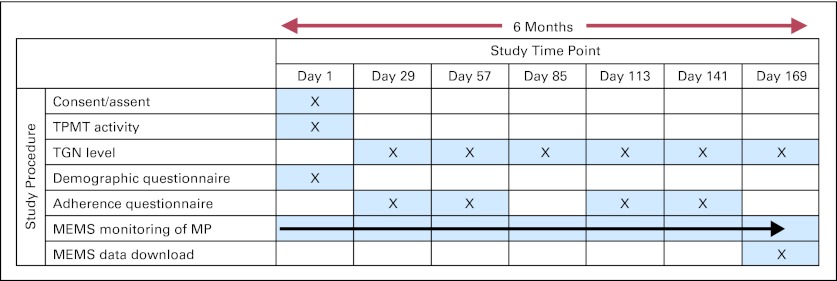
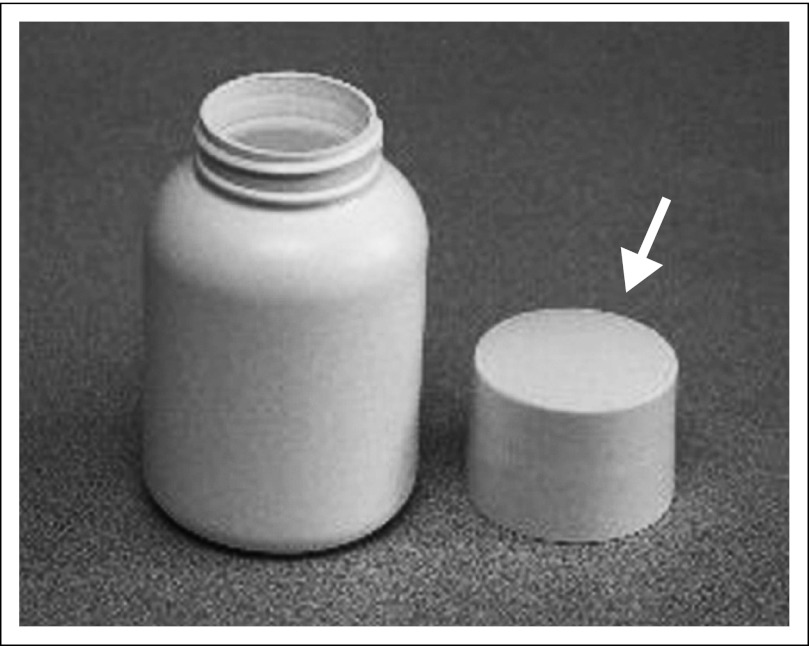
Patients and methods: A total of 327 children with ALL (169 Hispanic; 158 non-Hispanic white) participated. Medication event-monitoring system caps recorded date and time of MP bottle openings. Adherence rate, calculated monthly, was defined as ratio of days of MP bottle opening to days when MP was prescribed.
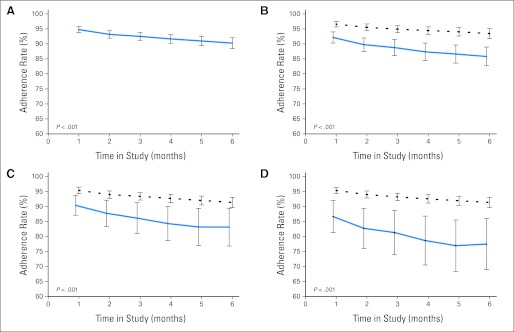
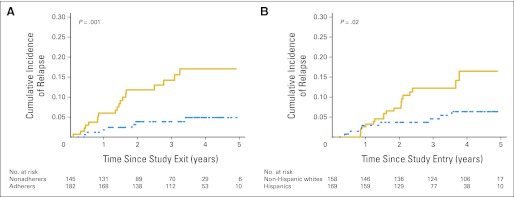
Results: After 53,394 person-days of monitoring, adherence declined from 94.7% (month 1) to 90.2% (month 6; P < .001). Mean adherence over 6 months was significantly lower among Hispanics (88.4% v 94.8%; P < .001), patients age ≥ 12 years (85.8% v 93.1%; P < .001), and patients from single-mother households (80.6% v 93.1%; P = .001). A progressive increase in relapse was observed with decreasing adherence (reference: adherence ≥ 95%; 94.9% to 90%: hazard ratio [HR], 4.1; 95% CI,1.2 to 13.5; P = .02; 89.9% to 85%: HR, 4.0; 95% CI, 1.0 to 15.5; P = .04; < 85%: HR. 5.7; 95% CI, 1.9 to 16.8; P = .002). Cumulative incidence of relapse (± standard deviation) was higher among Hispanics (16.5% ± 4.0% v 6.3% ± 2.2%; P = .02). Association between Hispanic ethnicity and relapse (HR, 2.6; 95% CI, 1.1 to 6.1; P = .02) became nonsignificant (HR, 1.8; 95% CI, 0.6 to 5.2; P = .26) after adjusting for adherence and socioeconomic status. At adherence rates ≥ 90%, Hispanics continued to demonstrate higher relapse, whereas at rates < 90%, relapse risk was comparable to that of non-Hispanic whites.
Conclusion: Lower adherence to oral MP increases relapse risk. Ethnic difference in relapse risk differs by level of adherence-an observation currently under investigation.
Conflict of interest statement
Authors' disclosures of potential conflicts of interest and author contributions are found at the end of this article.
Figures

References
-
- Linabery AM, Ross JA. Trends in childhood cancer incidence in the U.S. (1992–2004) Cancer. 2008;112:416–432. - PubMed
-
- Pui CH, Evans WE. Treatment of acute lymphoblastic leukemia. N Engl J Med. 2006;354:166–178. - PubMed
-
- Bhatia S, Sather HN, Heerema NA, et al. Racial and ethnic differences in survival of children with acute lymphoblastic leukemia. Blood. 2002;100:1957–1964. - PubMed
MeSH terms
Substances
Grants and funding
LinkOut - more resources
Full Text Sources
Other Literature Sources
Miscellaneous
