


Genetic variants in IGF-I, IGF-II, IGFBP-3, and adiponectin genes and colon cancer risk in African Americans and Whites
- PMID: 22565227
- PMCID: PMC4212518
- DOI: 10.1007/s10552-012-9981-2
Genetic variants in IGF-I, IGF-II, IGFBP-3, and adiponectin genes and colon cancer risk in African Americans and Whites
Abstract
Purpose: Evaluating genetic susceptibility may clarify effects of known environmental factors and also identify individuals at high risk. We evaluated the association of four insulin-related pathway gene polymorphisms in insulin-like growth factor-1 (IGF-I) (CA)( n ) repeat, insulin-like growth factor-2 (IGF-II) (rs680), insulin-like growth factor-binding protein-3 (IGFBP-3) (rs2854744), and adiponectin (APM1 rs1501299) with colon cancer risk, as well as relationships with circulating IGF-I, IGF-II, IGFBP-3, and C-peptide in a population-based study.
Methods: Participants were African Americans (231 cases and 306 controls) and Whites (297 cases, 530 controls). Consenting subjects provided blood specimens and lifestyle/diet information. Genotyping for all genes except IGF-I was performed by the 5'-exonuclease (Taqman) assay. The IGF-I (CA)(n) repeat was assayed by PCR and fragment analysis. Circulating proteins were measured by enzyme immunoassays. Odds ratios (ORs) and 95 % confidence intervals (CIs) were calculated by logistic regression.
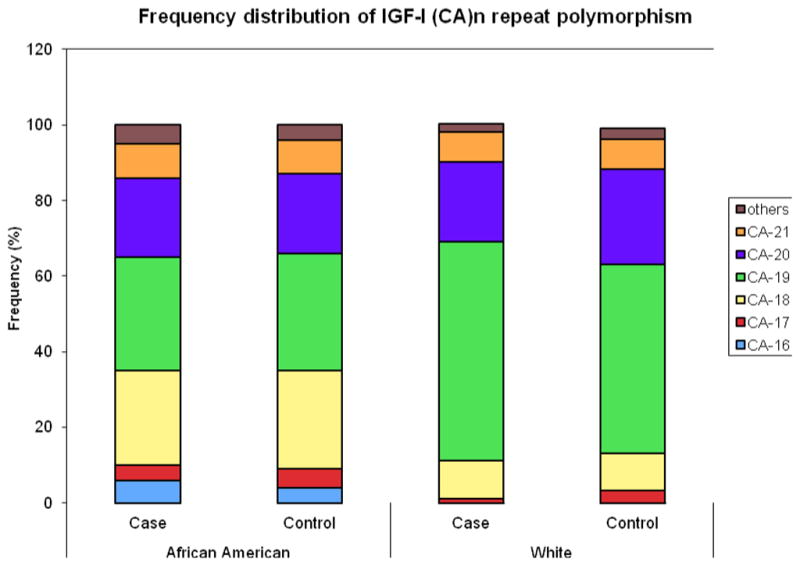
Results: The IGF-I (CA)( 19 ) repeat was higher in White controls (50 %) than African American controls (31 %). Whites homozygous for the IGF-I (CA)(19) repeat had a nearly twofold increase in risk of colon cancer (OR = 1.77; 95 % CI = 1.15-2.73), but not African Americans (OR = 0.73, 95 % CI 0.50-1.51). We observed an inverse association between the IGF-II Apa1 A-variant and colon cancer risk (OR = 0.49, 95 % CI 0.28-0.88) in Whites only. Carrying the IGFBP-3 variant alleles was associated with lower IGFBP-3 protein levels, a difference most pronounced in Whites (p-trend <0.05).
Conclusions: These results support an association between insulin pathway-related genes and elevated colon cancer risk in Whites but not in African Americans.
Figures
References
-
- Jemal A, Siegel R, Ward E, Hao Y, Xu J, Murray T, Thun MJ. Cancer statistics 2008. CA Cancer J Clin. 2008;58:71–96. - PubMed
-
- Giovannucci E. Insulin, insulin-like growth factors and colon cancer: a review of the evidence. J Nutr. 2001;131(11 Suppl):3109S–20S. - PubMed
-
- Giovannucci E. Insulin and colon cancer. Cancer Causes Control. 1995;6:164–179. - PubMed
-
- Keku TO, Lund PK, Galanko J, Simmons JG, Woosley JT, Sandler RS. Insulin resistance, apoptosis, and colorectal adenoma risk. Cancer Epidemiol Biomarkers Prev. 2005;14:2076–2081. - PubMed
-
- Le Marchand L, Kolonel LN, Henderson BE, Wilkens LR. Association of an exon 1 polymorphism in the IGFBP3 gene with circulating IGFBP-3 levels and colorectal cancer risk: the multiethnic cohort study. Cancer Epidemiol Biomarkers Prev. 2005;14:1319–1321. - PubMed
Publication types
MeSH terms
Substances
Grants and funding
LinkOut - more resources
Full Text Sources
Miscellaneous
