


Prospective comparison of three enoxaparin dosing regimens to achieve target anti-factor Xa levels in hospitalized, medically ill patients with extreme obesity
- PMID: 22565589
- PMCID: PMC3385867
- DOI: 10.1002/ajh.23228
Prospective comparison of three enoxaparin dosing regimens to achieve target anti-factor Xa levels in hospitalized, medically ill patients with extreme obesity
Abstract
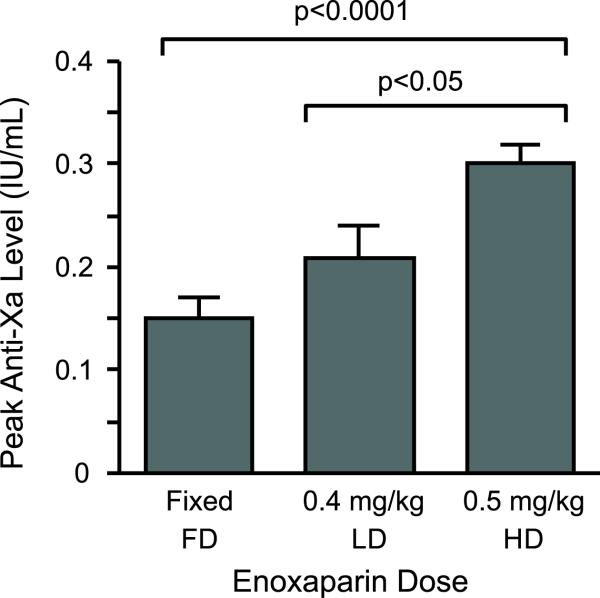
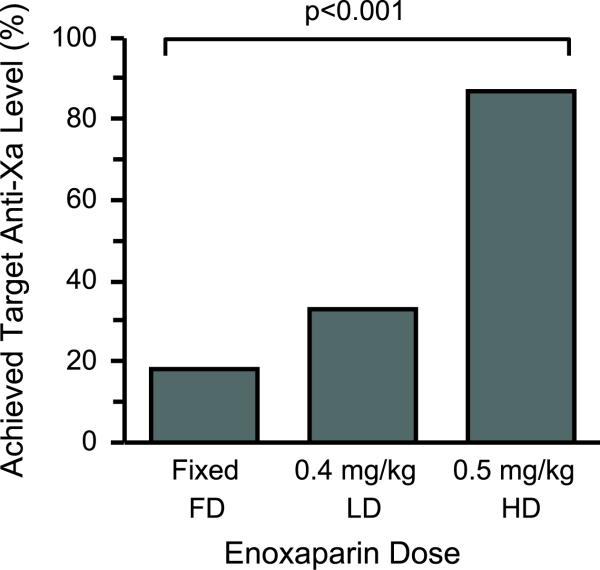
Enoxaparin is commonly used to prevent venous thromboembolism(VTE) [1,2] but has not been well-studied in patients with extreme obesity,a population at high risk for VTE. We prospectively compared three enoxaparin dosing regimens for the achievement of goal peak anti-Factor Xa levels in medically ill patients (n 5 31) with extreme obesity (body mass index (BMI) ‡ 40 kg/m2). Patients were assigned to receive fixed-dose (FD) enoxaparin 40 mg daily (QDay, n 5 11), weight based,lower-dose (LD) enoxaparin 0.4 mg/kg QDay (n 5 9), or weight based,higher-dose (HD) enoxaparin 0.5 mg/kg QDay (n 5 11). The average BMI and weight of the entire cohort was 62.1 kg/m2 (range40.5–82.4) and 176 kg (range 115–256 kg) and did not differ between groups. Peak anti-Factor Xa levels were significantly higher in the HD group compared to either LD or FD groups. Patients in the HD group achieved target anti-Factor Xa levels more frequently than the LD and FD groups (P < 0.05). Peak anti-Factor Xa levels did not correlate with age, weight, BMI, or creatinine clearance, demonstrating the predictability of weight-based enoxaparin dosing. There were no adverse events (e.g., bleeding, thrombosis, thrombocytopenia). To our knowledge this is the first prospective comparative study demonstrating that in extremely obese, medically ill patients enoxaparin 0.5 mg/kg QDay is superior to FD and LD enoxaparin for the achievement of target anti-Factor Xa levels.
Figures
References
-
- Rondina MT, Pendleton RC, Wheeler M, Rodgers GM. The treatment of venous thromboembolism in special populations. Thrombosis research. 2007;119:391–402. - PubMed
-
- Samama MM, Cohen AT, Darmon JY, Desjardins L, Eldor A, Janbon C, et al. A comparison of enoxaparin with placebo for the prevention of venous thromboembolism in acutely ill medical patients. Prophylaxis in Medical Patients with Enoxaparin Study Group. The New England journal of medicine. 1999;341:793–800. - PubMed
-
- Geerts WH, Bergqvist D, Pineo GF, Heit JA, Samama CM, Lassen MR, et al. Prevention of venous thromboembolism: American College of Chest Physicians Evidence-Based Clinical Practice Guidelines (8th Edition). Chest. 2008;133:381S–453S. - PubMed
-
- Stein PD, Beemath A, Olson RE. Obesity as a risk factor in venous thromboembolism. Am J Med. 2005;118:978–980. - PubMed
Publication types
MeSH terms
Substances
Grants and funding
LinkOut - more resources
Full Text Sources
Medical
Research Materials